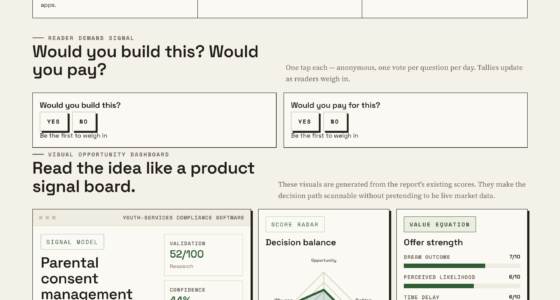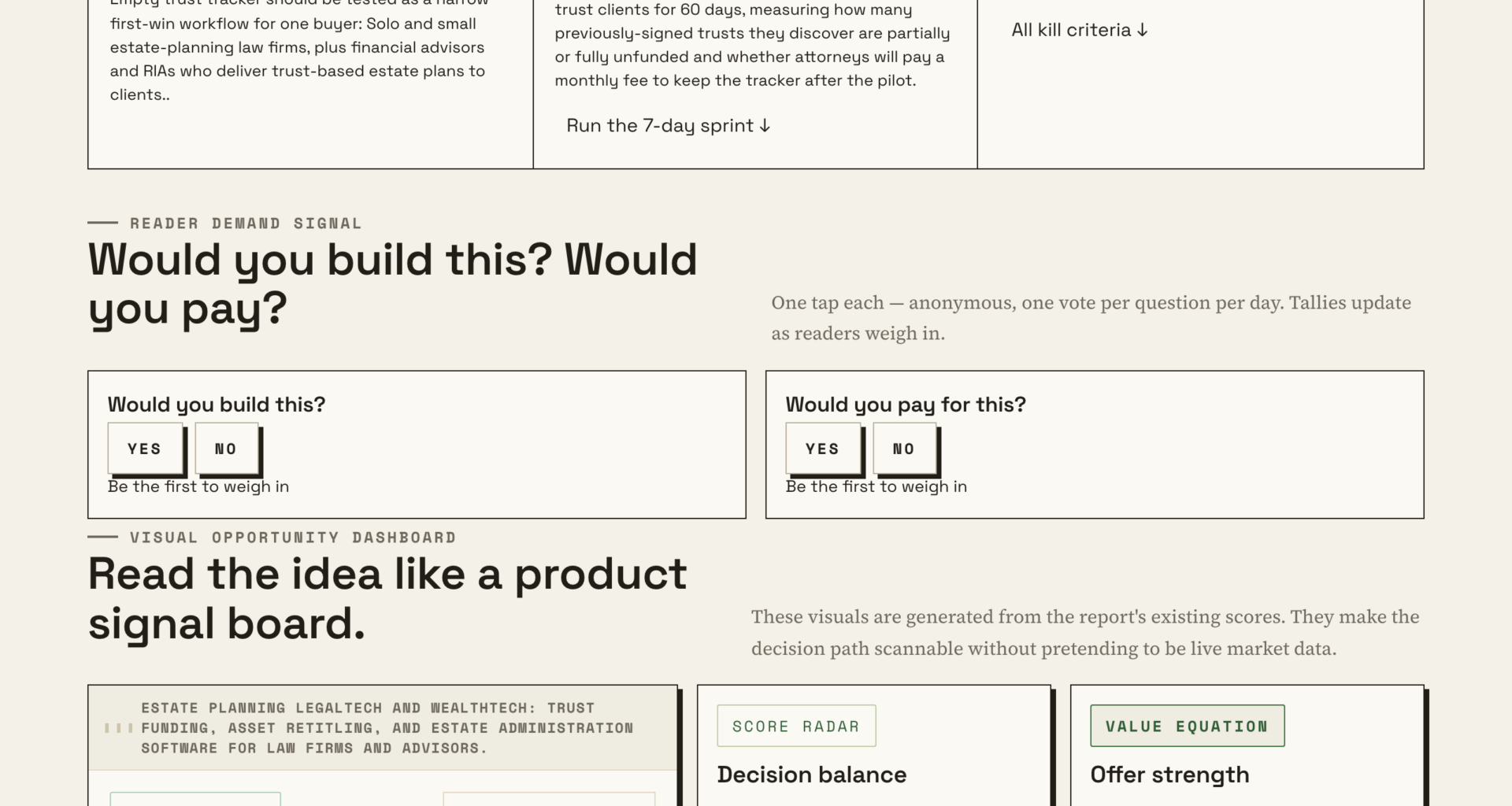

📊 Full opportunity report: Estate Planning Software: Start With An Empty Trust Tracker on IdeaNavigator AI — validation score, market gap, and execution plan.

Get business pricing on monitors, keyboards and dev gear
- Business-only prices and quantity discounts
- Tax-exempt purchasing
- Multiple users, one account, clear invoices
TL;DR
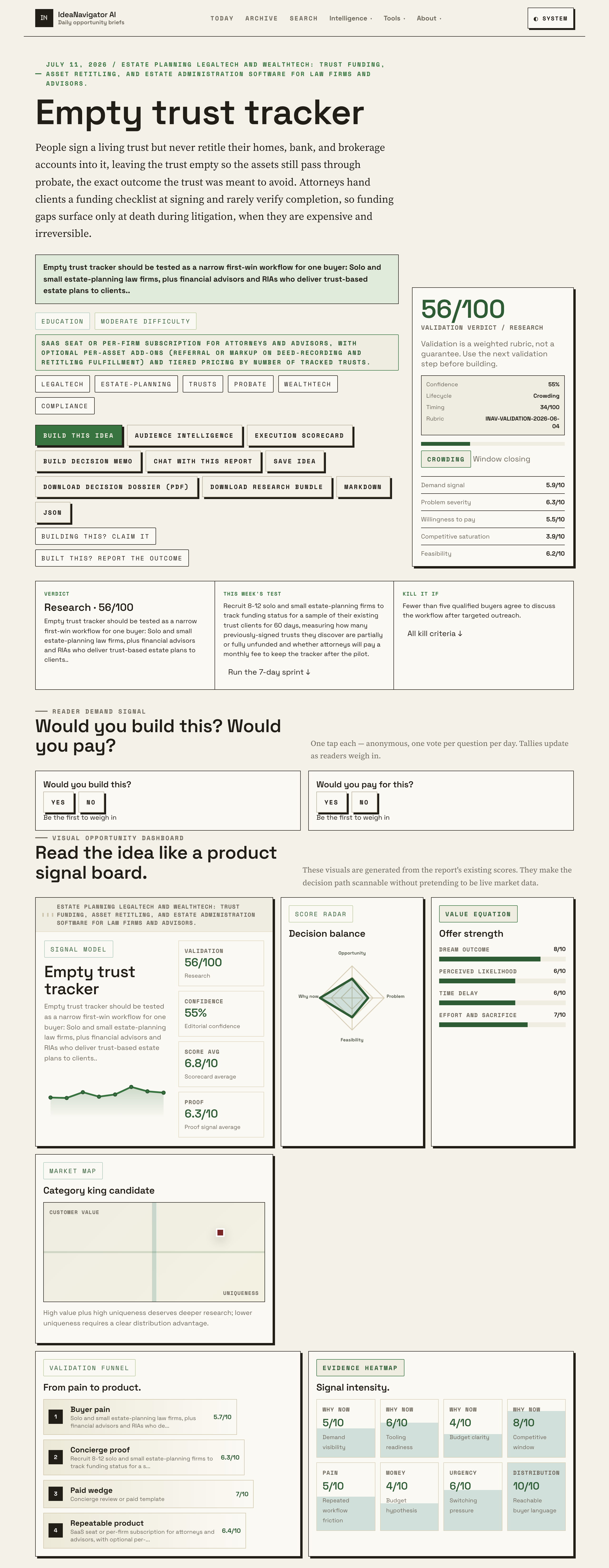
IdeaNavigator AI has published a product proposal for an ’empty trust tracker’ — a SaaS tool that lets estate-planning attorneys and financial advisors verify whether signed living trusts are actually funded. The analysis identifies unfunded trusts as a persistent gap in estate planning and proposes a 60-day pilot with 8-12 small law firms to validate willingness to pay.
A new product-analysis report from IdeaNavigator AI recommends that solo and small estate-planning law firms, together with financial advisors and RIAs, test a narrowly scoped software product: a trust funding tracker that verifies whether living trusts clients have signed are actually funded with their assets. The proposal targets a well-documented failure point in estate planning — trusts that remain legally valid but effectively empty because homes, bank accounts, and brokerage accounts were never retitled into them, forcing assets back through probate at death.
The core problem the analysis identifies is that trust funding remains manual and fragmented. Clients typically sign a living trust and receive a funding checklist, but according to the report, attorneys rarely verify whether the checklist was completed. As a result, funding gaps often surface only during post-death litigation, when they are expensive or impossible to fix. Assets held outside the trust generally pass through probate — the exact outcome the trust was created to avoid.
The proposed minimum viable product is a client-by-client funding tracker. Attorneys or advisors would create a funding checklist per trust covering real estate, bank accounts, brokerage accounts, retirement assets, business interests, and beneficiary designations. Each asset would carry a status — pending, in-progress, or confirmed funded — with proof attached, such as a recorded deed or a retitled account statement. Automated client reminders and a firm-level dashboard showing each book of trusts by percent funded would let partners flag dangerously empty trusts before a client dies.
The suggested business model is a SaaS seat or per-firm subscription for attorneys and advisors, with optional per-asset add-ons such as referral fees or markups on deed-recording and retitling fulfillment, plus tiered pricing based on the number of trusts tracked. The analysis notes that per-deed funding services already priced from $250 have created a paid market that a tracking and verification layer could sit on top of.
Why Unfunded Trusts Are a Real Market Gap
The proposal matters because it targets a gap between document-drafting software and actual estate outcomes. Existing estate-planning software largely focuses on generating documents, not on confirming that assets were moved into the resulting trusts. If the pilot validation succeeds, it would show that firms will pay recurring fees for verification work they currently do not perform.
The report frames the timing as favorable: estate planning adoption and digital tooling are expanding in 2026, yet only about 11% of Americans hold a trust, according to the analysis, leaving a large pool of prospective trust clients. Meanwhile, advisors and RIAs are increasingly bundling funded estate plans into client offerings, turning trust funding from an afterthought into a service line that needs tracking infrastructure.
For consumers, the underlying stakes are concrete: an unfunded trust can render years of planning and legal fees ineffective, with the failure discovered only when it can no longer be corrected.
How Estate Planning Tooling Reached This Point
Trust-based estate planning has historically been delivered through law firms, with funding left to the client after signing. Document-automation platforms have reduced the cost and time of drafting trusts, but the retitling step — recording deeds, changing account registrations, updating beneficiary designations — still requires coordination across banks, brokerages, and county recorders.
Per the IdeaNavigator AI analysis, two recent shifts change the picture: a surge in estate planning adoption and digital tooling in 2026, and the emergence of paid per-deed funding services starting around $250. Together, these create both demand for funded plans and an existing fulfillment market that a software tracking layer could orchestrate rather than replace.
What the Proposal Does Not Yet Prove
The analysis is a product opportunity assessment, not evidence of a working product or paying customers. No firm has publicly committed to the proposed pilot, and no startup named in connection with the idea has been announced.
Several key assumptions remain untested: whether attorneys, who currently perform no systematic funding verification, will pay a monthly subscription to start; whether clients will respond to automated reminders sufficiently to complete retitling; and whether the roughly 11% trust adoption figure and the 2026 adoption surge cited in the analysis hold up as reliable market signals. The size of the pricing tolerance per firm and per trust is also unknown until pilots run.
The 60-Day Pilot Test
The recommended next step is a validation pilot: recruit 8-12 solo and small estate-planning firms to track funding status for a sample of their existing trust clients over 60 days. The two success metrics are how many previously signed trusts are discovered to be partially or fully unfunded, and whether participating attorneys will pay a monthly fee to keep the tracker after the pilot ends.
If the pilot shows both a meaningful volume of unfunded trusts and willingness to pay, the proposal envisions expanding into per-asset fulfillment add-ons such as deed recording and account retitling referrals, and tiered pricing scaled to the number of trusts tracked. If either metric fails, the analysis suggests the idea should remain a narrow workflow tool rather than a standalone business.
Source: IdeaNavigator AI
Key Questions
What is an ’empty trust’?
A living trust that was legally signed but never funded — the client’s home, bank, and brokerage accounts were never retitled into it. Assets left outside the trust generally pass through probate, defeating the trust’s main purpose.
What would the proposed tracker actually do?
It would give attorneys and advisors a per-client checklist of trust assets, each with a funding status (pending, in-progress, confirmed funded), space to attach proof like a recorded deed, automated client reminders, and a dashboard showing each firm’s trusts by percent funded.
Who is the target customer?
Solo and small estate-planning law firms, plus financial advisors and RIAs who deliver trust-based estate plans to clients.
How would it make money?
Through a SaaS seat or per-firm subscription, with optional per-asset add-ons such as referral fees or markups on deed-recording and retitling services, and tiered pricing by number of trusts tracked.
Has this been validated?
No. It is a product proposal. The recommended validation is a 60-day pilot with 8-12 small firms to measure how many existing trusts are unfunded and whether attorneys will pay to keep the tool afterward.
Source: IdeaNavigator AI
Fall Picks
fall essentials
As an affiliate, we earn on qualifying purchases.