📊 Full opportunity report: Parental Consent Tools For Kid-Facing Vendors on IdeaNavigator AI — validation score, market gap, and execution plan.

Get business pricing on monitors, keyboards and dev gear
- Business-only prices and quantity discounts
- Tax-exempt purchasing
- Multiple users, one account, clear invoices
TL;DR
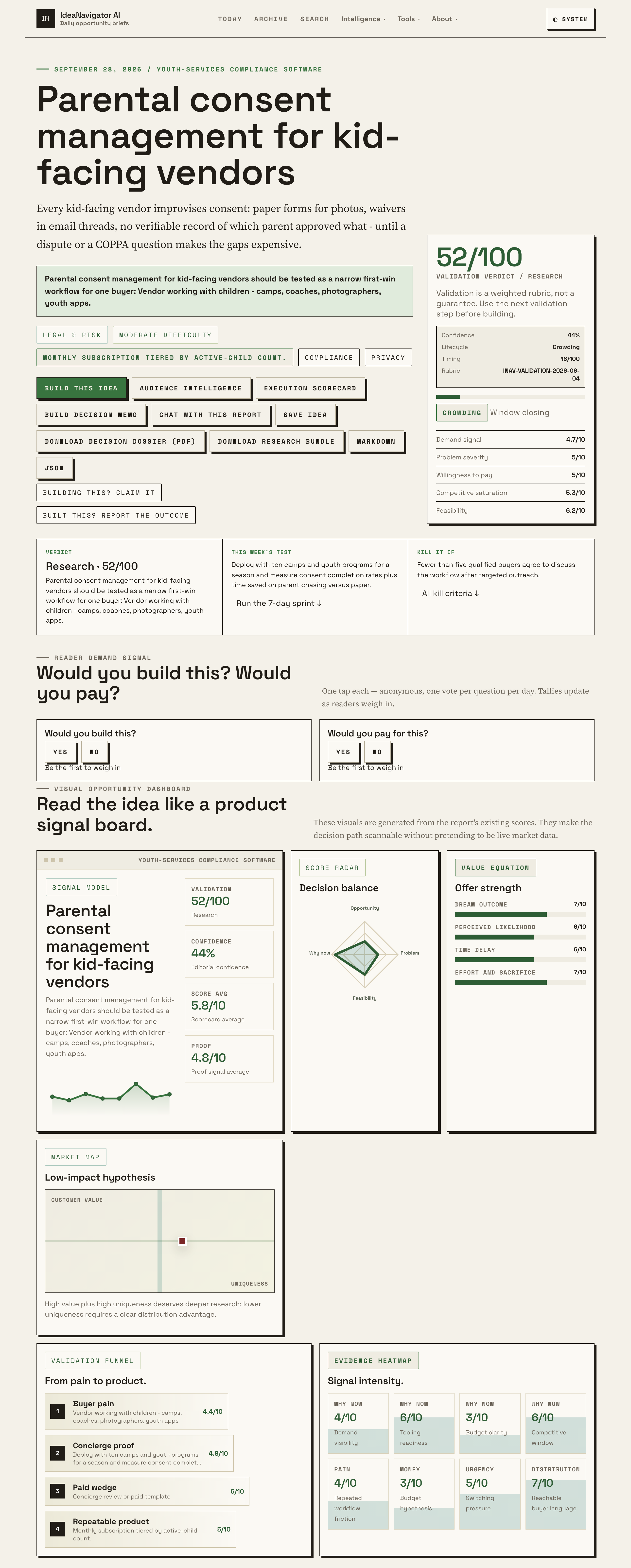
A proposal for youth-service vendors calls for testing a phone-based parental consent system with 10 camps and youth programs for one season. The plan is a product concept, not a reported launch, and no pilot results, participating vendors or legal determinations are provided.
In its proposal, IdeaNavigator AI describes a system that would let vendors create branded consent forms for parents to complete on their phones. The listed uses include photo permissions, data collection, medical information and liability waivers. The concept also calls for identity checks matched to the risk of each request, records organized by child, expiry tracking and an exportable audit history.
IdeaNavigator AI identifies paper forms and email threads as possible ways camps, coaches, photographers and youth apps currently handle permissions, which can leave records scattered or difficult to verify. The proposal frames that gap as a possible source of expense if a family disputes a photo or data use, or a vendor faces a question about its privacy practices. It documents no specific dispute, enforcement action or vendor experience.
The proposed business model is a monthly subscription priced by active-child count, according to IdeaNavigator AI. To assess demand and usefulness, the proposal recommends a season-long deployment with 10 camps and youth programs, measuring consent completion and staff time spent following up with parents compared with paper processes. It supplies no price, completion target, time-saving estimate or results.
Consent Records for Youth Programs
For organizations handling children’s information and images, a usable record of who gave permission, for which child and for what purpose could help staff answer parent questions and manage permissions as they change. A digital ledger and expiry tracking may also make it easier to see whether an approval is current, although IdeaNavigator AI’s proposal does not establish that the suggested system meets any particular legal standard.
The proposed pilot matters as a test of whether small youth-service providers will adopt and pay for a dedicated tool. As outlined by IdeaNavigator AI, completion rates and staff follow-up time could show whether phone-based forms improve on existing workflows. Until a pilot is reported, however, claims about efficiency, demand and compliance value remain unverified.
Top picks for "parental consent tool"
As an affiliate, we earn on qualifying purchases.
From Paper Forms to a Pilot
IdeaNavigator AI’s proposal identifies a specific customer group: vendors working with children, including camps, coaches, photographers and youth apps. It presents youth-services compliance software as the market and narrows the initial product to consent collection and record keeping.
The proposal’s case for acting now points to children’s privacy rules, including COPPA updates and state laws, as well as parents’ questions about photo and data use. These points are presented as the rationale for the product idea; the proposal does not identify a particular new law, effective date, enforcement case or change in parent behavior.
IdeaNavigator AI recommends a limited field test across one season; it does not report a product already in use. The proposed measures are consent completion rates and time spent chasing parent responses compared with paper forms.
Pilot Status and Legal Scope
IdeaNavigator AI’s proposal does not say whether any pilot has been arranged, which programs might participate, when a test would begin or whether a consent product has been built. It reports no completion data, customer feedback, subscription pricing or comparison results.
The proposal also does not specify how identity verification would work at different risk levels, how records would be secured or retained, or how the system would handle separated guardians, disputed authority or a parent withdrawing consent. It does not explain how the proposed forms would address different legal requirements across locations. The source presents no evidence that a recordkeeping tool, by itself, would establish compliance with COPPA or state laws.
Measures for a Season Trial
If the proposal advances, the next reported milestone would be the season-long trial with 10 camps and youth programs that IdeaNavigator AI recommends. Useful reporting would identify the participating vendors, the consent workflows tested and the baseline used to compare phone-based forms with paper.
Results would need to show how many parents completed forms, how much staff follow-up time changed, and whether vendors found the records useful when permissions expired or questions arose. Until those details are released, the concept remains a proposed product test rather than a demonstrated solution.
Source: IdeaNavigator AI
Key Questions
Has a parental consent product launched?
The IdeaNavigator AI proposal outlines product features but does not say that a product has launched.
Who is the proposed system for?
According to the proposal, it targets vendors working with children, such as camps, coaches, photographers and youth apps.
What would the pilot measure?
The proposed season-long test would track consent completion rates and staff time spent following up with parents compared with paper processes, according to IdeaNavigator AI.
Would using the tool guarantee legal compliance?
No such guarantee is established. The proposal does not provide a legal assessment or explain how the tool would satisfy specific COPPA or state-law requirements.
Source: IdeaNavigator AI
Fall Picks
fall essentials
As an affiliate, we earn on qualifying purchases.