
📊 Full opportunity report: Could StreetComplete Make OpenStreetMap Editing More Approachable? on IdeaNavigator AI — validation score, market gap, and execution plan.

Get business pricing on monitors, keyboards and dev gear
- Business-only prices and quantity discounts
- Tax-exempt purchasing
- Multiple users, one account, clear invoices
TL;DR
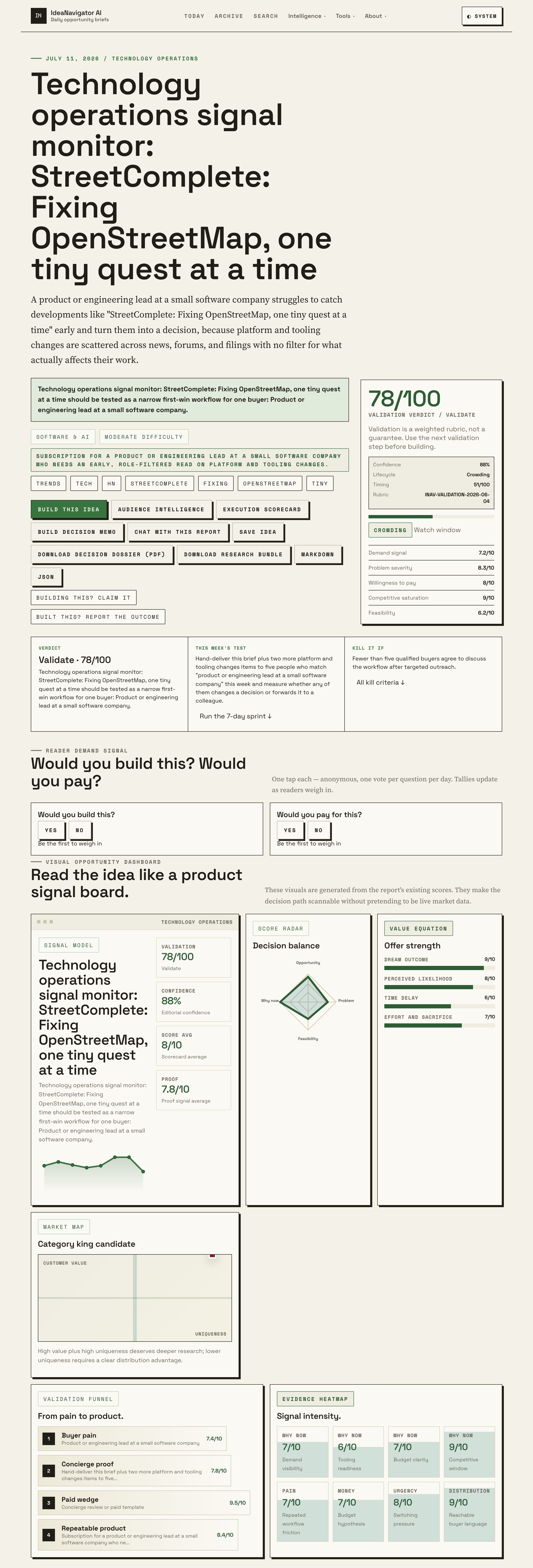
An IdeaNavigator AI signal brief highlights StreetComplete as a possible first-win workflow for OpenStreetMap editing. The available information does not establish a new product launch or measure whether the app increases contributions; it proposes testing the idea with product and engineering leads.
IdeaNavigator AI’s signal brief flags StreetComplete as a possible way to make contributing to OpenStreetMap more approachable, framing the app as a series of small mapping tasks rather than a broad editing project. The brief describes a test opportunity, not a newly announced feature or evidence that the approach has increased map contributions.
According to IdeaNavigator AI’s brief, the proposed use case is a narrow first-win workflow: invite people to complete one small mapping task at a time. The brief identifies a product or engineering lead at a small software company as its intended audience for evaluating whether the approach offers a useful model for reducing friction in a complex tool.
IdeaNavigator AI reports that Hacker News surfaced the StreetComplete item with an 88/100 signal. The brief does not define the scoring method, give a comparison baseline, or provide a time window for the score. It also reports no user research, contribution data, or comparison with other OpenStreetMap editing tools.
As a next step, IdeaNavigator AI proposes hand-delivering the brief alongside two other platform or tooling developments to five people matching its target audience during the same week. The suggested measures are whether recipients change a decision or forward an item to a colleague. These are proposed validation steps; the brief reports no results.
Small Tasks Could Ease Map Editing
OpenStreetMap depends on people adding and updating geographic information. A workflow organized around one manageable task at a time could offer a clearer starting point to people who might find a full map editor difficult to approach. That is the potential described in IdeaNavigator AI’s signal brief: a focused task may make participation easier to understand and begin.
For product teams, the idea also points to a broader design question: whether a complicated contribution process can be broken into specific, achievable actions without hiding important context or reducing the quality of edits. The signal brief raises that question for small software companies, but it does not show that StreetComplete has solved it or that the pattern transfers to other products.
The distinction matters because an appealing interface is not the same as a measurable effect. Evidence about task completion, accuracy, repeat participation, or the kinds of map information added would help establish whether guided tasks change how people contribute. IdeaNavigator AI’s brief reports none of those outcomes.
A Signal, Not a Product Launch
IdeaNavigator AI describes the item as part of a technology operations signal monitor, a proposed service for tracking platform and tooling developments across feeds such as Hacker News. The brief says the service would filter developments for a particular professional audience and turn each relevant item into a short account of what changed, why it matters, and what to do.
In this case, the brief treats the StreetComplete item as a possible example for that service. It argues that platform and tooling changes can move quickly and that a same-day, role-filtered summary may be more useful to some readers than a general weekly roundup. That is the monitor’s stated rationale, rather than a finding established through reported customer data.
IdeaNavigator AI proposes a subscription for product or engineering leads seeking early, filtered information. The suggested five-person check is an initial test of whether readers find the brief useful enough to influence a decision or share. The material does not say that a paid service has launched or that customers have agreed to subscribe.
Impact and Scoring Remain Unknown
IdeaNavigator AI’s brief does not establish how StreetComplete affects editing behavior, who uses it, or whether its tasks result in more complete or accurate OpenStreetMap data. It also includes no direct comment from StreetComplete’s developers, users, or the OpenStreetMap project.
The 88/100 signal score is reported by IdeaNavigator AI without its methodology or a stated baseline, so it should be read as a score from the monitor rather than a measure of adoption or impact. The brief reports no outcome from the proposed five-person validation and identifies no date for a product change, trial, or follow-up.
A Five-Reader Test Is Proposed
IdeaNavigator AI proposes sharing this brief and two additional technology developments with five product or engineering leads at small software companies. The monitor would then track whether any recipient changes a decision or forwards a brief to a colleague. That test could provide an early indication of reader interest, although it would not by itself verify StreetComplete’s effect on mapping contributions.
The IdeaNavigator AI brief reports no completed test or next product milestone. Further evidence would be needed on both sides of the idea: whether the monitoring service helps its intended readers act, and whether StreetComplete’s small-task approach changes participation or map quality.
Source: IdeaNavigator AI
Key Questions
What is the development being reported?
IdeaNavigator AI’s brief identifies StreetComplete as a possible example of a guided, small-task approach to OpenStreetMap editing. The brief recommends testing the opportunity; it does not announce a new release.
Does the brief show that StreetComplete increases contributions?
No. IdeaNavigator AI reports no contribution figures or user study results establishing an effect on the number or quality of edits.
What does the 88/100 score mean?
IdeaNavigator AI’s brief reports an 88/100 signal from Hacker News, but does not explain the scoring method, comparison baseline, or time window. Its meaning beyond the reported score is unclear.
How does IdeaNavigator AI propose validating its monitor?
The brief proposes sharing this item and two other technology developments with five small-company product or engineering leads, then recording whether they change a decision or forward an item.
Source: IdeaNavigator AI
Fall Picks
fall essentials
As an affiliate, we earn on qualifying purchases.