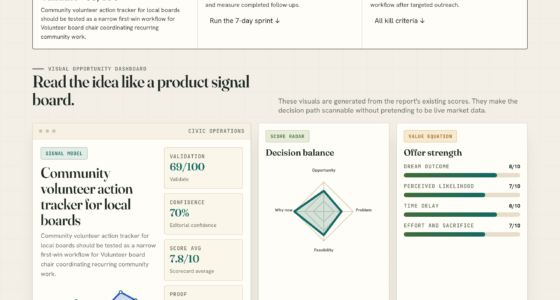
📊 Full opportunity report: Benefit Check Bot Technology And Its Role In Public Benefits Eligibility on IdeaNavigator AI — validation score, market gap, and execution plan.
Listen free for 30 days with Audible
Thousands of audiobooks and originals — cancel anytime.
Start your free trialAs an affiliate, we earn on qualifying purchases.
TL;DR
A benefit check bot is being piloted to help clinics, nonprofits, and agencies quickly identify eligible low-income clients for multiple benefits. It aims to reduce screening time and increase benefit enrollment, filling a capacity gap left by a nonprofit shutdown.
A new conversational benefit screening bot is being piloted to assist clinics, nonprofits, and government agencies in quickly determining client eligibility for multiple public benefits. The technology aims to address longstanding fragmentation and manual screening processes that leave over $100 billion in benefits unclaimed annually, according to sources familiar with the project.
The benefit check bot is designed as a white-label, multi-channel tool (web widget and SMS) that can be embedded on clinic or nonprofit websites or used by benefits navigators. It asks a short series of yes/no and multiple-choice questions, then generates a list of likely-eligible programs such as SNAP, Medicaid, EITC/CTC, WIC, and LIHEAP, along with estimated benefit amounts and next-step application links.
This pilot is focused on 2-3 states initially, with the goal of reducing screening times, increasing enrollment in eligible programs, and providing navigators with actionable summaries. The project follows the shutdown of a major nonprofit, Benefits Data Trust, which historically provided similar screening services across seven states, leaving a capacity gap.
The tool leverages conversational AI and multilingual support, making eligibility checks faster and more accessible than traditional manual processes, which often involve lengthy paperwork and multiple program-specific screens. The developers aim to validate the technology by testing it with 5-10 benefits navigators, measuring improvements in screening efficiency, accuracy, and client engagement over 4-6 weeks.
Potential Impact on Benefits Access and Efficiency
This technology could significantly improve how low-income clients access public benefits by reducing barriers created by complex eligibility rules and manual screening. For clinics and nonprofits, it offers a scalable, cost-effective way to identify benefits that clients may not be aware of, potentially unlocking over $100 billion in unclaimed benefits annually.
By automating eligibility checks and providing real-time benefit estimates, the benefit check bot could increase enrollment rates, reduce administrative burdens on frontline staff, and ensure more timely support for vulnerable populations. Its success could also influence broader adoption of AI-driven social care tools, aligning with ongoing efforts to modernize public benefits delivery and address social determinants of health.
benefits eligibility screening software
As an affiliate, we earn on qualifying purchases.
As an affiliate, we earn on qualifying purchases.
Background on Benefits Screening Challenges
Over the past decade, the complexity of public benefits eligibility has posed significant challenges for both clients and service providers. The fragmentation across federal, state, and local programs creates a confusing landscape, often resulting in benefits going unclaimed. Manual screening processes, involving lengthy paperwork and multiple program-specific inquiries, are time-consuming and prone to errors.
In 2024, the shutdown of Benefits Data Trust, a nonprofit that provided outsourced benefits screening for seven states, left a notable gap in capacity. Meanwhile, post-pandemic Medicaid redeterminations have increased the workload for eligibility verification, straining existing systems. Advances in conversational AI and SaaS models now make it feasible to automate and streamline these processes at scale, with minimal marginal costs. The pilot of this benefit check bot is part of a broader movement to modernize social care technology and improve outcomes for low-income populations.
public benefits application assistance tools
As an affiliate, we earn on qualifying purchases.
As an affiliate, we earn on qualifying purchases.
Uncertainties About Pilot Outcomes and Scalability
It is not yet clear how effectively the benefit check bot will perform in real-world settings, particularly regarding accuracy, user acceptance, and integration with existing systems. The pilot is limited to a small number of states and organizations, and results may vary based on local rules and client populations. Additionally, questions remain about long-term scalability, cost-effectiveness, and how the tool will be adopted by larger agencies or integrated into broader social care workflows.
As an affiliate, we earn on qualifying purchases.
Next Steps for Validation and Broader Adoption
Following the pilot, developers plan to analyze performance metrics such as screening time reduction, increase in benefits enrollment, and navigator feedback. Success could lead to expanded testing across more states and organizations, as well as potential commercialization through tiered SaaS subscriptions and API licensing. Stakeholders will also monitor regulatory and privacy considerations as the technology scales.
multilingual benefits screening tool
As an affiliate, we earn on qualifying purchases.
As an affiliate, we earn on qualifying purchases.
Key Questions
How does the benefit check bot determine eligibility?
The bot asks a series of yes/no and multiple-choice questions based on current eligibility rules for programs like SNAP, Medicaid, and others. It then estimates benefits and provides next-step application links.
Who can use the benefit check bot during the pilot phase?
Benefits navigators working at FQHCs and community nonprofits in the participating states are testing the tool with real clients.
Will this technology replace human benefits navigators?
It is designed to augment, not replace, human navigators by reducing screening time and increasing accuracy, allowing staff to focus on complex cases and application assistance.
What are the main challenges for scaling this technology?
Challenges include adapting the tool to different state rules, ensuring data privacy, integrating with existing systems, and achieving broad organizational acceptance.
When might this tool be widely available?
If pilot results are positive, wider deployment could occur within the next 1-2 years, depending on funding, regulatory approval, and stakeholder buy-in.
Source: IdeaNavigator AI
Flea & tick season Picks
flea and tick prevention
As an affiliate, we earn on qualifying purchases.