
🔍 Read the full analysis: Why Data Center Capacity Management Needs More Than One Number on Rymvard

Get monitors, keyboards and dev gear delivered free — and shop member deals
- Fast, free delivery on millions of items
- Access to Prime Big Deal Days deals on October 6–7
- Prime Video, Amazon Music and more included
TL;DR
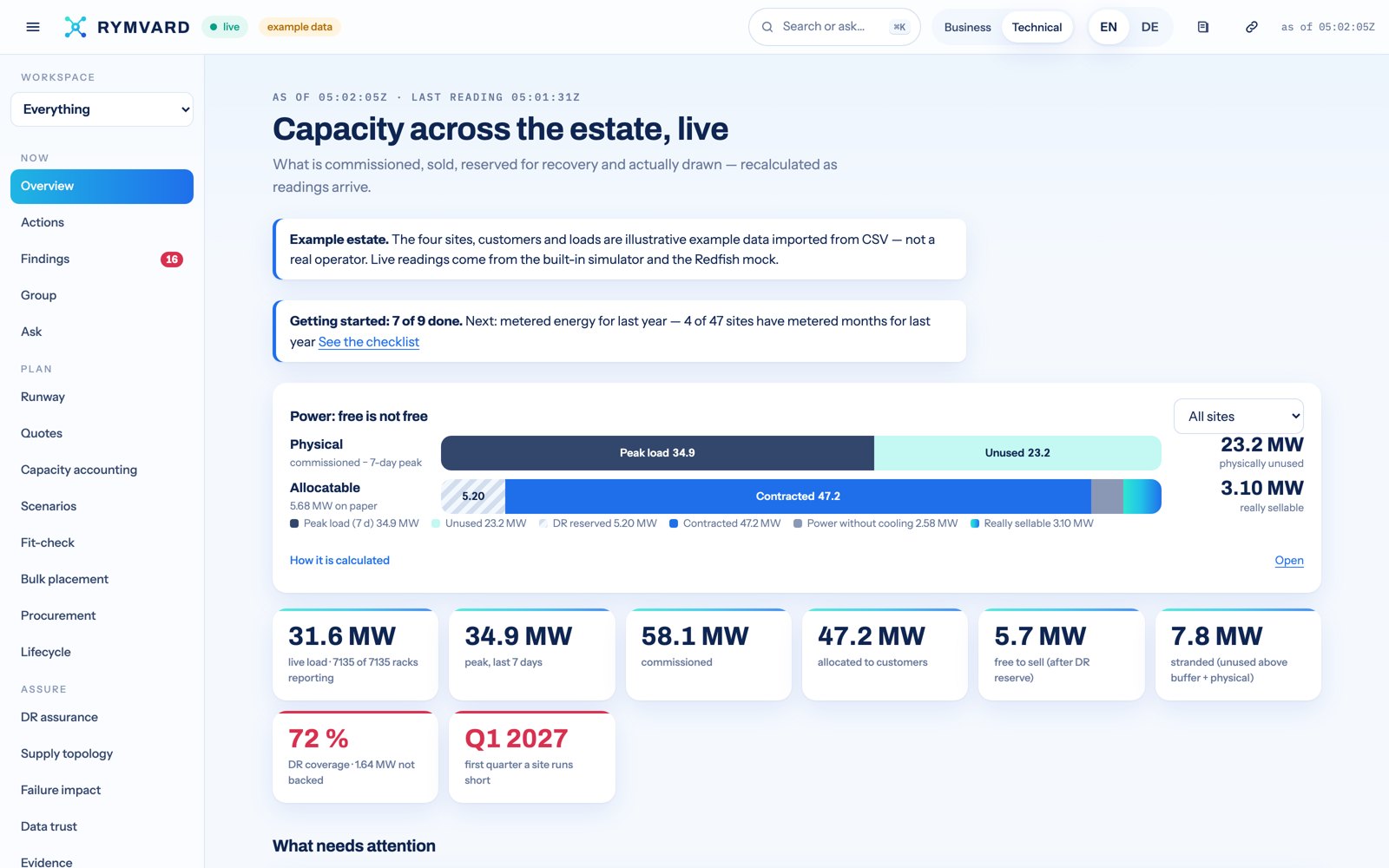
Rymvard says its capacity ledger has shown a more detailed capacity overview in every workspace since Oct. 3, 2026. In an illustrative example estate, 23.2 MW is physically unused, but only 3.1 MW is described as sellable after contracts, recovery reservations and cooling limits are accounted for.
Rymvard says its data-center capacity ledger now opens each workspace with an overview that separates physically unused power from power that is actually available to sell. The feature has been running since Oct. 3, 2026, and an illustrative example estate shows 23.2 MW unused physically but only 3.1 MW sellable after obligations and operational limits are counted.
The overview breaks a single capacity total into used, held back, promised and free amounts. For power, one bar compares the measured seven-day peak with commissioned capacity. A separate allocatable view accounts for contracted power, disaster-recovery reservations and power that lacks cooling, leaving the amount Rymvard classifies as sellable.
The figures are from an illustrative example estate, not a customer deployment. Rymvard says the screens are from its running product, but no customer, site or outcome is implied. The difference between 23.2 MW physically unused and 3.1 MW sellable is specific to that example and should not be read as a general industry ratio.
Rymvard says the same style of overview is available for compute resources, including vCPU, memory and storage, as well as HANA memory, contracts compared with measured use, energy and recovery. When a bar has no data, the interface gives a reason rather than displaying a zero. The company describes the ledger as being in early access; it does not publish prices, saying terms are agreed with early-access partners.
Why Sellable Power Is Lower
A headline capacity total can suggest room for new workloads even when some power is already committed, reserved for recovery, or cannot be used because cooling is unavailable. Separating these conditions makes the distinction between physical headroom and allocatable capacity visible, which is relevant to operators planning workloads and to teams evaluating what capacity could be offered to customers.
The example’s 20.1 MW gap between physical unused power and sellable power illustrates how those categories can diverge. It does not establish that the same gap exists at other data centers. The practical value of the view will depend on whether the underlying measurements and records are current and whether the categories reflect each operator’s contracts and operating rules.
data center capacity management software
As an affiliate, we earn on qualifying purchases.
As an affiliate, we earn on qualifying purchases.
How Rymvard Defines Capacity
Rymvard presents itself as a capacity ledger for data centers. Its overview distinguishes measured use from commissioned capacity and then applies additional constraints to show what can be allocated. The seven-day peak is the stated measurement window for the physical-power bar; the allocatable bar reflects commitments and operational conditions as well as physical availability.
This is a product announcement, not an independently verified assessment of customer results. Rymvard says the product is live and the displayed screens come from a running system, while also clarifying that the estate shown is illustrative. The company has not provided customer deployments, pricing or quantified operational outcomes in the supplied information.
“A bar without data shows the reason instead of a zero.”
— Rymvard
data center power monitoring tools
As an affiliate, we earn on qualifying purchases.
As an affiliate, we earn on qualifying purchases.
Customer Use And Measurement
Customer adoption and measured results are not established by the announcement. The example estate is illustrative, and the details provided do not identify a customer, site, independent evaluation or outcome. It is also unclear how frequently all inputs are refreshed, how the ledger handles conflicting records, or how operators can verify the calculations behind each category.
Rymvard has not provided public pricing or stated when early access will end or broader availability will begin. The 3.1 MW sellable figure is a product example, not evidence of typical capacity at data centers generally.
data center resource visualization dashboard
As an affiliate, we earn on qualifying purchases.
As an affiliate, we earn on qualifying purchases.
Early Access And Further Evidence
Rymvard says the ledger is currently in early access, with pricing arranged individually with participating partners. The company has not announced a public launch date or supplied a timetable for the program.
The next useful evidence will be details from real deployments: how operators populate and maintain the measurements, whether the categories match their allocation policies, and what changes in planning or sales decisions follow. Until those details are available, the feature’s operational impact remains unverified beyond Rymvard’s illustrative example.
Source: Rymvard
data center cooling capacity sensors
As an affiliate, we earn on qualifying purchases.
As an affiliate, we earn on qualifying purchases.
Key Questions
What did Rymvard announce?
Rymvard says its capacity ledger now opens each workspace with an overview that separates used, held-back, promised and free capacity. For power, it distinguishes physical headroom from the amount it considers allocatable or sellable.
Why does the example show 23.2 MW unused but only 3.1 MW sellable?
In Rymvard’s illustrative estate, contracts, disaster-recovery reservations and power without cooling reduce the amount classified as sellable. The figures describe that example only and are not presented as typical industry values.
Is the product available to customers?
Rymvard says the product is running and in early access. Its displayed screens use an illustrative estate rather than a named customer deployment.
What other resources does the overview cover?
Rymvard says it also provides views for vCPU, memory, storage, HANA memory, contracts compared with measured use, energy and recovery.
Are prices and customer results public?
No public prices or customer outcomes are provided in the announcement. Rymvard says pricing is agreed with early-access partners.
Source: Rymvard
Fall Picks
fall essentials
As an affiliate, we earn on qualifying purchases.