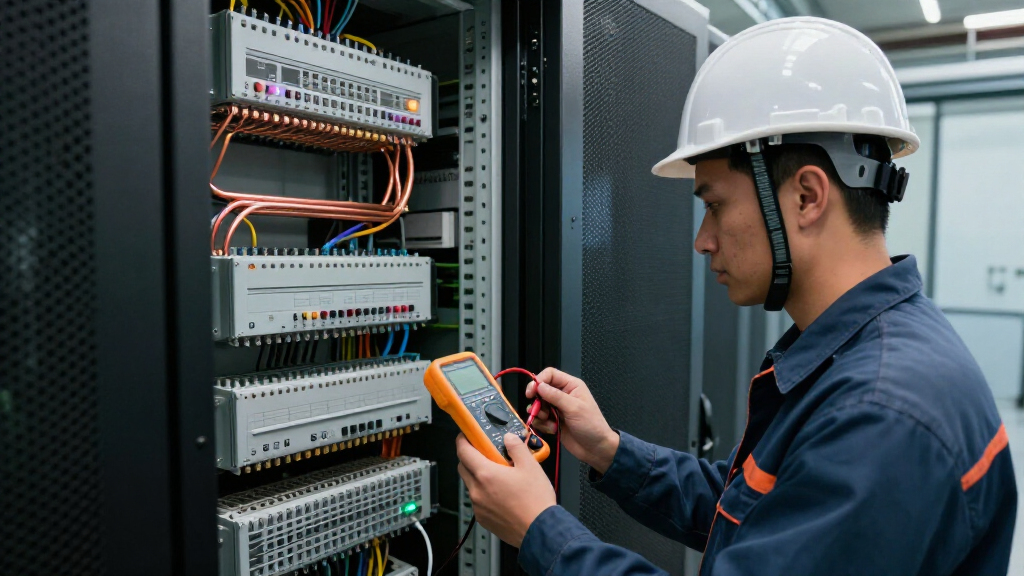

🔍 Read the full analysis: AI Data Centers Need Electricians As Power Systems Shift To 800-Volt DC on ThorstenMeyerAI.com

Get business pricing on monitors, keyboards and dev gear
- Business-only prices and quantity discounts
- Tax-exempt purchasing
- Multiple users, one account, clear invoices
TL;DR
Vantage reserved more than a gigawatt of factory capacity for Heron Power solid-state transformers that convert grid power to 800-volt DC, while a separate Microsoft-NiSource agreement includes new generation and a 600-megawatt battery. The developments show data center operators responding to rising AI power demand, but do not establish that 800-volt DC will become a standard or that the projects will lower electricity bills.
Data center operator Vantage reserved more than a gigawatt of factory capacity for Heron Power solid-state transformers designed to convert grid electricity directly to 800-volt direct current (DC), according to a report published October 27. The reservation, alongside a separate Microsoft-NiSource power agreement, reflects efforts to handle the rising electricity demand of AI facilities and could increase demand for workers who install and maintain power infrastructure.
The Vantage reservation was reported as a commitment to factory capacity, not as confirmation that more than a gigawatt of transformers has already been delivered or installed. Heron’s equipment is designed to combine power conversion with battery storage, placing storage on the facility’s main power path. The source does not provide a delivery schedule, project locations or the number of electricians and other workers involved.
On October 16, Indiana utility NiSource signed a 20-year power agreement with Microsoft that adds about 1,100 megawatts of generation and a 600-megawatt battery, according to the source. The agreement is a separate development from Vantage’s transformer reservation. The material does not state how much of the generation or battery capacity will serve particular data centers, or how project costs will be allocated.
The industry case for changing power systems is driven by the scale of AI hardware. The International Energy Agency (IEA) reported that AI server power density rose 11-fold between 2020 and 2025 and projected a further fourfold increase by 2027. NVIDIA has described an 800-volt design that converts grid power at a facility’s edge for racks drawing as much as one megawatt. Its projected reductions in copper use and improvements in efficiency are company estimates, not independent measurements; full-scale production with its Kyber systems is planned for 2027.
Infographic 01 · From grid to rack
AI racks near a megawatt are outgrowing the AC power chain.
Why the industry is moving to 800-volt direct current: fewer conversions, less copper, batteries on the main path. The numbers are vendor figures with different baselines, so they cannot be added up.
Today: many conversions
Typical AC chain from the grid to the rack
- Medium-voltage AC from the grid
- Transformer steps it down to low-voltage AC
- UPS converts to DC for the batteries and back to AC
- Distribution units feed the racks
- Every server power supply converts AC to DC again
Each stage loses energy, and almost all of the loss becomes heat the cooling system must remove.
800 V DC: convert once, outside
NVIDIA reference design, full-scale production planned with Kyber racks in 2027
- 13.8 kV AC from the grid
- Converted once to 800 V DC at the edge of the site, batteries on the same DC bus
- 800 V DC busway to the racks
- Stepped down inside the rack, for 1 MW racks and beyond
Bridge for existing halls: a “sidecar” cabinet next to the rack converts AC to 800 V DC, while the old chain stays in place.
Power lost per MW delivered to the rack
kW, SMA white-paper model vendor model
What NVIDIA says 800 V DC changes
NVIDIA’s engineering claims claim
Sources: NVIDIA technical blog (20 May 2025, updated 31 Jul 2025); SMA America, sponsored content in Utility Dive (26 Oct 2026). Rack density: IEA, Key Questions on Energy and AI (Apr 2026) (AI server power density 11× from 2020 to 2025, a further 4× by 2027).
Powered by Thorsten Meyer AI
Why AI Campuses Need New Electrical Skills
Higher power demand per rack changes the work required to build and operate data centers. Facilities need electrical systems that can move large amounts of power, manage conversion losses and accommodate batteries alongside computing equipment. That creates potential work for electricians and power-system specialists in installation, commissioning and maintenance. The source material, however, does not quantify job openings, required qualifications or whether the shift will create a net increase in employment.
Electricity supply and grid access also affect how quickly new data-center capacity can come online. The source cites IEA estimates that transformers can take two to three years to arrive and grid connections can take five to ten years in many places. Those constraints may matter as much as the availability of chips. New generation and storage agreements can support projects, but their effects on local supply and household bills depend on who pays for generation, batteries and grid upgrades.
The potential benefits of 800-volt DC should be treated as projections, not established outcomes. NVIDIA’s estimates include 45% less copper compared with 415-volt AC distribution and up to 5% better end-to-end efficiency than current 54-volt systems. The source also describes a Utility Dive article sponsored by inverter maker SMA America, whose white-paper model estimates lower conversion losses with an 800-volt DC arrangement. Both sets of figures come from vendor-linked material; independent performance data for operating deployments is not provided.
Popular right now

Bose QuietComfort Wireless Bluetooth Headphones with Active Noise Cancellation, Mic, USB‑C Charging, Deep Bass, 24‑Hour Battery – White Smok

Philips 3300 Series Fully Automatic Espresso Machine with LatteGo Milk System

Bose QuietComfort True Wireless Earbuds with Active Noise Cancellation, Black
As an affiliate, we earn on qualifying purchases.
From AC Server Rooms to DC Racks
Conventional data centers receive alternating current (AC), reduce its voltage through transformers, route it through uninterruptible power supplies and distribution equipment, then convert it to low-voltage DC inside servers. Each conversion loses some energy, much of which becomes heat that cooling systems must remove. Directly distributing higher-voltage DC could reduce some conversion steps, but it would require new equipment and changes to facility design.
The scale of demand helps explain the interest. The IEA estimated global data-center electricity use at 485 terawatt-hours in 2025 and projected about 950 terawatt-hours in 2030. Those are global estimates and projections, not measurements of the projects in the latest deals. Meanwhile, NVIDIA says a one-megawatt rack supplied at 54 volts could require up to 200 kilograms of copper busbar. Its proposed approach converts 13.8-kilovolt grid power to 800-volt DC near the facility perimeter.
Some sites may adopt DC in stages rather than replace existing electrical systems. SMA’s sponsored Utility Dive article describes a “sidecar” conversion cabinet beside a rack, allowing 800-volt equipment to operate in halls that still use AC infrastructure. This is a vendor-described option, not evidence that a particular operator has deployed it at scale.
“Leaving no room for compute”
— NVIDIA, in its 800 VDC technical blog
Costs, Jobs and Deployment Remain Open
The Vantage capacity reservation does not establish how many transformers will be manufactured, when they will be installed or which sites will use them. The source also does not identify the electricians or contractors selected for the work, or provide a hiring estimate. The NiSource-Microsoft agreement sets out a 20-year power arrangement, but the available details do not explain its full cost structure, construction timetable or ratepayer impact.
It is also unclear how quickly 800-volt DC systems will move beyond designs and vendor proposals. NVIDIA’s efficiency and copper figures are company projections; SMA’s comparison comes from a sponsored white-paper model. The material provides no independent, operating-site comparison of the systems. Nor does it establish that data-center demand is the cause of any particular household electricity-price change.
Watch for Orders and Site Builds
The next milestones are delivery and deployment details for Heron’s transformer capacity, construction and commissioning plans tied to the NiSource-Microsoft agreement, and evidence from data centers operating 800-volt systems. NVIDIA has said full-scale production with Kyber systems is planned for 2027. That timetable is a company plan, not confirmation that the systems will be widely installed by then.
For workers and local communities, useful indicators will include disclosed contractor and hiring plans, utility filings on new generation and grid work, and clear explanations of how project costs are assigned. Independent measurements of efficiency, reliability and operating costs would help establish whether the projected benefits hold up in real facilities.
Key Questions
What was Vantage’s announcement?
Vantage reserved more than a gigawatt of factory capacity for Heron Power solid-state transformers designed to convert grid power directly to 800-volt DC. The report does not say that the equipment has already been delivered or installed.
Why are data centers considering 800-volt DC?
AI racks draw far more power than conventional server racks. Higher-voltage DC distribution is intended to move that power with fewer conversion steps and less copper, although the performance figures cited so far are vendor claims rather than independent measurements.
How does the NiSource-Microsoft agreement relate to the transformer reservation?
It is a separate power-supply deal. The 20-year agreement adds about 1,100 megawatts of generation and a 600-megawatt battery, according to the source; it is not part of Vantage’s transformer reservation.
Will the shift create jobs for electricians?
New power-conversion equipment, batteries and grid infrastructure require electrical installation and maintenance work, so the shift could create demand for relevant skills. The source provides no hiring numbers, named contractors or estimate of net job growth.
Will these projects lower household electricity bills?
That is not established. The source does not specify how costs for the NiSource-Microsoft generation, battery or grid upgrades will be allocated, and it does not show that the projects will reduce retail electricity prices.
Source: ThorstenMeyerAI.com