
Econometrics helps you understand how economic variables interact by applying statistical methods to real-world data. It allows you to identify cause-and-effect relationships, not just correlations, so you can make informed decisions. Whether you’re analyzing time series data like GDP or testing economic theories, econometrics equips you with tools to interpret complex interactions. Keep exploring to uncover how these methods can provide clear insights into economic phenomena and improve your analysis skills.
Key Takeaways
- Econometrics applies statistical methods to economic data to test theories and uncover cause-and-effect relationships.
- It distinguishes between correlation and causation, enabling reliable policy analysis and decision-making.
- Time series analysis helps interpret economic data over time, identifying trends, cycles, and forecasting future outcomes.
- Proper model selection and assumptions are essential to ensure accurate, robust insights from economic data.
- Practical applications include transforming raw data into meaningful insights for policies, investments, and research.
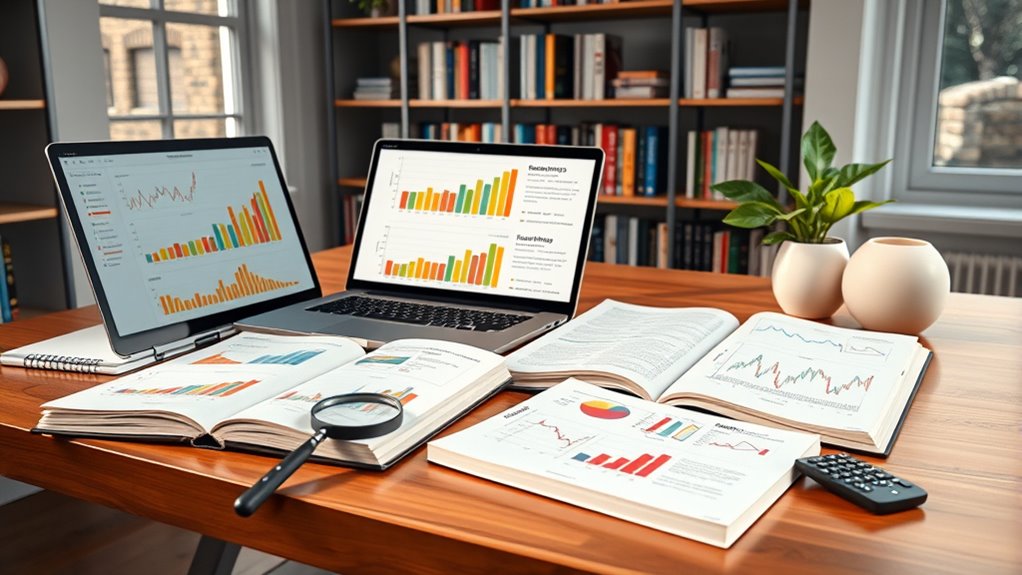
Economics econometrics is the application of statistical methods to economic data, enabling you to test theories and analyze real-world economic relationships. When you delve into econometrics, you’re essentially equipping yourself with tools to measure and interpret the complex interactions within economies. One key aspect is causal inference, which helps you determine whether one variable actually causes changes in another, rather than just being correlated. This distinction is essential because policymakers and economists need to understand cause-and-effect relationships to design effective interventions. For example, if you observe that higher education levels are associated with increased income, causal inference methods can help you evaluate whether improving education directly leads to higher earnings, rather than just being related through other factors.
Time series analysis is another critical component in econometrics, especially when dealing with data collected over time. You use time series analysis to identify patterns, trends, and cycles in economic indicators such as GDP, inflation rates, or stock prices. This approach allows you to forecast future values based on historical data and evaluate the impact of economic policies or shocks. For instance, if you’re analyzing how interest rate changes affect inflation, time series methods can help you isolate the effects and understand whether recent fluctuations are part of a larger trend or just short-term noise. These techniques are indispensable for making informed predictions and strategic decisions. Additionally, understanding projector technology can serve as an analogy for grasping how different econometric models work together to provide clearer insights.
In practice, implementing causal inference and time series analysis requires careful selection of models and assumptions. You need to verify your data meet certain criteria, like stationarity for time series, or control for confounding variables when testing causality. This often involves using regression models, difference-in-differences, or instrumental variables to strengthen your conclusions. By mastering these methods, you can move beyond simple correlations and uncover genuine economic mechanisms. This enables more reliable policy recommendations, investment decisions, and academic insights.
Ultimately, econometrics transforms raw data into meaningful insights. It empowers you to distinguish between mere associations and true causal relationships, especially through techniques like causal inference, and to analyze data over time with precision via time series analysis. With these tools, you gain a clearer understanding of economic phenomena, helping you make smarter decisions and contribute to effective economic policies. Whether you’re evaluating the impact of a new law or forecasting economic growth, econometrics provides the rigorous framework to support your analysis and deepen your understanding of how economies operate.
Top picks for "economic econometric demystifi"
As an affiliate, we earn on qualifying purchases.
Frequently Asked Questions
How Do Econometric Models Predict Future Economic Trends?
You might wonder how econometric models predict future economic trends. They do this by analyzing historical data, identifying patterns, and estimating relationships. Their predictive accuracy depends on how well the model assumptions hold true. If assumptions are valid, the model can effectively forecast trends. However, if assumptions fail or data changes, predictions can become unreliable. So, understanding model assumptions and ensuring data quality are key for accurate forecasts.
What Are Common Pitfalls in Econometric Analysis?
Did you know that nearly 60% of econometric analyses face pitfalls? You should watch out for model misspecification, which can lead your results astray, or multicollinearity, where variables become too intertwined, skewing your insights. These issues can distort your findings and reduce reliability. Always guarantee your model accurately reflects reality and check your variables’ relationships to avoid these common pitfalls in econometric analysis.
How Does Causality Differ From Correlation in Econometrics?
When you explore causality versus correlation, remember causality implies one factor directly influences another, while correlation just shows a relationship without cause and effect. In econometric inference, confusing the two can lead to incorrect conclusions. Always look for evidence that supports a causal link, like experiments or proper models, rather than assuming correlation equals causality. This distinction is essential for accurate analysis and reliable policy recommendations.
What Software Is Best for Econometric Analysis?
When choosing software for econometric analysis, you should consider a software comparison based on your needs and familiarity with programming languages. R and Stata are popular for their user-friendly interfaces and extensive econometric packages, while Python offers flexibility and powerful libraries like statsmodels. Both options support various data analysis tasks, but your choice depends on whether you prefer a coding-heavy approach or more visual tools for your econometric work.
How Can Econometrics Improve Public Policy Decisions?
Think of econometrics as your policy compass, guiding you through complex decisions. It improves public policy by providing robust policy evaluation, ensuring your choices are grounded in solid evidence. By analyzing high-quality data, you can identify what works and what doesn’t, making policies more effective. This scientific approach helps you avoid pitfalls, optimize resources, and craft solutions that truly benefit the public.
Conclusion
As you explore economics and econometrics, you’ll find that understanding their connection feels like uncovering a hidden thread in a complex tapestry. Suddenly, patterns emerge, and the pieces fall into place, revealing a clearer picture of how economies truly work. It’s almost as if the universe conspired to bring these concepts together just when you needed them most. Embrace the journey—sometimes, the most surprising coincidences lead to the greatest insights.