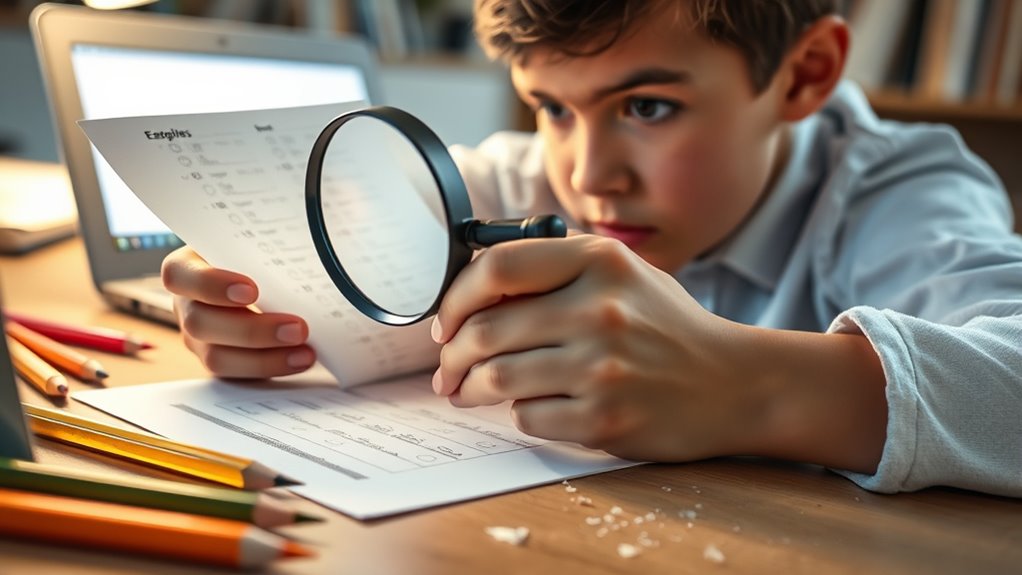

To effectively check your answers, systematically review each step with a critical eye, set your work aside briefly, and then re-examine it carefully. Be honest about your confidence levels and focus more on areas you’re less sure about. Verify calculations, logic, and instructions to catch simple mistakes before finalizing. Patience and consistency improve your chances of catching errors. Keep practicing these strategies, and you’ll develop sharper error detection skills that can considerably boost your accuracy.
Key Takeaways
- Review answers with a fresh perspective after a break to spot overlooked errors.
- Systematically verify calculations and reasoning to ensure accuracy.
- Calibrate confidence levels honestly, focusing on areas where doubt is present.
- Be aware of cognitive biases that may lead to overconfidence or missed mistakes.
- Practice patience and deliberate checking habits to develop effective error detection skills.

Have you ever finished a test or completed a task only to wonder if your answers are correct? It’s a common feeling, and it highlights the importance of effective checking strategies. When reviewing your work, error detection becomes your best tool. Error detection involves actively scrutinizing each response or step to identify mistakes or oversights. Instead of rushing through your answers, take a moment to step back and approach them with a critical eye. Ask yourself, “Does this make sense?” or “Is this consistent with what I know?” This habit helps you catch simple errors, such as miscalculations or misinterpretations, before they cost you points or lead to incorrect conclusions.
Effective checking involves critically reviewing your work to catch simple errors before they cost points.
Along with error detection, confidence calibration plays a pivotal role in the review process. Confidence calibration means honestly assessing how sure you are about each answer. Sometimes, you might feel overly confident about a response that’s actually incorrect, while other times, you might doubt yourself even when you’re right. Being aware of these biases allows you to allocate more attention to answers you’re less certain about. As you review, focus on questions or tasks where your confidence is low—these are the areas most prone to mistakes. Conversely, if you’re highly confident but your answer seems inconsistent or out of place, it’s worth double-checking. This balance helps guarantee you don’t overlook errors simply because you’re either too trusting of your initial instincts or overly hesitant to rely on them.
Developing a systematic approach enhances both error detection and confidence calibration. For example, after completing your work, set your answers aside briefly, then return with fresh eyes. Review each response methodically, questioning whether it aligns with the question’s requirements and your understanding. When you identify a potential mistake, pause and verify it by rechecking calculations or reasoning. This process trains you to become more aware of your own thought patterns, making it easier to recognize when your confidence might be misplaced. Additionally, understanding your own cognitive biases can help you avoid overlooking errors or overestimating your correctness. Over time, you’ll develop a more accurate sense of your abilities, reducing the likelihood of overlooking errors or overestimating your correctness.
Ultimately, the key to checking your answers effectively lies in patience and deliberate effort. By honing your error detection skills and calibrating your confidence levels, you improve your overall accuracy. Remember, no one is perfect, but with consistent practice, you can minimize mistakes and feel more assured in your results. Taking these steps ensures you’re not just rushing to finish but genuinely verifying that your answers are as correct as possible.
error checking and correction tools
As an affiliate, we earn on qualifying purchases.
As an affiliate, we earn on qualifying purchases.
Frequently Asked Questions
How Often Should I Review My Answers During a Test?
You should review your answers at least once during the test, especially if you experience test anxiety. Take a few moments after completing each section to check for mistakes and boost your answer confidence. Regularly reviewing helps catch errors early, reducing stress later. Remember, spaced reviewing keeps your mind fresh and sharp, so don’t wait until the end—checking in during the test improves accuracy and eases anxiety.
What Tools Can Help Me Identify Mistakes Quickly?
Quickly catch errors with clever tools like digital devices and peer review. Digital tools, such as grammar checkers and answer analyzers, swiftly spot slips and syntactical snafus. Peer review provides a fresh pair of eyes, spotting slips you might miss. Combine these tools to create a safety net, safeguarding your scores and sharpening your skills. With digital and peer support, you’ll swiftly spot mistakes and confidently submit your best work.
How Do I Stay Focused When Checking Multiple Answers?
To stay focused when checking multiple answers, practice mindful concentration by giving each question your full attention. Manage distractions by creating a quiet environment and setting specific time blocks for each answer. Take short breaks to reset your focus, and avoid multitasking. Staying present helps you notice errors more effectively, ensuring you catch mistakes without losing track. These strategies keep your mind sharp and your review thorough.
Should I Change My Answers After Reviewing Them?
Yes, you should consider changing your answers after reviewing them, especially if you spot inconsistencies or answer patterns that seem off. In guessing games, it’s common to stick with initial choices, but a second look helps you catch mistakes. Trust your instincts, but don’t be afraid to change answers if your review reveals a better option. Sometimes, a fresh perspective uncovers errors you initially overlooked.
What Common Errors Should I Look for When Checking Answers?
When checking your answers, watch out for erroneous assumptions and careless oversights—like missing key words or misreading questions. Double-check calculations and make sure your reasoning aligns with the problem. Look for inconsistent answers or answers that don’t make sense in context. Treat your answer sheet like a detective’s magnifying glass, catching small errors that could lead to big mistakes. These habits help you catch errors before they slip through unnoticed.
calibration and confidence assessment apps
As an affiliate, we earn on qualifying purchases.
As an affiliate, we earn on qualifying purchases.
Conclusion
Always double-check your work; it’s a simple step that saves time and boosts confidence. You might think rushing is faster, but catching mistakes early prevents bigger errors later. Remember, no answer is perfect on the first try. By taking a moment to review, you learn and improve with each mistake you catch. Embrace the process—your future self will thank you for the effort you put in today.
revision and proofreading checklists
As an affiliate, we earn on qualifying purchases.
As an affiliate, we earn on qualifying purchases.
test review and answer verification tools
As an affiliate, we earn on qualifying purchases.
As an affiliate, we earn on qualifying purchases.