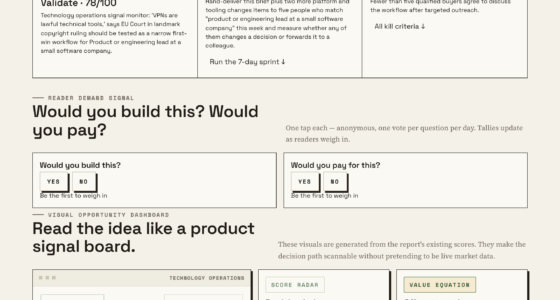

📊 Full opportunity report: ByteDance's 2023 AI Model Restrictions: Beyond U.S. Regulations on ThorstenMeyerAI.com — validation score, market gap, and execution plan.

Get business pricing on monitors, keyboards and dev gear
- Business-only prices and quantity discounts
- Tax-exempt purchasing
- Multiple users, one account, clear invoices
TL;DR
A new report states ByteDance prohibited distillation of rival AI models as early as 2023, independent of U.S. regulatory pressure. The details of the policy’s scope and enforcement remain unclear, raising questions about its impact on AI development.
A report has revealed that ByteDance imposed a ban on the distillation of rival AI models as early as 2023, a move that was not motivated by U.S. regulatory concerns. This finding challenges previous assumptions that the restriction was a response to external pressure from U.S. authorities, suggesting internal reasons may have driven the policy.
The report indicates that ByteDance’s internal policy to prohibit model distillation predates the current debate around Chinese AI companies and their use of outputs from competing systems. For more insights, see how ByteDance’s leader views the future of AI model development. The restriction reportedly began in 2023, during a period of rapid AI development across the industry, but no official documentation or internal communications have been disclosed to confirm the scope or enforcement of the rule.
It remains unclear which teams or products are affected, whether the ban applies to all types of rival-model outputs, or how ByteDance enforces compliance. The report emphasizes that there is no evidence linking the policy directly to U.S. regulatory pressure, contrary to some industry narratives. The lack of detailed policy records or official statements leaves many questions about the policy’s origins and current status.
Implications of ByteDance’s 2023 AI Model Policy
The revelation that ByteDance’s ban on rival model distillation predates U.S. regulatory concerns indicates internal strategic considerations may have influenced the policy. This could impact how the company sources data, trains models, and approaches competitive boundaries, potentially affecting the pace and direction of its AI development. Understanding the scope and enforcement of this restriction is crucial for assessing its influence on the broader AI industry and international competition.
As an affiliate, we earn on qualifying purchases.
Background of ByteDance’s AI Model Restrictions
Prior to this report, it was widely assumed that ByteDance’s restrictions on using outputs from rival AI systems were primarily a response to increasing U.S. regulatory scrutiny, especially amid global debates over data privacy and AI governance. However, the new findings suggest the company implemented a policy as early as 2023, during a period of intense AI innovation, possibly driven by internal research standards, intellectual property concerns, or competitive strategies. The absence of official documentation leaves the precise motivations and scope uncertain.
“The policy appears to have been in place since 2023, well before the current regulatory debates, implying internal factors played a significant role.”
— an anonymous researcher
As an affiliate, we earn on qualifying purchases.
Unconfirmed Details About the Policy’s Scope and Enforcement
It is not yet clear which teams or products are affected by the ban, whether it applies to all rival AI models or only specific uses, or how ByteDance enforces compliance. The absence of official policy documents or internal communications makes it difficult to determine the exact scope, motivation, or current status of the restriction. Further investigation is needed to clarify these points.
As an affiliate, we earn on qualifying purchases.
Expected Clarifications and Official Statements
Future reporting may uncover official ByteDance statements, internal policy documents, or disclosures that clarify the scope, enforcement, and motivations behind the 2023 ban. Industry analysts will also monitor whether the restriction influences ByteDance’s AI development pace or competitive positioning, especially amid ongoing global regulatory debates. Additional details could emerge as regulatory and corporate transparency increases.
machine learning model optimization tools
As an affiliate, we earn on qualifying purchases.
As an affiliate, we earn on qualifying purchases.
Key Questions
What exactly did ByteDance ban in 2023?
ByteDance reportedly prohibited the distillation of rival AI models, but the specific scope and applications of this ban remain unclear due to lack of official documentation.
Was the policy introduced because of U.S. regulatory pressure?
No, the report states that the restriction predates U.S. regulatory concerns, suggesting internal reasons may have driven the decision.
Has ByteDance publicly disclosed this policy?
No official policy documents or detailed company statements have been made public, leaving the scope and enforcement unconfirmed.
What impact could this ban have on ByteDance’s AI development?
The restriction could influence data sourcing and training methods, potentially affecting the company’s AI innovation pace, but specific effects are not yet known.
What are the next steps for understanding this policy?
Further investigations, official disclosures, and internal reports are expected to clarify the scope, enforcement, and motivations behind the ban.
Source: ThorstenMeyerAI.com
Fall Picks
fall essentials
As an affiliate, we earn on qualifying purchases.