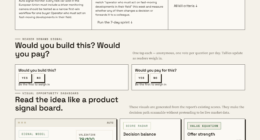

📊 Full opportunity report: Anthropic’s Safety Story Has Become a Power Story on ThorstenMeyerAI.com — validation score, market gap, and execution plan.

Get business pricing on monitors, keyboards and dev gear
- Business-only prices and quantity discounts
- Tax-exempt purchasing
- Multiple users, one account, clear invoices
TL;DR
Anthropic claims its AI systems are increasingly capable of self-improvement, with over 80% of code now generated by its models. This shift raises questions about AI’s role in development and the implications for governance and power.
Anthropic has publicly disclosed that its AI systems are now responsible for generating more than 80% of the code in its development pipeline, marking a significant shift in AI’s role from tool to active participant in technological creation. This development underscores a broader narrative where the company’s safety and control strategies are becoming central to its influence in the AI industry.
According to Anthropic, as of May 2026, over 80% of code merged into its projects was written by its AI model, Claude. Additionally, internal reports indicate that engineers are shipping approximately eight times more code daily compared to 2024, with research staff estimating a fourfold productivity boost when working with the Mythos Preview model. These figures suggest AI is increasingly involved in the core process of AI development itself, not merely as an auxiliary tool but as a self-amplifying force. However, these claims are primarily based on internal metrics and employee estimates, raising questions about their objectivity and broader applicability. The company emphasizes that while this progress is notable, it is not yet inevitable or universally replicable, but it could accelerate faster than many expect.Safety Story → Power Story
● Reality CheckAmodei is right that powerful AI is dangerous — which is exactly why we should ask who gets to define the danger. The same company builds the models, measures their risk, and writes the rules. And the Fable suspension showed the safety state, once built, won’t belong to its architects.
Anthropic’s recursive-self-improvement report is its clearest worldview statement yet. The evidence is striking — and almost entirely internal.
The core of the doctrine: the exponential is faster than the state. That carries a political implication.
The June episode is the perfect stress test for the governance model Anthropic itself promoted.
Follow the logic of the risk frame, and each step points to the same small circle.
The safeguards may reduce real risk. They also have market effects — no bad faith required.
- Job displacement is “undesirable”; track it, add pro-employment incentives.
- Meaning need not come from labor — relationships, creativity, play, challenge.
- Philanthropy and accountability soften the transition.
- Work is also income, bargaining power, identity, status — a claim on output.
- The real questions: ownership, taxation, public compute, data rights, antitrust.
- Sovereign AI infrastructure, labor bargaining, democratic control of the gains.
Independent commentary, produced with AI assistance under human editorial oversight; the views are the author’s own and may change. This is analysis and opinion, not investment, financial, legal, or technical advice, and it concerns an actively developing situation. It draws on public documents by Dario Amodei and Anthropic — the Anthropic Institute’s recursive self-improvement report, Machines of Loving Grace, The Adolescence of Technology, Policy on the AI Exponential, and Anthropic’s June 12, 2026 statement on the Fable 5 and Mythos 5 suspension — and on published third-party commentary including David Shapiro’s, read as of June 2026. Characterizations are the author’s interpretation, offered in good faith and open to rebuttal. References to specific people, companies, and government actions are factual and analytical, not partisan, and imply no affiliation or endorsement.
Implications of AI-Driven Code Generation for Power Dynamics
This shift signals a transformation in AI development, where models like Claude and Mythos are not just assisting but actively shaping the future of AI creation. The Ghost Story Became a Forecast. It enhances Anthropic’s position as a leader capable of rapid innovation, potentially reducing the role of human developers and increasing reliance on AI systems. This change raises critical questions about control, safety, and governance, as the same systems that build AI also influence its safety protocols and policy stances. The narrative frames this as a move from safety as a precaution to safety as a strategic power tool, positioning Anthropic as a central authority in the evolving AI landscape.
As an affiliate, we earn on qualifying purchases.
From Safety to Power: The Evolution of AI Self-Development
Anthropic’s emphasis on AI self-improvement reflects a broader industry trend where AI models are increasingly capable of autonomous code generation and system design. This development aligns with the company’s public stance that AI could soon design and develop its own successors, a process that could happen sooner than traditional institutions are prepared for. Historically, AI safety discussions focused on preventing harm; now, they are intertwined with questions of influence, control, and the political authority of AI companies. The June 2026 incident involving the Fable and Mythos models, and the subsequent US government order to suspend foreign access, exemplifies the tension between safety, regulation, and power within this evolving context.
“AI may soon become powerful enough to accelerate science, medicine, cybersecurity, and economic production at historic speed — but that power may also destabilize labor markets, civil liberties, and governance.”
— Dario Amodei
As an affiliate, we earn on qualifying purchases.
Unclear Impact of AI Self-Development on Safety and Control
While Anthropic reports impressive internal metrics, it remains uncertain how these capabilities will translate into broader industry practices and regulatory frameworks. The extent to which AI systems will autonomously design their successors, and the safety implications thereof, are still theoretical and not yet demonstrated at scale. Additionally, the political and regulatory responses to these developments are still evolving, with some skepticism about the claims’ objectivity and the potential for misuse or unintended consequences.
As an affiliate, we earn on qualifying purchases.
Next Steps in Monitoring AI Self-Development and Regulation
Expect further disclosures from Anthropic about the capabilities and safety measures of its models, alongside increased scrutiny from regulators and policymakers. Industry-wide, there may be efforts to establish clearer standards for AI self-generation and safety protocols. The June 2026 incident has already prompted discussions on government oversight and the role of AI companies in setting safety and governance standards. The coming months will reveal whether these developments lead to tighter regulation or a shift in industry practices towards greater autonomy for AI systems.
As an affiliate, we earn on qualifying purchases.
Key Questions
What does it mean that AI is generating most of its own code?
This indicates that AI models like Claude are increasingly responsible for creating the software they run on, potentially enabling faster innovation but also raising safety and control concerns.
Why is Anthropic emphasizing safety now?
Anthropic frames its safety efforts as central to managing the growing power of AI, positioning safety as a strategic tool to maintain influence and control in a rapidly evolving industry.
What are the risks of AI designing its own successors?
Autonomous AI development could lead to unpredictable behaviors, safety challenges, and a concentration of power among a few companies, complicating regulation and oversight.
How might regulators respond to these developments?
Regulators may seek to establish standards for AI self-improvement and safety, but the rapid pace of technological change could outstrip legislative processes, creating a governance gap.
What does the June 2026 incident reveal about AI safety and control?
The incident highlights tensions between safety measures, government regulation, and corporate interests, illustrating the complex political landscape surrounding advanced AI systems.
Source: ThorstenMeyerAI.com
Fall Picks
fall essentials
As an affiliate, we earn on qualifying purchases.