
📊 Full opportunity report: An App For Tracking Labs And Symptoms During TRT on IdeaNavigator AI — validation score, market gap, and execution plan.

Get business pricing on monitors, keyboards and dev gear
- Business-only prices and quantity discounts
- Tax-exempt purchasing
- Multiple users, one account, clear invoices
TL;DR
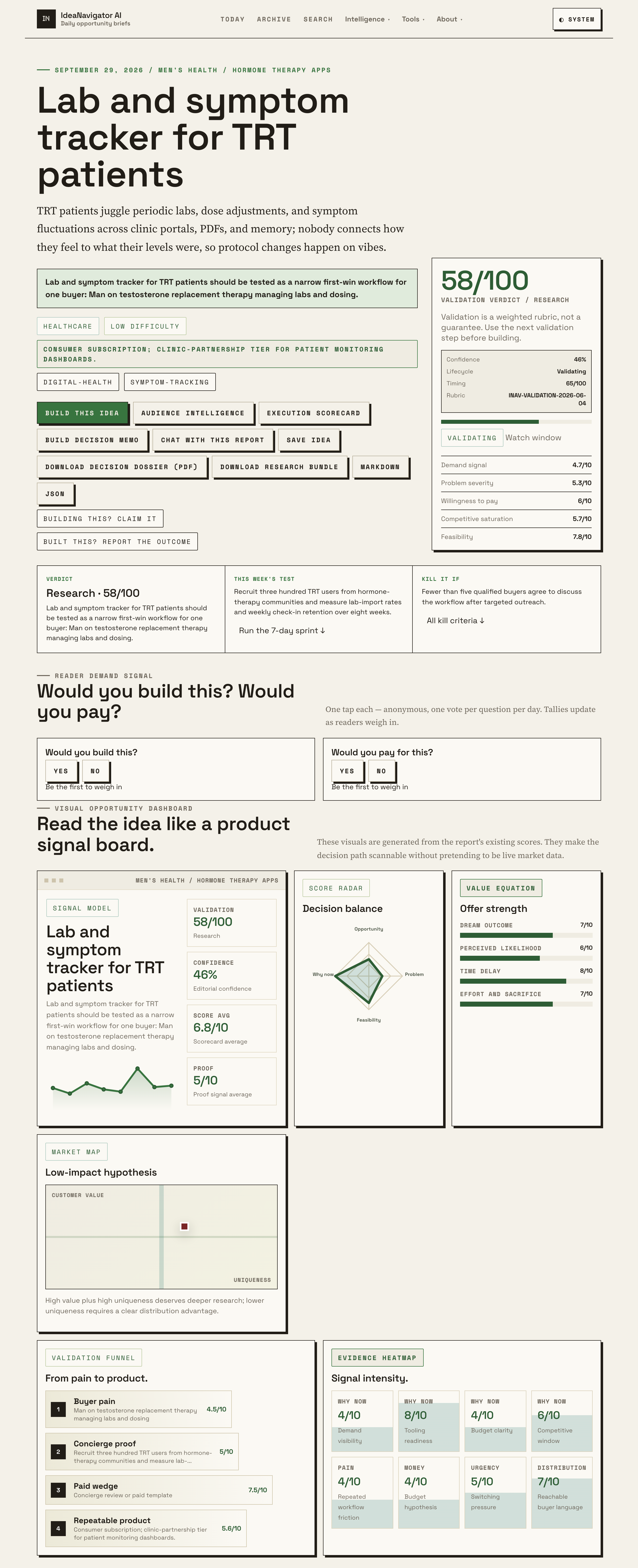
IdeaNavigator AI has outlined a proposed app for men on testosterone replacement therapy that would connect lab results, dose changes and symptom check-ins. The concept has not been presented as a launched product or a clinically tested tool; its proposed validation would track use by 300 TRT patients over eight weeks.
IdeaNavigator AI has proposed testing a lab and symptom tracking app for men receiving testosterone replacement therapy (TRT), with a planned workflow that would chart hormone panels alongside dose changes and daily check-ins. The proposal describes a product concept and a way to test demand; it does not establish that an app has launched, that patients are already using it, or that the approach improves care.
According to the IdeaNavigator AI proposal, the app would let users import lab-test PDFs, record dose changes and log symptoms each day. It would display hormone results over time in relation to those changes, produce summaries for clinic visits and flag results that move outside target ranges. The proposal does not specify which lab values or target ranges the app would use, or how those ranges would be set for individual patients.
IdeaNavigator AI frames the intended user as a man managing TRT labs and dosing across fragmented records. The proposal says patients may have to navigate clinic portals, PDFs and their own recollections, making it difficult to connect how they feel with their hormone levels. That is the problem the concept aims to address; the material provides no patient interviews, clinical data or other evidence establishing how common the problem is.
The suggested business model combines a consumer subscription with a possible clinic-partnership tier offering patient-monitoring dashboards. To test the idea, IdeaNavigator AI proposes recruiting 300 TRT users from hormone-therapy communities and tracking lab-import rates and weekly check-in retention for eight weeks. Those are proposed measures, not completed trial results, and no recruitment or study start date is given.
Connecting Records to Patient Reports
If built and adopted, a single record of lab results, dose adjustments and symptoms could give patients a clearer account of changes between clinic visits. Visit summaries might also help patients and clinicians review patterns without relying only on memory or separate records. These are potential uses described by IdeaNavigator AI, not demonstrated outcomes.
The clinical boundary matters. A chart that displays results beside symptoms does not by itself show that one caused the other, and an alert based on a target range is not a diagnosis or treatment recommendation. The proposal gives no details on clinical review, individualized ranges, privacy protections or how patients would be directed to discuss concerning results with a clinician. Those decisions would affect whether the app could be useful in care as well as whether people trust it with sensitive health information.
The proposed eight-week test could answer an initial product question: whether recruited users import their labs and continue logging symptoms. Even strong retention would not establish improved health outcomes, safer dosing or better clinical decisions. A separate clinical evaluation would be needed to examine those claims.
A Proposed First TRT Workflow
The concept focuses on a specific user and task rather than a broad hormone-health platform: a man already receiving TRT who wants to manage records and dosing. Its suggested first version centers on document import, charts, check-ins and visit summaries. The IdeaNavigator AI proposal describes a possible product scope, not a product specification or a report of development progress.
IdeaNavigator AI says a rise in TRT prescriptions and telehealth clinics has created a larger population of people managing care across providers. The provided material does not include prescription figures, dates, geography or supporting data for that assertion, so the scale and timing of the claimed trend cannot be assessed here.
The concept’s immediate test is behavioral: find 300 users through hormone-therapy communities and measure two forms of engagement over eight weeks. The material does not say whether those participants would be recruited, whether a prototype exists, or what threshold would count as sufficient demand.
Clinical and Adoption Questions
The IdeaNavigator AI proposal identifies no app, launch, user cohort or results. It remains unclear whether development has begun, what the app would be called, who would operate it, or which clinics might participate. The 300-person recruitment plan is a suggested validation step, not evidence that the study is underway.
The proposal also leaves clinical and technical details open. It does not identify the lab panels to be supported, how imported PDF data would be checked for errors, who would choose target ranges, or how changes in dose would be recorded and verified. It provides no information on data security, consent, sharing with clinics or the handling of abnormal results.
It is also unclear whether patients or clinicians would find the summaries useful, and whether users would keep logging symptoms beyond the proposed eight-week period. Import rates and weekly check-ins could show whether participants use the workflow, but they would not on their own answer whether the app improves treatment decisions or outcomes.
The Proposed Eight-Week Test
IdeaNavigator AI’s proposal describes recruiting 300 people receiving TRT from hormone-therapy communities, then measuring how many import lab results and how many continue weekly symptom check-ins during an eight-week period. No start date, recruitment status or results are available in the proposal.
If that test proceeds, its findings could indicate whether the app’s core record-keeping workflow attracts repeat use. Further development would still need to address clinical oversight, accuracy, privacy and the role of alerts before the concept could be assessed as a care tool. No such development milestones or clinical evaluation plans are specified.
Source: IdeaNavigator AI
Key Questions
Has the TRT tracking app launched?
The IdeaNavigator AI proposal describes a proposed app concept. It does not identify a launched product or say that development is underway.
What would the app track?
According to the proposal, the workflow combines imported lab PDFs, dose changes and daily symptom check-ins, with charts, clinic-visit summaries and alerts for results outside target ranges.
Has the app been shown to improve TRT care?
No clinical results are provided in the proposal. The suggested eight-week test would measure lab imports and weekly check-in retention, not whether the app improves treatment decisions or health outcomes.
What is the proposed validation plan?
IdeaNavigator AI proposes recruiting 300 TRT users from hormone-therapy communities and measuring lab-import rates and weekly check-in retention over eight weeks. The material does not say the recruitment has started.
Source: IdeaNavigator AI
Fall Picks
fall essentials
As an affiliate, we earn on qualifying purchases.