
TL;DR
Play games included with Prime
Start a Prime free trial and play with Amazon Luna on your devices.
Start playingAs an affiliate, we earn on qualifying purchases.
IdeaClyst is a local-first, AI-powered war room for founders, combining structured debate, discovery, and strategic planning. It helps avoid costly missteps and accelerates innovation by grounding ideas in real research and structured critique.
Imagine standing in a room filled with your most talented advisors, each pointing out flaws, risks, and opportunities in your idea. Now, picture doing that all on your laptop, with a tool that simulates a diverse, critical board of experts. That’s the core promise of IdeaClyst—a digital war room designed to help you pick the right idea, fast.
This platform isn’t just another brainstorming app. It’s a digital war room designed to help you pick the right idea, fast. When you’re staring at three promising concepts, how do you choose which one to pour six months into? IdeaClyst offers a structured environment to cut through the noise and make confident decisions—saving time, money, and stress. To learn more about innovative collaboration methods, see A War Room for Your Next Idea: Inside IdeaClyst.
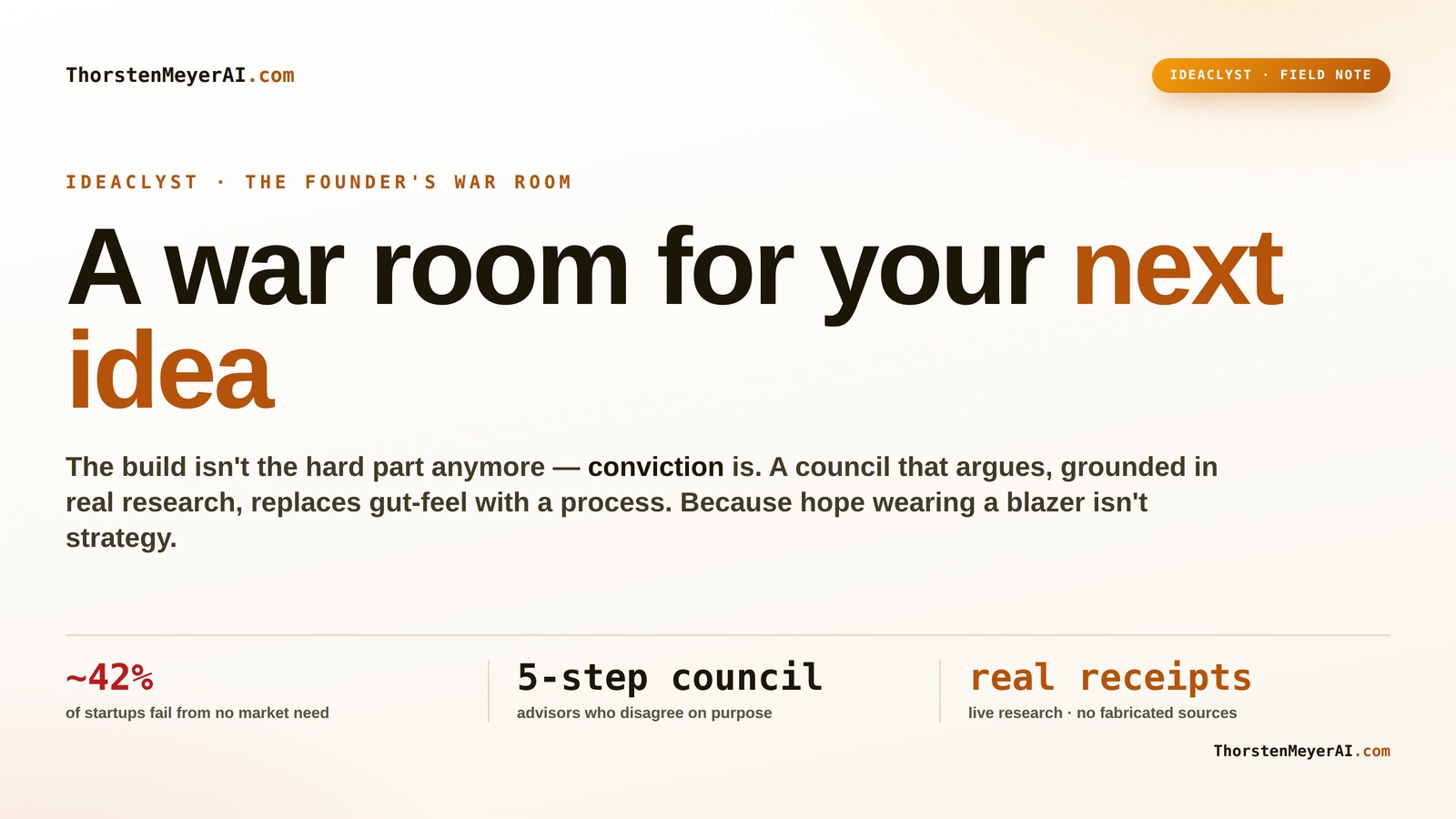
A war room for your next idea
The build isn’t the hard part anymore — conviction is. Knowing which idea deserves the next six months, and being able to defend it. Most founders answer with gut feel and optimistic math. That’s hope wearing a blazer. IdeaClyst replaces it with a process.
The most expensive decision is what to build
The single most valuable thing a tool can do is talk you out of the wrong six months. The numbers make the case better than any pitch.
Three tools in one — on your own machine
Strip away the framing and IdeaClyst is three things at once, all running locally with nothing leaving your laptop.
An AI council
Pressure-tests an idea you bring it — advisors who argue on purpose.
A discovery engine
Finds ideas you didn’t know to look for by hunting real demand signals.
A founder’s workspace
Carries winners from “interesting” all the way to “ready to build.”
Advisors who disagree on purpose
Not one confident, agreeable answer — a structured five-step deliberation where models play different roles and turn on their own work. The disagreement is the feature.
The five-step deliberation
A council that leads with the bad news surfaces the objections you’d otherwise find the expensive way, on month five.
Product strategy
Who’s it for, what’s the wedge, why now, what’s the business model.
Technical architecture
What would it actually take to build — and where’s the risk.
Critique pass
The council turns on its own work. Where’s the hand-waving? What kills this?
Second, independent critique
A different voice, a different angle — so blind spots don’t survive.
Final synthesis
Everything into one coherent founder packet: strategy, architecture, validation, plan.
When IdeaClyst cites a source, it actually fetched it
The hard departure from “ask an AI what it thinks of my startup.” It runs in a strict, real-data-only mode — if it can’t gather genuine evidence, it says so plainly rather than inventing a plausible paragraph.
Confidence with receipts
No fabricated statistics, no imaginary competitors, no made-up citations. The packet survives a skeptical co-founder or a sharp investor because the reasoning has receipts.
Market research first
Scouts the landscape before the council reasons about anything.
Competitor read
Real positioning, pricing signals, feature claims — differentiation vs. reality.
Validation with links
Not “talk to customers” — concrete signals & sources you can click.
From the blank page to build-ready
Evaluation is half the problem; the blank page is the other half. And a plan is worthless if it dies in a tab you never reopen.
Bring a space, not an idea
“AI for accountants,” “tools for indie game studios” — plus your goal and real capacity. It hunts demand signals across HN, Reddit, Product Hunt, GitHub, pricing pages.
- An honest market read — leads with the bad news when a space is hard
- An opportunity map — high pain, thin competition
- Ranked candidates — wedge, who pays, effort, risk, confidence
- each with KILL CRITERIA — when to walk away
A home and a forward path
Every promising idea gets carried forward, with every artifact in plain files on your disk.
- Validation tooling — sprint board, interview list, evidence browser
- Founder profile — a personal-fit lens; same discovery, different advice
- Build workspaces — funnel, personas, landing draft, version history
- “Build this idea” → a PRD + task queue, ready for a coding agent
Key Takeaways
- IdeaClyst’s structured AI council surfaces flaws early by staging debate among diverse models, reducing failure risk.
- Grounding critiques in live web research ensures ideas are evaluated against current market realities, not assumptions.
- Running entirely locally keeps your sensitive ideas private, secure, and under your control—crucial for IP-heavy projects.
- The step-by-step process inside IdeaClyst makes validation fast, repeatable, and less costly than traditional methods.
- Comparing traditional validation with IdeaClyst shows it slashes time and cost, helping founders make smarter, faster decisions.
AI-powered idea validation software
As an affiliate, we earn on qualifying purchases.
As an affiliate, we earn on qualifying purchases.
Why a War Room Matters More Than Ever for Your Next Big Idea
Startups and innovators face a brutal truth: 42% of failures come from building something nobody actually needs. For insights on sustainable practices, visit listof.org. Traditional validation takes months and costs thousands—often out of reach for most founders. IdeaClyst compresses that process into hours, using AI-driven research and structured critique.
Picture this: a founder in Silicon Valley, debating whether to pivot or persevere. With IdeaClyst, they get a real-time, neutral panel of AI advisors evaluating market fit, technical risks, and strategic fit. No more gut feelings—just data-backed clarity.
Understanding why this matters is crucial: in today’s fast-paced environment, the ability to quickly validate or pivot can be the difference between success and failure. The tradeoff is between investing heavily upfront without certainty or making rapid, informed decisions that minimize costly missteps. The speed and objectivity offered by IdeaClyst empower founders to navigate this delicate balance more effectively, reducing the emotional bias and guesswork often involved in early-stage decisions.
collaborative digital war room tools
As an affiliate, we earn on qualifying purchases.
As an affiliate, we earn on qualifying purchases.
How IdeaClyst Works: The 3 Pillars of Your Digital War Room
IdeaClyst combines three core functions into one powerful local-first platform: For more on local-first software benefits, check out twogreenleaves.org.
- The AI Council: Diverse models argue and critique your idea from multiple angles, surfacing flaws early. This multiplicity ensures that no single bias skews your perception, and the debate format helps surface hidden risks or overlooked opportunities that could derail your project later on.
- The Discovery Engine: It finds related ideas and market signals you might miss, expanding your horizon. This broader perspective helps you understand the competitive landscape, identify emerging trends, and avoid reinventing the wheel. The implication is that your idea isn’t developed in isolation but is contextualized within real-world signals, making your strategy more robust.
- The Founder’s Workspace: Organize, document, and refine your ideas into a final plan, all stored securely on your device. This component ensures that your insights are not lost and that your decision-making process is transparent and repeatable. It also allows for iterative refinement, which is vital in adapting to new information or shifting market conditions.
For example, a SaaS founder struggling to validate a new feature can run a quick council review, get competing perspectives, and document the final strategy—all without uploading sensitive data to the cloud. This integrated approach reduces dependencies on external systems and keeps your strategic thinking secure and adaptable.
local-first research and planning software
As an affiliate, we earn on qualifying purchases.
As an affiliate, we earn on qualifying purchases.
The Power of a Disagreeing AI Council: Why Debate Wins
Instead of one AI giving you a yes-or-no answer, IdeaClyst stages a structured debate among models playing different roles—strategy, tech, market. This disagreement exposes blind spots and weak points early, saving months of costly mistakes. To explore how debate improves decision-making, see A War Room for Your Next Idea: Inside IdeaClyst.
Think of it as a jury of experts in your laptop, challenging each assumption. When you’re pitching a new product, this council can reveal flaws that might otherwise surface after months of wasted effort. The implication is that embracing disagreement isn’t about seeking consensus but about uncovering vulnerabilities and strengthening your idea through rigorous challenge.
Research shows that diverse perspectives reduce failure rates. The council’s structured debate mimics this, making your idea stronger and more resilient before you go to market. The tradeoff is that such debate requires careful design to ensure it’s constructive rather than confrontational, but the payoff is a more thoroughly vetted and reliable concept.
As an affiliate, we earn on qualifying purchases.
Grounding Your Idea in Real Data: The Truth-Driven Approach
Many AI tools just echo your enthusiasm or assumptions. IdeaClyst flips that script by anchoring every critique and suggestion in live web research. For more on scientific testing devices, visit chemicalceo.com. It pulls in real-time data, market signals, and competitive analysis—so you’re not just trusting the model’s vibe, but actual facts.
For instance, if you’re considering a new telehealth app, the platform scans recent market growth, regulatory changes, and user trends. It then feeds this into the council’s debate, making sure your idea stands on solid ground. This approach helps you distinguish between genuine opportunities and fleeting trends, which is critical when resources are limited and the cost of pursuing the wrong idea is high.
The tradeoff here is that relying on live data requires the system to be accurate and current; otherwise, it might mislead you with outdated or incomplete information. Nonetheless, grounding ideas in real data significantly reduces the risk of failure due to false assumptions or market misjudgment, leading to more sustainable innovation.
Your Local-First Secret: Why It Matters for Founders
IdeaClyst runs entirely on your machine, not in the cloud. That means your raw ideas stay private, secure, and owned. No cloud accounts, no data leaks—just your laptop, your ideas, and your control.
Imagine a startup with sensitive IP—no worries about leaks or leaks. Or a founder who just prefers not to upload their early-stage concepts to third-party servers. The local-first design keeps everything under your nose, safe and intact. This approach also offers a significant advantage in terms of compliance, especially for industries bound by strict data privacy regulations, as your data never leaves your device.
This isn’t just a tech detail. It’s a strategic advantage in today’s data-driven world, reducing dependency on external vendors and minimizing exposure to cyber threats. The tradeoff is that local processing might limit some functionalities that rely on cloud computing, but for core idea validation, security and privacy take precedence.
From Idea to Action: The Step-by-Step Process Inside IdeaClyst
Here’s how you move from a fuzzy concept to a solid plan with IdeaClyst:
- Input your idea: Write a quick summary or a detailed paragraph.
- Run the council: Let the AI models debate your idea from multiple angles.
- Review critiques: Dive into the feedback, identify risks or gaps.
- Explore related ideas: Use the discovery engine to find similar concepts or market signals.
- Refine and document: Organize your plan into sections, write down your final strategy, and save it securely.
This process is designed to be iterative, allowing you to refine your ideas with each cycle. The implication is that the more you use the platform, the better your ability to quickly validate and adapt ideas, creating a cycle of continuous improvement that enhances your decision-making confidence over time.
Comparison: Traditional Validation vs. IdeaClyst’s Approach
| Aspect | Traditional Validation | IdeaClyst |
|---|---|---|
| Time to validate | 3-6 months | Hours to days |
| Cost | $5,000–$50,000 | Hundreds of dollars |
| Data grounding | Mostly assumptions, surveys, or expert opinions | Live web research and data |
| Decision confidence | Depends on experience and bias | Data-backed, structured critique |
The implications of these differences are profound: traditional validation methods are slow and often rely on subjective judgments, which can lead to biases and missed opportunities. In contrast, IdeaClyst’s approach offers rapid, data-driven insights that enable founders to make smarter decisions faster. The tradeoff is that rapid validation might sometimes overlook nuanced context that slower, more in-depth methods could capture, but the overall efficiency and reliability significantly outweigh this concern, especially in early-stage environments.
What Founders Say About Using IdeaClyst
Early adopters report feeling more confident in their choices. One startup founder shared, “It’s like having a panel of experts on my laptop, fighting for and against my ideas.” Another said, “It cut our validation time from three months to just a week.” These real-world stories highlight how the platform accelerates smart decision-making and reduces costly mistakes.
Beyond individual testimonials, case studies from Fortune 500 companies demonstrate that structured critique combined with real-time research leads to more resilient products and strategic alignment. The broader implication is that such rigorous validation processes can bridge the gap between startup agility and corporate robustness, fostering a culture of continuous learning and adaptation that ultimately enhances long-term success.
Frequently Asked Questions
How does IdeaClyst differ from just talking to a mentor or advisor?
Unlike mentors, IdeaClyst provides structured, multi-perspective critique from AI models that simulate diverse opinions. It’s faster, more consistent, and always available on your laptop, giving you a rigorous debate anytime you need it.Can I use IdeaClyst for my small startup or solo project?
Absolutely. Its local-first design and flexible workflow make it ideal for startups and solo founders who want serious validation without the overhead of cloud-based tools.Is the research in IdeaClyst real-time and reliable?
Yes. It pulls in live web data and market signals, ensuring your critiques are grounded in the latest information. This reduces the risk of building on outdated assumptions.How secure is my data with IdeaClyst?
Your ideas and research stay on your device, not in the cloud. That means your sensitive IP remains private, and you have full control over your data.What support options are available if I get stuck?
Since IdeaClyst is open source, community forums and documentation are available. Plus, many users find that the platform’s intuitive design helps them get started with minimal help.Conclusion
In a world where speed and certainty can make or break a startup, a tool like IdeaClyst becomes your secret weapon. It’s not just about faster ideas—it’s about smarter, safer decisions rooted in real data and honest critique.
Whether you’re testing a new feature, pivoting your strategy, or validating an idea, this local-first war room keeps your best insights close and your risks minimized. Ready to turn your next idea into a winning plan? The future of innovation is just a click away.
NFL season / tailgating Picks
team gear
As an affiliate, we earn on qualifying purchases.