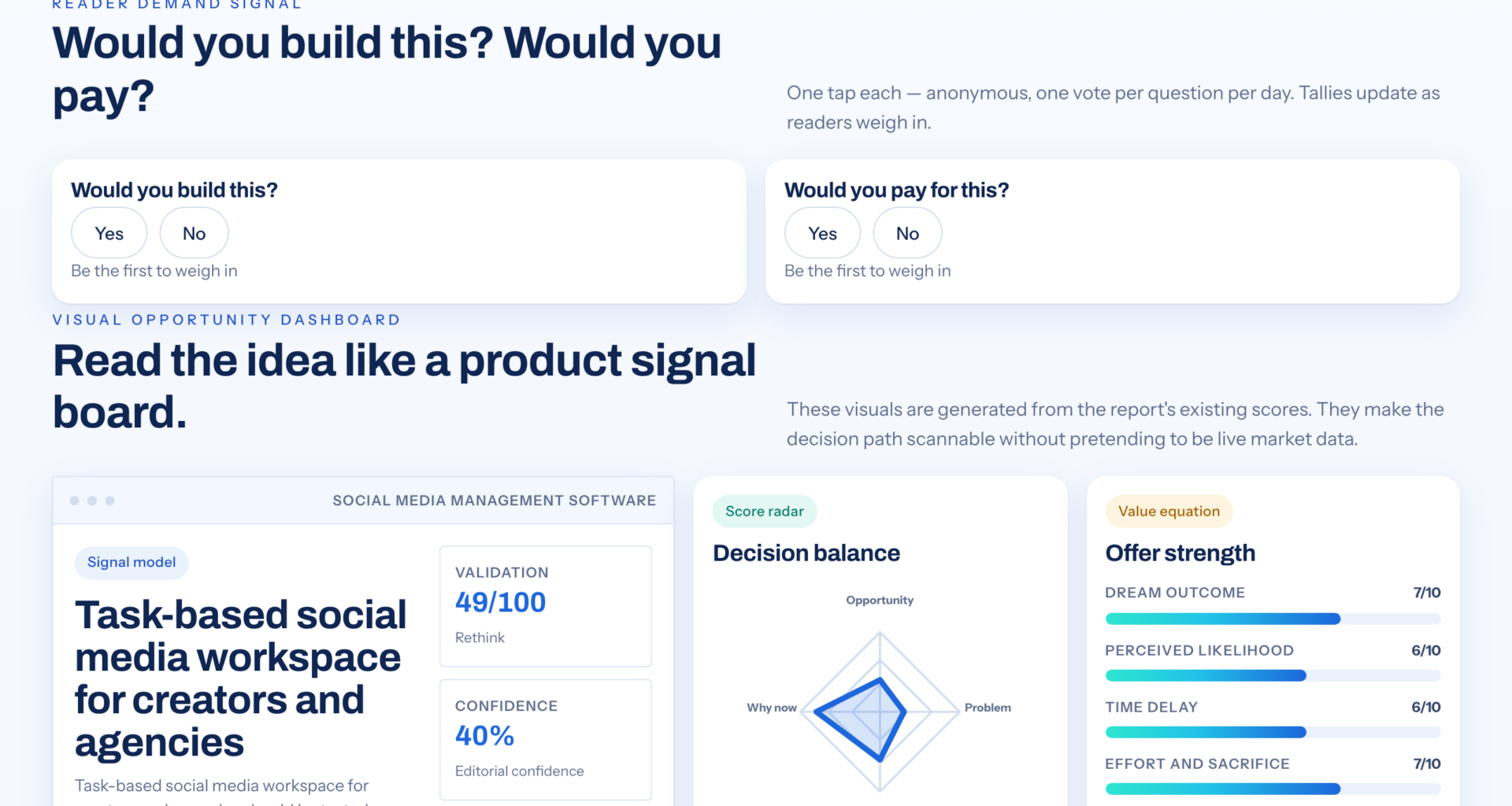

📊 Full opportunity report: A Better Way To Coordinate Social Media Tasks For Clients on IdeaNavigator AI — validation score, market gap, and execution plan.

Get business pricing on monitors, keyboards and dev gear
- Business-only prices and quantity discounts
- Tax-exempt purchasing
- Multiple users, one account, clear invoices
TL;DR
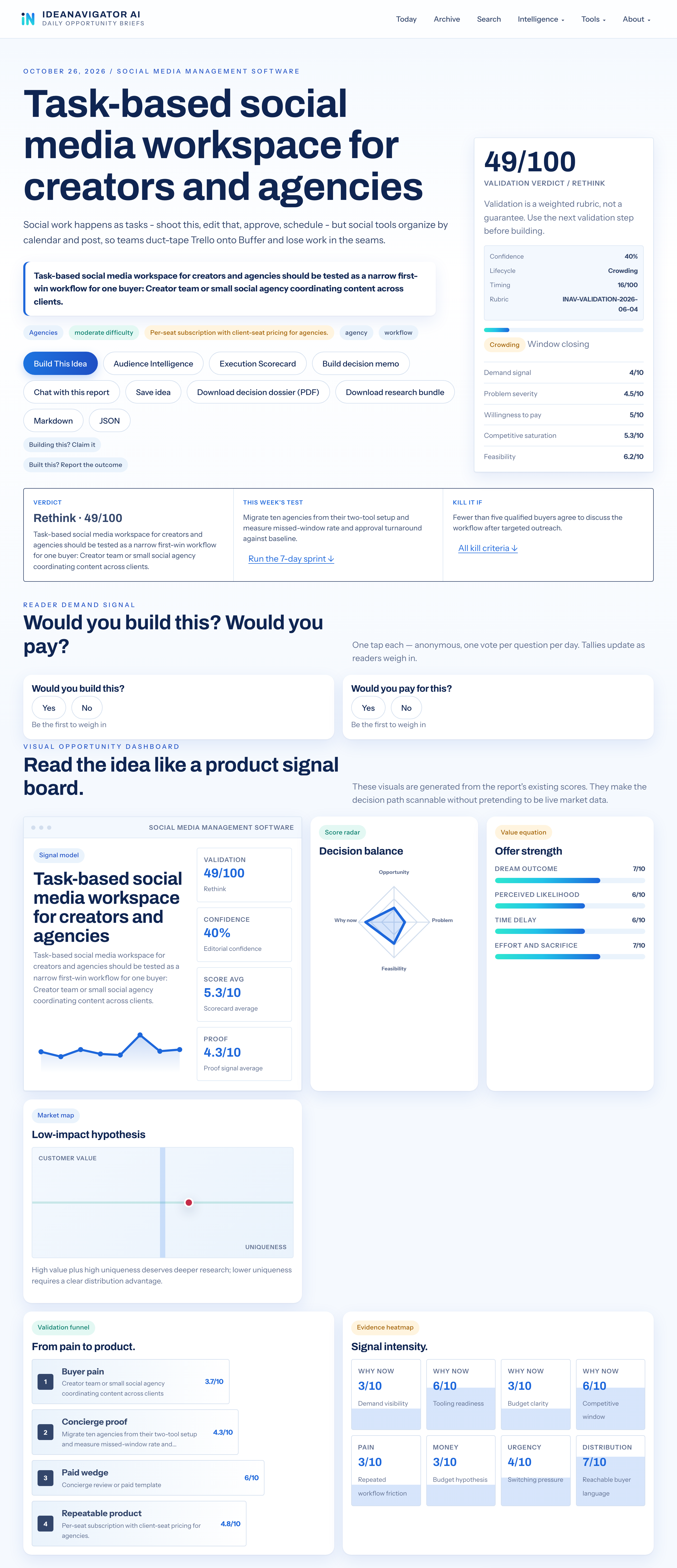
IdeaNavigator AI has outlined a proposed social media workspace that would combine content tasks, asset versions, client approvals and scheduling in one pipeline. The concept is aimed at creator teams and small agencies, but it is a product proposal, not a launched service; its value would need testing against existing workflows.
IdeaNavigator AI has proposed a task-based social media workspace for creator teams and small agencies coordinating posts across clients. In its product proposal, the company describes a workflow that would bring content production, client approvals and scheduling together. The proposal does not report a product launch, participating agencies or validation results.
According to IdeaNavigator AI’s proposal, the workspace would treat each social post as a task, moving it through stages such as brief, asset creation, editing, approval and scheduling. The proposal identifies a workflow in which teams may use a social scheduling service alongside a separate project-management tool, with work passing between them.
Features outlined in the proposal include client-facing approval links, asset versioning and scheduling after a post is approved. IdeaNavigator AI presents the intended result as one pipeline from an initial idea to publication, rather than a calendar or post list separated from the production work behind each item.
The proposal targets creator teams and small social agencies handling content for multiple clients. It suggests a per-seat subscription, with pricing for client seats. This is a proposed business model, not a confirmed pricing plan or evidence of customer demand.
Connecting Approvals to Publishing
For small teams, coordinating a post can involve collecting a brief, finding the right asset, making edits, getting client sign-off and scheduling publication. If those steps are split across tools, team members may have to transfer files and status updates manually. IdeaNavigator AI’s proposal argues that a connected workspace could make it easier to see who owns the next step and whether content is ready to publish.
The proposal addresses a boundary between two kinds of software: social platforms and schedulers organize content for publication, while general project tools track tasks. IdeaNavigator AI suggests a product designed around both could suit agencies that repeatedly move work between those systems. However, the claimed workflow benefit has not been measured, and the proposal does not establish that teams would prefer a dedicated product over improving their current setup.
The commercial question is whether fewer missed posting windows or faster client approvals would justify another subscription. IdeaNavigator AI’s proposed validation focuses on those outcomes, rather than relying only on feature interest. No test results are provided, so agencies cannot yet judge whether the added coordination layer would save enough time to offset setup, migration and per-seat costs.
Popular right now

Vitamix Propel Series 510 Professional-Grade Blender, 3 Programs, Black

Vitamix 5200 Professional-Grade Blender, 64 oz. Container, Black

Shark Rocket Pet Plus Corded Stick Vacuum, Bordeaux, HV322
As an affiliate, we earn on qualifying purchases.
The Two-Tool Workflow Problem
IdeaNavigator AI’s proposal starts from a specific workflow complaint: social teams often manage production tasks in one place and publishing calendars in another. In that arrangement, the post is visible in the scheduler, while its brief, draft assets or approval status may be tracked elsewhere. The proposal argues that this split can leave work falling between systems, but provides no data on how often that happens.
The proposal’s timing rationale is that expectations for content output have increased team workload, while established scheduling products have not necessarily replaced general-purpose project tools for production management. These points are presented as the rationale for testing the product, not as independently measured market findings. The relevant question is whether a unified workflow solves a frequent, costly problem for the specific target buyer.
Adoption and Results Remain Unknown
IdeaNavigator AI’s proposal does not describe a working product or customer trial. It does not name participating agencies, provide a launch timeline, list confirmed integrations or specify which scheduling services would be supported. It also offers no pricing figures, customer interviews or evidence that agencies are willing to pay for client seats.
The proposal’s validation plan calls for migrating ten agencies from their existing two-tool setup and comparing missed-window rates and approval turnaround with a baseline. It provides no baseline figures, measurement period, definitions or results. Until those details are reported, it is not possible to say whether the proposed workflow improves either measure, or how its performance would compare with teams that keep their current tools.
Other practical questions remain open: how clients would access approval links, how changes and version history would be handled, and whether scheduling would work across the platforms and account types agencies use. These are product-design questions, not confirmed limitations; the proposal does not provide enough information to assess them.
Agency Testing Is the Next Step
IdeaNavigator AI identifies a ten-agency migration test as the next stated step. A useful comparison would record each agency’s existing missed-window rate and approval turnaround before moving work into the proposed pipeline, then measure the same outcomes over a clearly defined period. Reporting the agencies’ size, client mix and tools would help readers understand how broadly any results might apply.
The proposal gives no confirmed schedule for that test, and no launch or release date has been announced in the information available. Until a pilot produces results, the workspace is best understood as a product concept aimed at a defined operational problem—not a proven replacement for social schedulers or project-management tools.
Source: IdeaNavigator AI’s product proposal
Key Questions
Is the task-based social media workspace available now?
No launch or availability information is provided. IdeaNavigator AI describes the workspace as a product concept, and no released service is identified.
Who is the proposed product for?
IdeaNavigator AI’s proposal targets creator teams and small social agencies that coordinate content for multiple clients.
What would the workspace include?
The proposal outlines post-level tasks with production stages, client approval links, asset versioning and scheduling after approval.
How would the product be tested?
IdeaNavigator AI proposes migrating ten agencies from a two-tool workflow and comparing missed-window rates and approval turnaround with their baseline. The proposal reports no test results or measurement details.
How would it make money?
The suggested model in IdeaNavigator AI’s proposal is a per-seat subscription, with client-seat pricing for agencies. No actual prices or confirmed commercial terms are available.
Source: IdeaNavigator AI