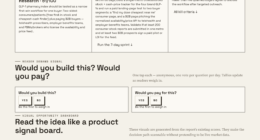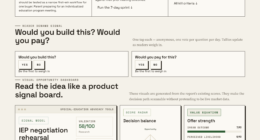

📊 Full opportunity report: How To Leverage AI For SaaS Success In A Crowded Market on ThorstenMeyerAI.com — validation score, market gap, and execution plan.

Get business pricing on monitors, keyboards and dev gear
- Business-only prices and quantity discounts
- Tax-exempt purchasing
- Multiple users, one account, clear invoices
TL;DR
AI is transforming SaaS competition by reducing switching costs and shifting the market’s focus from lock-in to agility, scaling, and model capabilities. Companies that adapt to this new frontier can maintain growth and valuation.
AI is reshaping the competitive landscape for SaaS companies, with market valuation multiples declining and the traditional advantages of lock-in eroding. This shift is driven by advancements in AI agents that make migration easier, challenging long-standing barriers to switching and redefining success criteria for SaaS firms.
According to Thorsten Meyer, AI’s ability to automate and simplify migration tasks is reducing the significance of high switching costs, which historically formed the moat for many SaaS providers. This change is evident in the market, where median SaaS valuation multiples have dropped from around 18x to 6-8x forward revenue since 2021, with AI-native SaaS companies trading at significantly higher multiples than legacy firms.
Market data indicates a bifurcation: high-growth AI-native SaaS firms command multiples of 15-40x, while slower, legacy-oriented companies trade at 2-4x. This reflects a shift in what investors value—beyond mere software presence, toward AI capability and agility. Companies like Sierra and Legora exemplify this trend, with rapid growth driven by AI-enabled workflows.
Thorsten Meyer emphasizes that the new frontier involves four key edges—understanding AI’s jagged capabilities, scaling from zero to large usage efficiently, integrating seamlessly into workflows, and exploiting AI’s ability to peel off layers of traditional systems. This landscape favors firms that innovate along these axes, rather than relying solely on lock-in or migration barriers.
SaaS’s competitive frontier — the things that actually decide winners — relocated. Companies struggling now are defending the old line while the fight moved elsewhere.
- Own the system of record
- Make switching painful
- Migration as the moat
- Compound at 85% margins
- Lock-in = durability
- Fluency with the jagged edge
- Outcome pricing, not per-seat
- Cost & clean zero-to-infinity scaling
- Proprietary workflow data
- Value of staying, not cost of leaving
Implications of AI-Driven Market Shift for SaaS Companies
This transformation matters because it redefines what constitutes competitive advantage in SaaS. Companies that continue to rely on lock-in and migration pain as their moats risk losing valuation and market share. Instead, success now hinges on AI capability, operational agility, and the ability to deliver targeted workflow improvements. Investors are increasingly valuing AI-native SaaS at higher multiples, signaling a fundamental change in industry dynamics and strategic priorities.
As an affiliate, we earn on qualifying purchases.
Evolution of SaaS Market Frontiers and AI's Role
For over two decades, SaaS firms thrived by creating high switching costs through deep integration, data gravity, and lock-in strategies. The dominant market logic was that migration was costly and risky, deterring customers from switching. However, recent advances in AI, particularly agents capable of automating migration and integration tasks, are undermining these barriers. The market's valuation shift and the emergence of AI-specific SaaS firms illustrate this evolving landscape, where agility and AI capability are now key differentiators.
"The frontier has moved. When starting and migrating are cheap, the criteria for success shift toward scalability, agility, and AI-driven workflow improvements."
— Thorsten Meyer
AI automation software for SaaS companies
As an affiliate, we earn on qualifying purchases.
As an affiliate, we earn on qualifying purchases.
Unclear Aspects of AI's Impact on SaaS Competition
It remains unclear how quickly traditional SaaS firms can adapt to this new frontier and whether AI capabilities will be sufficiently mature to fully replace legacy advantages. Additionally, the long-term durability of AI-driven differentiation and the potential for new forms of lock-in based on AI models are still developing areas of understanding.
As an affiliate, we earn on qualifying purchases.
Next Steps for SaaS Firms in an AI-Driven Market
SaaS companies should focus on integrating AI into their core offerings, understanding the jagged capabilities of current models, and developing strategies that leverage AI for workflow enhancement and scalability. Investors and acquirers will scrutinize whether firms' low churn rates are based on genuine switching costs or inertia that AI can dissolve. The industry will likely see increased M&A activity centered on AI-native capabilities and strategic repositioning.
SaaS analytics platform with AI capabilities
As an affiliate, we earn on qualifying purchases.
As an affiliate, we earn on qualifying purchases.
Key Questions
How does AI reduce switching costs in SaaS?
AI automates migration and integration tasks, making it easier and less risky for customers to switch providers, thus lowering traditional switching barriers.
Why are valuation multiples declining for legacy SaaS companies?
Investors are shifting their focus from lock-in and migration pain to AI capability, agility, and operational scalability, which benefits AI-native SaaS firms more.
Can legacy SaaS firms compete effectively in this new landscape?
Legacy firms can adapt by investing in AI capabilities and reorienting their strategies toward agility and workflow innovation, but the transition may be challenging and slow.
What are the key areas SaaS companies should focus on to succeed with AI?
Understanding AI's jagged capabilities, scaling from zero to large usage efficiently, seamless workflow integration, and exploiting AI to peel off layers of traditional systems are critical areas.
Source: ThorstenMeyerAI.com
Fall Picks
fall essentials
As an affiliate, we earn on qualifying purchases.