
📊 Full opportunity report: IEP Negotiation Practice: Why Simulation Matters For Parents on IdeaNavigator AI — validation score, market gap, and execution plan.

Get business pricing on monitors, keyboards and dev gear
- Business-only prices and quantity discounts
- Tax-exempt purchasing
- Multiple users, one account, clear invoices
TL;DR
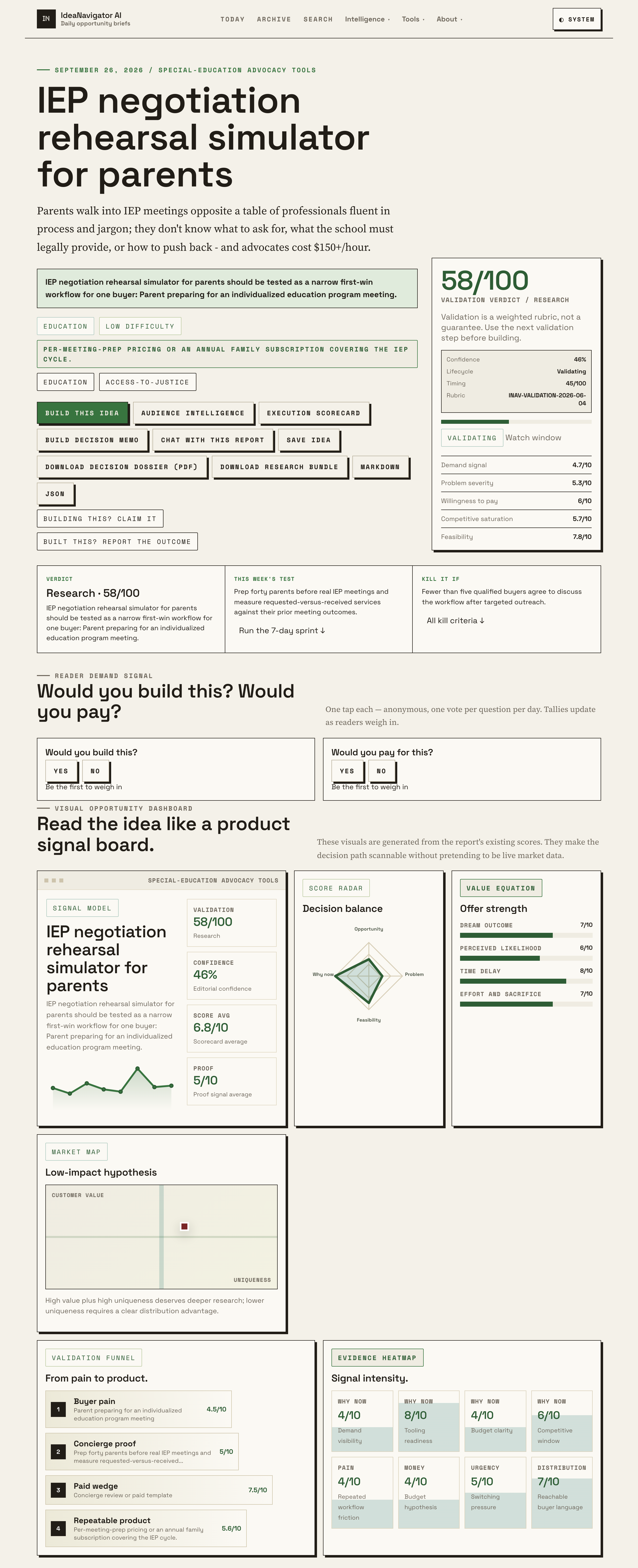
A product proposal from IdeaNavigator AI calls for building an AI-powered IEP meeting rehearsal simulator for parents, who typically face school teams alone while advocates cost $150 or more per hour. The proposal includes a concrete validation plan: prep forty parents and compare services requested versus received against their prior meetings.
A new product proposal from IdeaNavigator AI outlines an AI-driven rehearsal simulator designed to help parents practice and prepare for Individualized Education Program (IEP) meetings, using large language model role-play to simulate the negotiation before parents sit down with their child’s school team. The proposal, framed as a “narrow first-win workflow” for a single type of user — a parent preparing for an upcoming IEP meeting — includes a specific validation plan to test whether simulated practice actually changes meeting outcomes.
The problem the proposal targets is an information and power imbalance. According to IdeaNavigator AI, parents typically enter IEP meetings opposite a table of professionals who are fluent in special-education process and jargon, while the parents often do not know what to ask for, what the school is legally required to provide, or how to push back when requests are declined. Professional advocates, the proposal notes, charge $150 or more per hour, putting sustained expert support out of reach for many families.
The proposed minimum viable product works in three stages. First, a parent uploads their child’s current IEP and evaluation reports. The simulator then explains the child’s entitlements in plain language and generates a request list with legal grounding. Finally, it role-plays the meeting itself — including realistic pushback from a simulated school team — repeating until the parent can hold their positions under pressure.
The business model proposed is either per-meeting-prep pricing or an annual family subscription covering the full IEP cycle. The target market is described as special-education advocacy tools, a segment the proposal says is becoming more relevant as special-education identification rates climb while district resources tighten, making meetings more adversarial.
Why Rehearsal Could Shift IEP Outcomes
IEP meetings determine the services, accommodations, and goals a child with a disability will receive for the school year — speech therapy hours, classroom aides, extended school year services, and placement decisions among them. If a parent does not know what to request or how to respond when a district declines a service, the resulting document may reflect what the school offers by default rather than what the child needs.
The proposal’s core argument is that practice is the missing input: improved LLM role-play is now, in IdeaNavigator AI’s assessment, good enough to simulate a realistic IEP meeting, meaning parents could rehearse objections and negotiations repeatedly before the real session. If the validation plan works, it would offer a lower-cost alternative to hiring an advocate, though the proposal itself acknowledges no product has yet been built or tested.
The Rising Pressure on Special Education
The proposal situates the idea within two converging trends. First, special-education identification rates keep climbing, increasing the number of families navigating the IEP process each year. Second, district resources are tightening, which the proposal says makes meetings more adversarial as schools balance legally mandated services against budget constraints.
Against that backdrop, the existing options for parents are limited: self-education through state parent centers and advocacy guides, or paid advocates and special-education attorneys whose hourly rates the proposal cites at $150 or more. The proposed simulator would sit between those options — cheaper than an advocate, more interactive than static guides.
What the Proposal Does Not Yet Prove
The simulator is currently a product concept, not a shipping product. No build timeline, pricing figures, or launch date have been announced. The claim that LLM role-play can realistically simulate an IEP meeting is the vendor’s own assessment and has not been independently tested or peer-reviewed.
Several practical questions remain unanswered: whether an AI system can accurately interpret uploaded IEP and evaluation documents, whether its plain-language explanations of entitlements would be legally reliable across different states, and how it would handle situations where district pushback in a real meeting differs from the simulation. The proposal also does not address privacy considerations around uploading sensitive special-education records, a point any real implementation would need to resolve.
Most importantly, there is no outcome data yet. Whether rehearsed parents actually secure more services than they did in prior meetings will not be known until the proposed validation — forty parents tracked across real meetings — is actually run.
The Forty-Parent Validation Test
The proposal’s stated next step is validation: recruit forty parents ahead of real IEP meetings, prepare them using the simulator, and compare the services requested versus services received against each family’s prior meeting outcomes. That comparison would provide the first evidence of whether simulated rehearsal translates into measurably different negotiation results.
If validation succeeds, the proposal envisions expanding from a single-meeting prep tool toward a product covering the full IEP cycle under an annual subscription. No date has been set for either the build or the validation study.
Source: IdeaNavigator AI
Key Questions
Does the IEP meeting simulator exist yet?
No. It is currently a product proposal from IdeaNavigator AI. No software has been built, no launch date has been announced, and the pricing structure is only described in general terms — per-meeting prep or an annual family subscription.
How would the simulator work for a parent?
According to the proposal, a parent would upload the current IEP and evaluation reports. The tool would explain the child’s entitlements in plain language, generate a request list with legal grounding, and then role-play the meeting — including simulated pushback — until the parent can hold their positions.
How would anyone know the simulator actually helps?
The proposed validation would prepare forty parents before real IEP meetings and measure services requested versus services received, compared against each family’s prior meeting outcomes. That study has not yet been conducted.
Is this a replacement for a professional advocate or attorney?
The proposal positions it as a lower-cost alternative to advocates, who it says charge $150 or more per hour. Whether an AI rehearsal tool can substitute for professional representation is unproven, and parents facing complex disputes may still need qualified legal or advocacy help.
Why is this being proposed now?
Per the proposal, LLM role-play quality has improved enough to simulate a realistic IEP meeting, while rising special-education identification rates and tightening district resources are making IEP meetings more adversarial, increasing demand for preparation tools.
Source: IdeaNavigator AI
Fall Picks
fall essentials
As an affiliate, we earn on qualifying purchases.