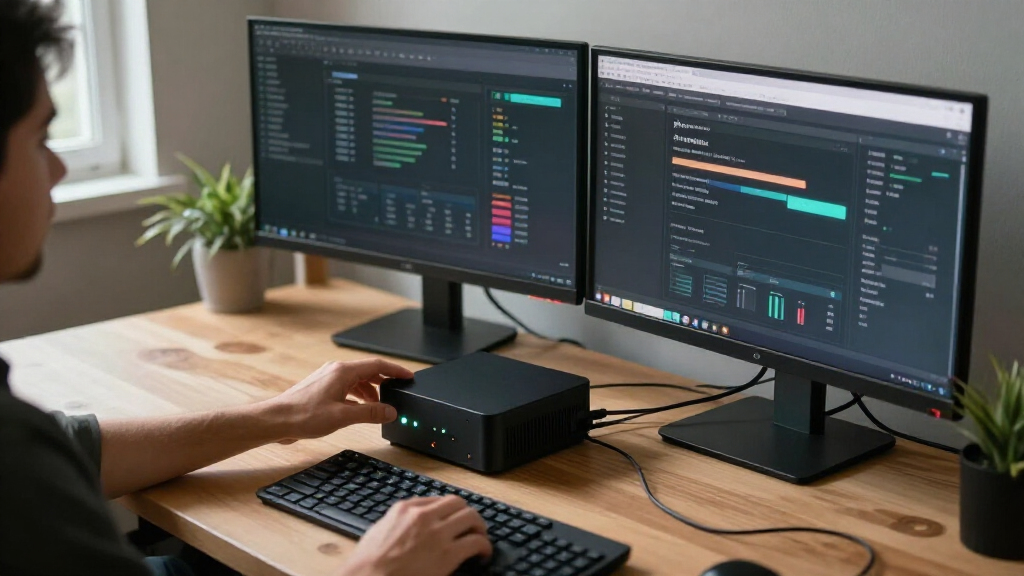
🔍 Read the full analysis: 10 Mini PCs Built For Local AI Workloads To Consider In 2027 on ThorstenMeyerAI.com

Get business pricing on monitors, keyboards and dev gear
- Business-only prices and quantity discounts
- Tax-exempt purchasing
- Multiple users, one account, clear invoices
TL;DR
ThorstenMeyerAI.com published a buyer’s guide comparing 10 mini PCs for local AI workloads. It ranks the MINISFORUM MS-S1 MAX first, citing its Ryzen AI Max+ 395 processor, 64GB of memory and 2TB SSD. The guide also names the GEEKOM A9 Max as a high-performance alternative and notes that some product listings lack configuration details. It provides no benchmark results, prices or complete specifications for every system.
ThorstenMeyerAI.com has published a comparison of 10 mini PCs for local AI workloads, ranking the MINISFORUM MS-S1 MAX first based on its listed Ryzen AI Max+ 395 processor, 64GB of memory and 2TB SSD. The guide also names the GEEKOM A9 Max as a high-performance alternative and notes that several listings lack configuration details needed for comparison.
The guide compares the systems by their listed hardware, including processors, memory, storage and everyday usability, much like this guide to AI mini PCs for on-device workloads. It highlights memory as a factor for local models and creative applications that share system resources, and says processor branding alone does not establish which workloads a machine can handle.
The MS-S1 MAX’s listed 64GB of memory and 2TB SSD are cited as features for demanding local workloads, a consideration also explored in local AI workloads on a Mac Mini. The guide says its workstation-oriented setup may be more than lighter users need. The GEEKOM A9 Max pairs a Ryzen AI 9 HX 470 with 32GB of memory. The source describes it as a balanced alternative and notes that its listed memory capacity is half that of the MINISFORUM system.
Other listings have incomplete specifications. The GMKtec EVO-X2 is listed with a Ryzen AI Max+ 395, but the source says its memory and storage details are unspecified. Two GEEKOM IT13 MAX versions are described as having different listed memory types, so the guide advises checking the exact configuration. It characterizes the GEEKOM A5, with a Ryzen 7 7730U and DDR4 memory, as suited to basic desktop work rather than heavy local AI.
The 10 picks
- 1
 MINISFORUM MS-S1 MAX Mini AI Workstation PC, Ryzen AI Max+ 395, 64GB LPDDR5x,…View on Amazon →
- 2
 GMKtec EVO-X2 AI Mini PC with AMD Ryzen AI Max+ 395View on Amazon →
- 3
 GEEKOM A9 Max Mini PC with AMD Ryzen AI 9 HX 470, 32GB DDR5 RAM, and 2TB SSDView on Amazon →
- 4
 GEEKOM IT15 Mini PC, Intel Core Ultra 9 285H, 32GB DDR5 RAM, 1TB NVMe SSDView on Amazon →
- 5
 ACEMAGIC F5A Top AI Mini PC with AMD Ryzen AI 9 HX 470View on Amazon →
- 6
 ACEMAGIC Retro X5 Mini Gaming PC with AMD Ryzen AI 9 365, 32GB RAM and 1TB SSDView on Amazon →
- 7
 GEEKOM IT13 MAX AI Mini PC 2026, Intel Ultra 9 185H, 24GB LPDDR5, 500GB SSDView on Amazon →
- 8
 GEEKOM IT13 MAX Mini PC with Intel Core Ultra 9 185H, 24GB RAM, 512GB SSDView on Amazon →
- 9
 GMKtec K17 AI Mini PC – Intel Core Ultra 5 226V, 16GB LPDDR5X, Intel Arc 130V…View on Amazon →
- 10
 GEEKOM A5 Mini PC with AMD Ryzen 7 7730U, 16GB RAM, 500GB SSDView on Amazon →
Why Memory Shapes Local AI Choices
For people running models on their own computers, a mini PC’s memory capacity can limit practical workload size, even when its processor appears capable on paper. Storage affects how much software, model data and project material can remain on the machine. These specifications provide information beyond a broad “AI PC” label when comparing compact systems.
Hardware requirements also vary by use. People mainly using cloud-based assistants may not need workstation-oriented hardware because processing takes place on remote servers. Those who want to run models locally, work offline or keep files on-device may have different requirements. The guide’s ranking reflects its assessment of listed hardware; it does not establish how a particular system will perform with a specific model or application.
Popular right now

De'Longhi Classic Signature Espresso Machine with Adjustable Milk Frother

Dyson V8 Cordless Vacuum

Breville Barista Express Espresso Machine with Built-In Grinder, Black Truffle
As an affiliate, we earn on qualifying purchases.
How the Guide Compares Ten Systems
The source says it considers listed processors, memory and SSD capacity, along with general usability and the balance between system capability and demands. It distinguishes systems positioned for AI from older or less AI-focused alternatives, rather than treating every mini PC as suited to the same workloads.
The comparison covers 10 products, but the supplied material provides detailed specification notes for only some of them. It also notes that several systems share Intel Core Ultra 9 185H hardware and that product names alone may not show differences in memory configuration. The guide recommends checking memory upgrade options, software support for processor acceleration features and storage expansion.
“The MINISFORUM MS-S1 MAX leads for demanding local workloads in this lineup, pairing a Ryzen AI Max+ 395 with 64GB memory and a 2TB SSD.”
— ThorstenMeyerAI.com guide
Specifications Buyers Still Need
The supplied source does not state the guide’s publication date, current prices, regional availability or independent benchmark results. It does not establish whether the named products will remain available in 2027 or whether every listed configuration is sold in every market. The rankings reflect the source’s assessment of listed hardware, not a controlled performance test.
Some product details remain incomplete: the GMKtec EVO-X2 listing does not specify memory or storage, and the two GEEKOM IT13 MAX versions differ in listed memory type. The source does not provide a complete specification table for all 10 picks. It also does not confirm which local AI models or software packages each machine supports, or whether memory is upgradeable in every configuration.
Check Configurations Before Buying
Buyers should verify the exact model number and installed configuration with the retailer or manufacturer, including memory type, capacity and upgrade options. They should also confirm SSD capacity and expansion, operating-system and driver support, and the requirements of the AI software they plan to run.
Any purchase decision for 2027 will depend on current availability, pricing and product specifications, which the source does not establish. A comparison using current prices and workload-specific benchmarks could assess how the listed hardware performs with particular local models.
Key Questions
Which mini PC does the guide rank first?
ThorstenMeyerAI.com names the MINISFORUM MS-S1 MAX its best overall choice for demanding local workloads, citing its Ryzen AI Max+ 395, 64GB of memory and 2TB SSD.
What makes the GEEKOM A9 Max an alternative?
The guide describes the GEEKOM A9 Max as a more balanced high-performance option. Its listed configuration includes a Ryzen AI 9 HX 470 and 32GB of memory, compared with 64GB listed for the MS-S1 MAX.
Does a mini PC with an AI-capable processor guarantee good local AI performance?
No. The guide says processor names alone do not show whether a workload will run well. Memory capacity, software compatibility, drivers and workload requirements also matter, and the supplied material provides no benchmark results.
What should buyers verify before choosing one of these systems?
Check the exact configuration, including installed memory, memory type and upgradeability, SSD capacity and expansion options. Confirm that the operating system and software support the hardware, and compare those details with the requirements of the models or applications you intend to use.
Source: ThorstenMeyerAI.com