
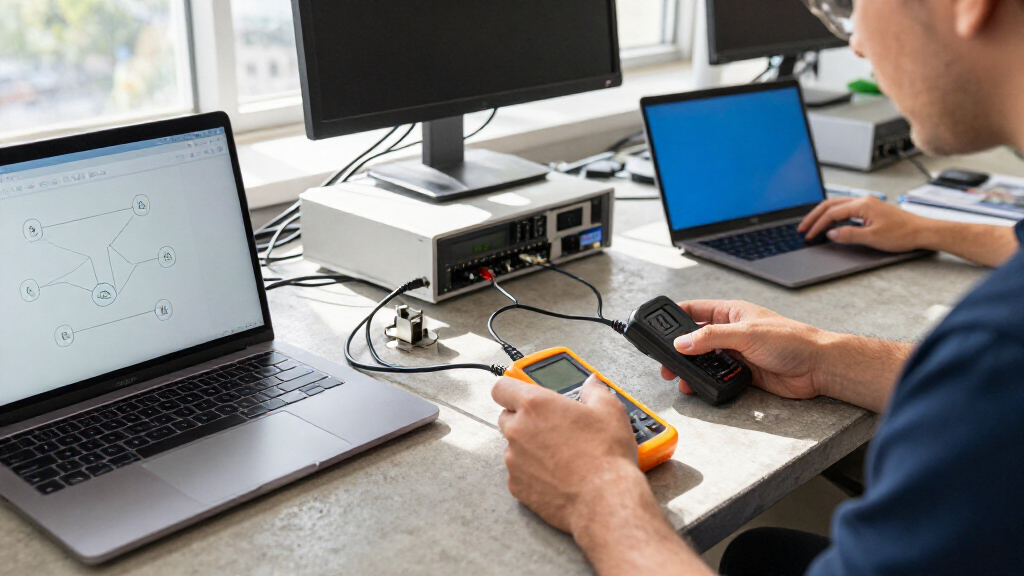
This checklist is for developers, QA teams, and hands-on troubleshooters choosing gear for network testing. It covers connection options across wired and wireless setups, with a separate advice-only slot for a portable tester.

Get business pricing on monitors, keyboards and dev gear
- Business-only prices and quantity discounts
- Tax-exempt purchasing
- Multiple users, one account, clear invoices
The sections follow the requested checklist slots: adapters, a managed switch, an access point, a tester, and a loopback plug. Each product pick is shown in its assigned slot, even where its name may suggest a different use than the slot heading.
Use the notes to compare the job each item needs to do with its connections, supported standards, and physical setup. Check compatibility first against your computer, network equipment, and test workflow; confirm the exact product specifications before buying.
USB Ethernet Adapter
A USB Ethernet adapter slot is meant to address a practical need: connecting a computer to a wired network when its available ports do not match the test setup. For development and QA work, that connection may be part of a repeatable workflow, so first identify the computer’s ports, operating system, and the network connection required. Check whether the device name and specifications actually describe the function you need. The listed pick is called a USB 3.0 HDMI Video Capture Card with USB-C Adapter; its name identifies a video capture card, so do not assume it provides Ethernet just because this checklist slot is for an adapter.
Common buying mistakes include choosing by connector shape alone, overlooking the host-side connection, or assuming a product supports a particular network speed or operating system without checking. Compare the manufacturer’s specification details with your computer and the Ethernet connection you intend to test. If the goal is Ethernet connectivity, confirm that the product explicitly provides an Ethernet port and the required function. Also consider how the adapter will fit into the desk or portable setup, including clearance around neighboring ports and any cable strain. Verify the actual function before treating this pick as a USB Ethernet adapter.
What to look for:
- A product explicitly specified as a USB Ethernet adapter
- Host connector compatible with the computer
- Operating-system support for the intended test machine
- Ethernet port and network capability matching the setup
- Physical clearance and cable fit at the computer
USB 3.0 HDMI Video Capture Card with USB-C Adapter
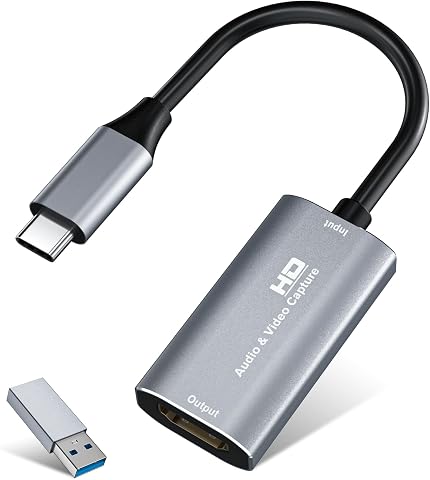
Captures HDMI video with up to 4K at 30Hz input and records at up to 2K at 30Hz or 1080p at 60Hz. Its compact aluminum alloy body supports plug-and-play use without external power and works with Windows, macOS, Linux, and Android devices and common streaming software.
Pros:
- Supports 4K at 30Hz HDMI input and capture up to 1080p at 60Hz.
- Compact aluminum alloy design for portability and heat dissipation.
- Plug-and-play operation without external power.
- Compatible with multiple operating systems, devices, and streaming applications.
Cons:
- Recording is limited to 2K at 30Hz or 1080p at 60Hz.
- Tablet use may require enabling OTG.
Best for: Shoppers checking whether this named capture card meets an Ethernet need
Not ideal for: Anyone who needs a confirmed Ethernet adapter without further specification checks
Bottom line: The product name identifies a video capture card, so verify that it provides Ethernet before using it for this slot.
Managed Network Switch
A managed switch can be an important part of a development test setup when the workflow calls for configuring network connections. The right choice depends on the devices to connect, the management features needed, and the link types required. The listed pick is the Ubiquiti UniFi Switch Enterprise 8-Port Gigabit and 2.5G PoE+ Managed. Its name supplies several points to investigate, including the port count, listed link types, PoE+ wording, and managed designation. Treat those as prompts to confirm the detailed specifications, not as a substitute for checking what your equipment requires.
A common mistake is buying based on a headline feature and then discovering that a specific device, cable, or management workflow does not fit the setup. Make a list of the devices that will connect at the same time, which connections need power, and the link capability each endpoint requires. Check the switch’s management method and compatibility against the network environment you plan to use. Confirm the exact port capabilities and whether the product’s full specification matches the intended configuration. Consider where it will sit, how its ports will be reached, and whether the existing cables fit the plan. Map every connection before deciding that the switch is a match.
What to look for:
- Enough ports for the devices connected at once
- Link capabilities matching each endpoint
- PoE+ requirements and compatibility for powered devices
- Management features suited to the intended workflow
- Physical placement and compatible cabling
Ubiquiti UniFi Switch Enterprise 8-Port Gigabit and 2.5G PoE+ Managed Switch

The Ubiquiti UniFi Switch Enterprise 8-PoE is a managed network switch featuring eight ports with support for both Gigabit and 2.5G speeds. It provides PoE+ power delivery and SFP+ uplinks, housed in a durable metal case suitable for enterprise networking environments.
Pros:
- Supports high-speed 2.5G and Gigabit connections
- Includes PoE+ for powering devices over Ethernet
- Durable metal construction suitable for enterprise use
- Managed switch capabilities for advanced network control
Cons:
- Limited to 8 ports, which may not suit larger networks
- Requires specific UniFi software ecosystem for full management
Best for: Teams comparing managed switching needs with the listed port and link details
Not ideal for: Setups whose device or management requirements have not been checked
Bottom line: Confirm the full port, management, and power specifications against every device in your setup.
WiFi 6 Access Point
An access point slot matters when a test workflow needs a wireless network component. Start by defining where it will be used, what devices must connect, and which wireless features the test actually requires. The listed pick is the WAVLINK AX3000 Outdoor WiFi 6 Extender and Access Point. Its name describes it as an outdoor WiFi 6 extender and access point, so review the manufacturer’s specifications to determine which operating modes and installation requirements apply to your intended use. Do not assume that a product name alone confirms coverage, compatibility, or a particular result in your environment.
Common mistakes include selecting an access point without checking whether its mode suits the network, overlooking how it will connect to the rest of the setup, or assuming the intended placement is supported without reviewing installation details. Check the requirements of the wired network connection, the client devices, and any management workflow involved. If the test is indoors, verify that the product’s installation and use specifications suit that location; if outdoors, review the stated environmental and mounting requirements. Compare the capabilities you need with the published details, and account for where power and network cabling will reach. Match the mode and placement to the test before buying.
What to look for:
- Access point mode and other modes stated in the specifications
- WiFi compatibility required by client devices
- Network connection and power requirements
- Installation and placement details for the intended location
- Management options that fit the test workflow
WAVLINK AX3000 Outdoor WiFi 6 Extender and Access Point

This dual-band outdoor WiFi device supports speeds up to 2402 Mbps on 5 GHz and 573 Mbps on 2.4 GHz, with six omnidirectional antennas and two built-in amplifiers. Its IP67-rated enclosure, mesh support, multiple operating modes, and compatibility with active or passive PoE suit indoor or outdoor network setups.
Pros:
- Supports dual-band WiFi 6 speeds up to 3000 Mbps
- IP67-rated enclosure for outdoor use
- Offers mesh and several other operating modes
- Supports active and passive PoE
Cons:
- The PoE converter is not waterproof
- The listed wireless compatibility does not include 802.11ax
Best for: Buyers evaluating an outdoor WiFi 6 extender and access point for a defined setup
Not ideal for: Anyone who has not confirmed placement, mode, and network requirements
Bottom line: Verify the product’s supported mode and installation details for the place and workflow you intend.
Portable Network Tester
A portable network tester can make sense when troubleshooting or QA work moves between locations, but this slot has no specific product pick. Choose based on the tests you need to perform, the connections involved, and the information you need to capture. Write down the actual tasks first: for example, whether you need to inspect a wired connection, a wireless environment, or both. Then check that a candidate’s specifications explicitly cover those tasks. Avoid relying on a broad label such as “network tester” to establish what it can measure or report.
Common buying mistakes include paying for functions the workflow will not use, overlooking connector compatibility, and assuming that a compact device supports a particular test. Check how the tester connects to the networks and devices in your setup, what outputs or reports it provides, and whether its operating instructions fit the users who will carry it. For portability, assess the physical size, power approach, and how it can be stored with the cables or accessories needed for the task. Confirm that the published documentation covers your intended scenarios. Define the test list first, then compare candidate devices against it rather than choosing from a name alone.
What to look for:
- Explicit support for each test in your workflow
- Connectors compatible with the networks and devices involved
- Clear outputs or reports for the intended users
- Power and portability suited to field use
- Documentation covering the required scenarios
USB WiFi Adapter
A USB WiFi adapter may be useful when a computer needs a wireless connection for a test, but the host device and the required wireless features determine whether a particular model fits. The listed pick is the TP-Link 2-in-1 USB Bluetooth WiFi Adapter Archer TX10UB Nano AX900 WiF. Its name mentions both Bluetooth and WiFi, as well as AX900; confirm the complete product specification and the capabilities required by the test before relying on those labels. Check the computer’s USB ports and operating-system support alongside the wireless requirements of the network and client devices.
Common mistakes include assuming that a wireless adapter will work with every operating system, overlooking the needed USB connection, or expecting a product to support a wireless mode that is not documented. Compare the adapter’s published capabilities with the network bands and standards your workflow requires. Consider whether the adapter’s physical size and placement will work with nearby ports and the computer’s location during testing. If Bluetooth is relevant, confirm that the documented Bluetooth support matches the device and test task; do not infer a particular version or capability from “2-in-1.” Check the full specification against the host computer and the wireless scenario before buying.
What to look for:
- Operating-system support for the test computer
- USB connector compatibility and physical port clearance
- WiFi standards and bands required by the network
- Bluetooth capability if the workflow needs it
- Complete product specification matching the intended test
TP-Link 2-in-1 USB Bluetooth WiFi Adapter Archer TX10UB Nano AX900 WiFi 6 BT 5.3

The TP-Link Archer TX10UB Nano is a compact dual-function USB adapter that provides high-speed WiFi 6 and Bluetooth 5.3 connectivity for desktop PCs. It supports dual-band WiFi up to 900 Mbps, MU-MIMO, OFDMA, and WPA3 security, ensuring reliable and secure wireless connections.
Pros:
- Compact and discreet design for a clutter-free setup
- Supports high-speed dual-band WiFi 6 with MU-MIMO and OFDMA
- Enhanced security with WPA3 protocol
- Easy plug-and-play installation
Cons:
- Bluetooth function is not compatible with Mac, Linux, TV, or Windows Vista/8/7
- Requires disabling internal Bluetooth or WiFi to avoid conflicts
- Bluetooth is for PC use only and not compatible with gaming consoles
Best for: Buyers comparing a USB WiFi and Bluetooth adapter with documented test needs
Not ideal for: Anyone assuming the name confirms operating-system or network support
Bottom line: Check the adapter’s full specifications against the host computer and wireless test requirements.
Ethernet Loopback Plug
An Ethernet loopback plug is intended for a particular kind of connection check, so it is important to confirm that a candidate is actually described and specified for that function. The listed pick is an Ethernet Surge Protector with Inline Plug-in Design. Its name identifies a surge protector, not a loopback plug. Do not assume it can create a loopback or perform a tester’s function based on its Ethernet connector or inline design. Decide what check you need to perform and verify that the product’s documentation explicitly supports it.
Common buying mistakes include confusing products that share a connector, assuming that inline means loopback, or relying on a product title instead of its stated purpose. For a loopback task, look for a product explicitly identified as an Ethernet loopback plug and confirm the connection type and use instructions match your equipment. If you are evaluating the listed surge protector for its own purpose, check its specifications and compatibility independently; this checklist slot does not establish those details. Consider whether the plug will fit the relevant port and how it will be used alongside the rest of the test setup. Confirm the intended function before using this pick for a loopback check.
What to look for:
- A product explicitly specified as an Ethernet loopback plug
- Connection type compatible with the equipment
- Instructions describing the intended loopback use
- Clear distinction between surge protection and loopback functions
- Physical fit with the port and test setup
Ethernet Surge Protector with Inline Plug-in Design

This Ethernet surge protector complies with IEC 61000-4-5 standards and supports data rates of 100/1000Mbps. It provides protection for multiple pairs of Ethernet lines, ensuring network safety against power surges.
Pros:
- Complies with industry surge protection standards
- Supports high data transfer rates
- Protects multiple Ethernet line pairs
Cons:
- Limited information on durability or lifespan
- No mention of compatibility with specific devices
Best for: Shoppers checking whether this inline Ethernet product supports loopback testing
Not ideal for: Anyone needing a confirmed loopback plug without further specification checks
Bottom line: The product name identifies a surge protector, so confirm loopback support before using it for this slot.
Buy in a budget-first order by setting a spending limit, then prioritize the items tied to immediate test tasks: confirm the required computer connections, network configuration, wireless needs, and any portable tests. Compare complete specifications and compatibility before choosing among products, and defer items that do not support a current workflow. Prioritize the required function for each slot over a broad product label.
A thoughtful checklist can keep a gear purchase focused on the work your team actually does. Confirm the details, match each item to its connection and test role, and adjust the list as the setup changes. One verified fit at a time is a solid way to build a useful testing kit.