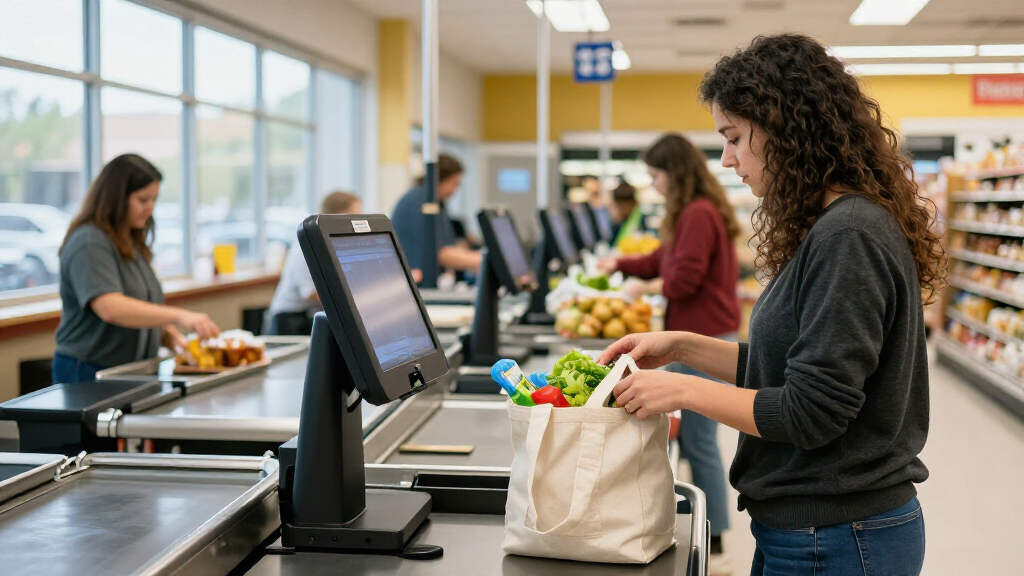
🔍 Read the full analysis: Self-Checkout And Kiosks Move Tasks To The Customer on ThorstenMeyerAI.com

Get business pricing on monitors, keyboards and dev gear
- Business-only prices and quantity discounts
- Tax-exempt purchasing
- Multiple users, one account, clear invoices
TL;DR
Self-checkout and self-service kiosks shift tasks such as selecting, scanning and bagging items from store employees to customers. U.S. cashier employment was about 3.1 million in 2025, and the Bureau of Labor Statistics projects a further 6% decline by 2035, though retailers’ use of self-checkout varies by market and some have pulled back.
Self-checkout has shifted scanning and bagging work from store employees to customers, and U.S. cashier employment is projected to fall further, according to Bureau of Labor Statistics figures cited in a November 26 report by ThorstenMeyerAI.com. The BLS counted about 3.1 million cashiers in 2025 and projects a 6% decline in cashier jobs between 2025 and 2035, while retailers in some markets are expanding self-service and others are scaling it back.
The report traces customer-operated retail back to Piggly Wiggly, which opened in Memphis in 1916. Its founder, Clarence Saunders, patented a store layout in which shoppers selected goods from shelves and brought them to a checking station. Staff still handled the checkout, but customers took over the earlier task of having clerks fetch products. Self-service, in this account, predates computer-based automation by decades.
Barcode technology later made automated scanning possible. GS1, the organization that manages the barcode system, identifies a ten-pack of Juicy Fruit gum scanned on June 26, 1974, at a Marsh supermarket in Troy, Ohio, as the first product scanned with a barcode. In 1984, David R. Humble and colleagues filed a patent for a self-service checkout system. The design had shoppers scan items while a scale checked their weight; the patent’s process still sent shoppers to a cashier to pay.
The employment figures show both a decline and the continued scale of the occupation. The BLS counted 3,596,630 cashiers in May 2019 and 3,089,410 in May 2025 in its Occupational Employment and Wage Statistics survey. Separately, the agency’s Occupational Outlook Handbook lists 3,106,300 cashier jobs in 2025 and projects a 6% reduction, or about 200,600 fewer jobs, by 2035. Those totals come from different BLS measures and should not be treated as identical series.
Infographic 01 · A short history of self-service
From the clerk to the customer, 1916 to today
Each step moved a piece of the work across the counter: first fetching the goods, then reading the price, then scanning and ordering.
How the customer took over the clerk's work
- Before 1916: a clerk fetched, weighed and wrapped every item at the counter.
- 1916, Piggly Wiggly (Memphis): shoppers take the goods off the shelves themselves and pass a checking station to pay. Clarence Saunders files his patent on 21 October 1916.
- 26 June 1974, Troy, Ohio: a ten-pack of Juicy Fruit gum is the first product scanned with a barcode. A machine now reads the price.
- 9 July 1984: David R. Humble and two colleagues file the CheckRobot patent: the shopper scans, a scale checks the weight, a tunnel stops unscanned items. Payment still goes to a cashier.
- From 1986: CheckRobot machines in several Kroger supermarkets, as reported by CNN (2022).
- 2018: McDonald’s has kiosks in nearly 17,000 restaurants; in France, Italy and Spain well over half of in-restaurant orders go through them (company filing).
Sources differ on the exact opening day of the first Piggly Wiggly (6 or 11 September 1916). The Kroger installation is reported second-hand; we did not retrieve the 1987 newspaper original.
Sources: C. Saunders, US Patent 1,242,872 (1916/17); Tennessee Encyclopedia; GS1 Belgium & Luxembourg; Humble et al., US Patent 4,676,343 (1984/87); CNN (2022); McDonald's Form 10-K 2018.
Powered by Thorsten Meyer AI
Who Performs the Checkout Work
The change is not simply that a machine replaces a cashier. In self-checkout, customers take on scanning, bagging and parts of the payment process, while employees may supervise several stations or assist when something goes wrong. The BLS described that transfer directly in a January 2026 review of its previous projection round: “Self-checkout reduces the need for labor because the main task of scanning and bagging items is transferred to the customer.”
For shoppers, the shift can change how quickly and easily they complete a purchase, particularly when a kiosk needs staff assistance or a customer has accessibility or payment needs. For workers, the trend contributes to uncertainty around cashier roles, although the projected decline does not mean the job is disappearing: the BLS still counts more than three million cashier jobs. For retailers, self-service can reduce staffing needs, but decisions about whether to keep or remove stations also reflect service, losses and checkout speed.
Popular right now

LG 77-Inch OLED evo C5 Series Smart TV (2025)

Hisense 75-Inch E6SR Series Hi-QLED 4K UHD Smart Roku TV (2026 Model)

Dyson V15s Detect Submarine Wet and Dry Vacuum, Yellow/Nickel
As an affiliate, we earn on qualifying purchases.
From Store Aisles to Self-Scanning
Self-service began as a change in store layout, not a machine. The Tennessee Encyclopedia says Saunders’s Piggly Wiggly stores let shoppers select goods placed within easy reach rather than asking clerks to retrieve them. His 1916 patent described guiding customers through the assortment to a station where goods could be checked and paid for. The arrangement moved one part of retail work to the buyer while leaving other tasks with store staff.
Automated checkout arrived much later. After barcode scanning became practical, the 1984 self-service distribution system patent proposed letting shoppers scan their own purchases. CNN reported in 2022 that CheckRobot systems were installed in several Kroger supermarkets, with machines introduced in 1986. The report places the current debate within that longer history: retail technology has repeatedly reorganized tasks, but adoption and the division of work have changed over time.
Retailers have not followed a single path. The source report says Booths in England, Dollar General and Target in the United States pulled back from self-checkout between 2023 and 2024, citing concerns including service, losses and speed. It also reports continued adoption in Germany and Japan, including a mix of fully self-service and hybrid checkout systems. These examples indicate different market choices, not a universal reversal or expansion.
“Self-checkout reduces the need for labor because the main task of scanning and bagging items is transferred to the customer.”
— U.S. Bureau of Labor Statistics, January 2026 review of its previous employment projections
How Retailers Will Settle the Balance
The employment projections do not establish how much of the expected cashier decline will result from self-checkout alone. The BLS names both self-service checkout and rising online sales among the factors behind its outlook; the cited figures do not isolate each cause or account for every change in retail work. The 2019 and 2025 employment counts also span a period that included the pandemic and growth in online shopping, so the comparison cannot by itself show what self-checkout caused.
It is also unclear from the source material how quickly retailers will adopt or withdraw customer-operated stations across regions, or how much the balance between self-checkout, staffed lanes and hybrid systems will change. The examples from the United States, England, Germany and Japan are not a common, standardized measure of adoption. Nor do the figures establish what share of cashier tasks will shift to other employees, new roles or customers.
Cashier Projections Through 2035
The next major benchmark in the BLS outlook is its 2025–2035 projection period. The agency expects cashier employment to decline 6%, or about 200,600 jobs, over those years, citing self-service checkout and increasing online sales. That is a forecast, not a count of jobs already lost, and future employment data will show whether the projection tracks actual changes.
Retailers’ decisions will also shape how the shift affects customers and workers. Some may add or retain self-checkout stations, while others may favor staffed or hybrid lanes if service, losses or speed remain concerns. The source report provides no new company announcements or implementation timetable. For now, the confirmed picture is a large cashier workforce, a projected decline and a retail model in which customers already perform more of the checkout process themselves.
Key Questions
How many cashiers were employed in the United States in 2025?
The source report cites two BLS measures: 3,089,410 cashiers in May 2025 in the Occupational Employment and Wage Statistics survey, and 3,106,300 cashier jobs in the Occupational Outlook Handbook. They are different measures, so the figures are close but not interchangeable.
How much does the BLS expect cashier employment to decline?
The BLS projects a 6% decline from 2025 to 2035, equivalent to about 200,600 fewer cashier jobs. The agency cites self-service checkout and increasing online sales; the projection does not attribute the entire change to kiosks.
When did self-checkout begin?
The source report traces the self-checkout patent to 1984, with machines introduced at supermarkets in 1986, according to its account of CNN reporting. Customer self-service in stores is older: Piggly Wiggly opened in 1916, allowing shoppers to select goods themselves while staff still handled checkout.
Are retailers getting rid of self-checkout?
Not across the board. The report says some retailers in England and the United States pulled back between 2023 and 2024, while adoption continued in Germany and Japan. The examples show differing decisions, not a single global trend.
Source: ThorstenMeyerAI.com