If you’re a statistics student, you definitely need a dedicated GPU. It’ll boost your data processing capabilities and speed up complex computations, letting you focus on interpreting your results. With significant reductions in analysis time, you can tackle large datasets and experiment with different models more effectively. Plus, mastering GPU tools can give you a competitive edge in the job market. There’s so much more to explore about how GPUs can enhance your studies and career.
Key Takeaways
- A dedicated GPU significantly speeds up data processing, allowing statistics students to focus on analysis rather than waiting for computations.
- For large datasets, GPUs perform multiple computations simultaneously, enhancing computational efficiency and facilitating quicker insights.
- In machine learning, GPUs accelerate the training of models, enabling faster iterations and exploration of complex algorithms.
- Mastery of GPU tools can improve academic performance, leading to better project outcomes and higher grades.
- Familiarity with GPU technologies is increasingly sought after by employers in data analysis and data science fields.
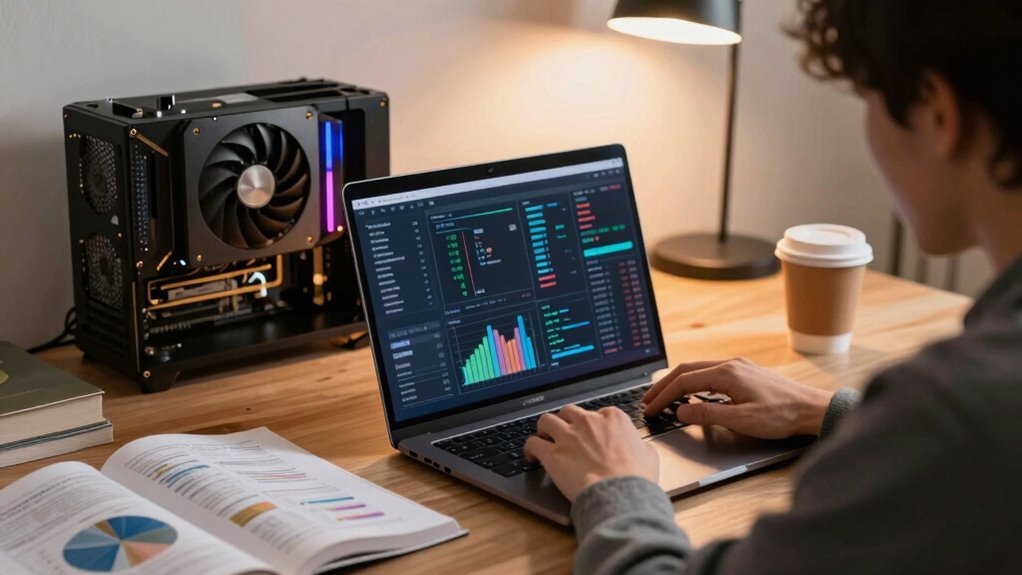
As you immerse yourself in the world of statistics, you might wonder how GPUs can enhance your learning experience. Graphics Processing Units, or GPUs, are not just for gaming; they play a vital role in data processing, especially in the field of statistics. If you’re diving into complex statistical models or machine learning algorithms, having a dedicated GPU can greatly boost your capabilities.
Imagine you’re tackling a large dataset for a project. Processing that data on a standard CPU could take ages, leaving you frustrated and overwhelmed. A dedicated GPU, however, can handle multiple computations simultaneously, drastically reducing the time it takes to analyze your data. This computational efficiency allows you to focus on interpreting results rather than waiting for them to generate. You’ll find that you can experiment more freely with different models and approaches, enhancing your understanding of statistical concepts.
Moreover, if you’re delving into machine learning, a GPU becomes even more indispensable. Training machine learning models often involves processing vast amounts of data, and GPUs excel in this area. They can greatly speed up the training process, allowing you to iterate faster and refine your models more efficiently. This means you can explore more complex algorithms without worrying about the time constraints typically associated with CPU processing. The quicker you can run simulations, the more you can learn and apply your knowledge to real-world problems. Additionally, understanding parallel processing concepts can deepen your grasp of how GPUs accelerate data analysis, making your skills even more valuable. Recognizing the importance of hardware acceleration can help you better optimize your workflow and improve your project outcomes.
In terms of academic performance, using a GPU can be a game changer. The ability to process data quickly and accurately can lead to better project outcomes and deeper insights. You’ll find that your capacity to engage with advanced statistical techniques increases, which can reflect positively in your grades. Additionally, mastering these tools early on could give you a competitive edge in the job market. Employers often seek candidates proficient in data analysis and machine learning, and familiarity with GPUs will certainly set you apart. Understanding how AI technologies integrate with statistical tools can further enhance your skill set and open new career opportunities. Furthermore, exploring GPU-accelerated software solutions can help you optimize your workflow and achieve more precise results efficiently.
Frequently Asked Questions
Can a Laptop Suffice for Statistics Work Without a GPU?
Yes, a laptop can suffice for statistics work without a dedicated GPU. If you’re mainly focusing on data processing and basic analysis, most modern laptops handle these tasks well. However, for large datasets or complex models, you might notice a drop in computational efficiency. In such cases, a dedicated GPU could considerably speed up your work. Ultimately, it depends on the complexity of your statistical tasks and data size.
What Software Benefits Most From a Dedicated GPU?
If you think about how a painter needs quality brushes, you’ll see how software like TensorFlow and Tableau benefits from a dedicated GPU. These tools enhance data visualization and machine learning tasks, making processes faster and more efficient. When you’re working with large datasets or complex models, a dedicated GPU helps you visualize results quickly and run algorithms seamlessly. So, investing in one could elevate your analytical work considerably.
How Much Does a Dedicated GPU Typically Cost?
A dedicated GPU typically costs anywhere from $150 to over $1,500, depending on the model and performance level. You’ll find budget options around $200 that can handle basic tasks, while high-end models can skyrocket in price. Keep an eye on GPU pricing trends, as they fluctuate based on demand and availability. If you’re on a tight budget, consider timing your purchase during sales or looking for used options to save money.
Are Integrated GPUS Sufficient for Basic Statistical Analysis?
If you’re driving a compact car on a smooth road, you probably won’t miss a sports car’s speed. Similarly, integrated GPUs often handle basic statistical analysis just fine. For tasks like data processing and simple models, their performance is usually sufficient. However, if you find yourself juggling larger datasets or complex algorithms, a dedicated GPU could greatly enhance your efficiency, making that performance comparison an essential factor for your studies.
What Are the Signs That I Need a Dedicated GPU?
You’ll know you need a dedicated GPU if your data visualization tasks lag or require long render times. If you’re diving into machine learning and notice slow model training or performance issues, that’s another sign. When your projects demand more graphical power for complex computations, an integrated GPU might not cut it. Upgrading can greatly enhance your efficiency and allow you to tackle more demanding statistical analyses seamlessly.
Conclusion
So, do statistics students need a dedicated GPU? Absolutely! Without one, you might as well be trying to catch lightning in a bottle! Imagine your data analysis crawling at a snail’s pace while your friends are zooming ahead with their powerful machines. A dedicated GPU isn’t just a luxury; it’s your golden ticket to statistical stardom! Embrace the speed, release the power, and watch your data dance like never before. Don’t settle for less—your stats deserve the best!