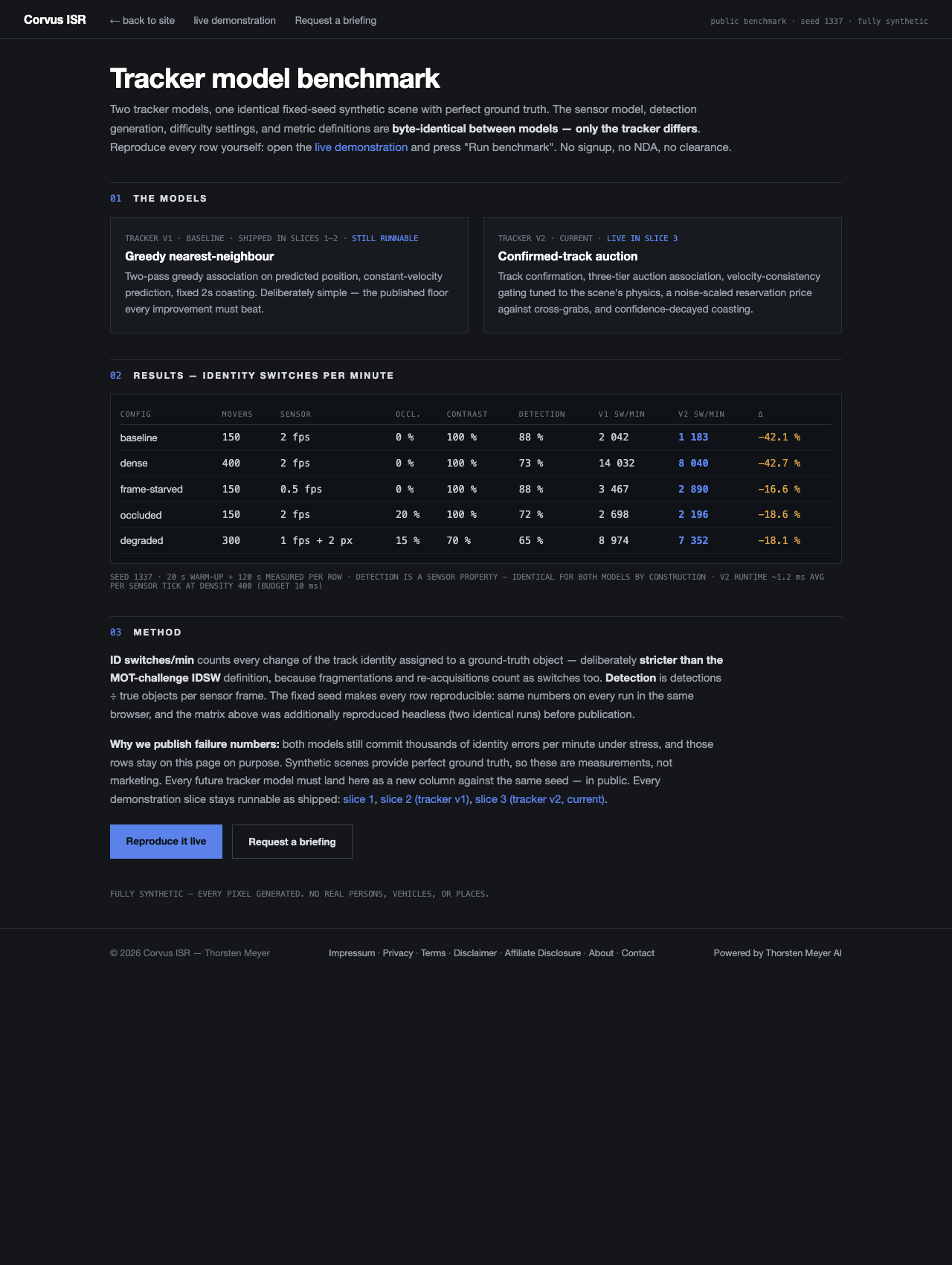
Corvus ISR has released a comprehensive public tracker benchmark that evaluates its two tracker models on an identical synthetic scene with perfect ground truth. This benchmark uses a fixed seed (seed 1337) with a 20-second warm-up and 120 seconds of measurement per row, ensuring byte-identical sensor modeling, detection generation, and metric definitions. Such meticulous setup underscores the importance of reproducibility in software testing, especially for complex tracking algorithms.

Get business pricing on monitors, keyboards and dev gear
- Business-only prices and quantity discounts
- Tax-exempt purchasing
- Multiple users, one account, clear invoices
The two models compared are v1, the “greedy nearest-neighbour” baseline, and v2, the current “confirmed-track auction”. The baseline employs a two-pass greedy association with constant-velocity prediction and fixed 2-second coasting, serving as a deliberate published floor. The newer v2 incorporates advanced features like track confirmation, three-tier auction association, velocity-consistency gating, noise-scaled reservation price, and confidence-decayed coasting. These enhancements aim to reduce identity errors while maintaining real-time performance.
Results clearly show the value of the upgrades: for 150 movers at 2fps, ID switches per minute dropped from 2,042 to 1,183, a remarkable 42.1% reduction. In a dense scenario with 400 movers, switches decreased from 14,032 to 8,040, a 42.7% improvement. Under challenging conditions such as frame starvation (0.5fps), occlusion (20%), and degraded image quality (1fps + jitter, 70% contrast), the model still achieved notable reductions of approximately 18%. The detection rate remains constant for both models, as it is a sensor property.
One of the key strengths of this benchmark is its strict metric honesty. The ID-switch metric counts every change of an object’s assigned identity, including fragmentations and re-acquisitions, making it more rigorous than standard MOT challenge definitions. This ensures that every reported failure is a genuine measure of tracking performance, not an artifact of lenient metrics. Corvus ISR publishes these failure numbers deliberately, emphasizing transparency over marketing hype, and providing clear data on current limitations.
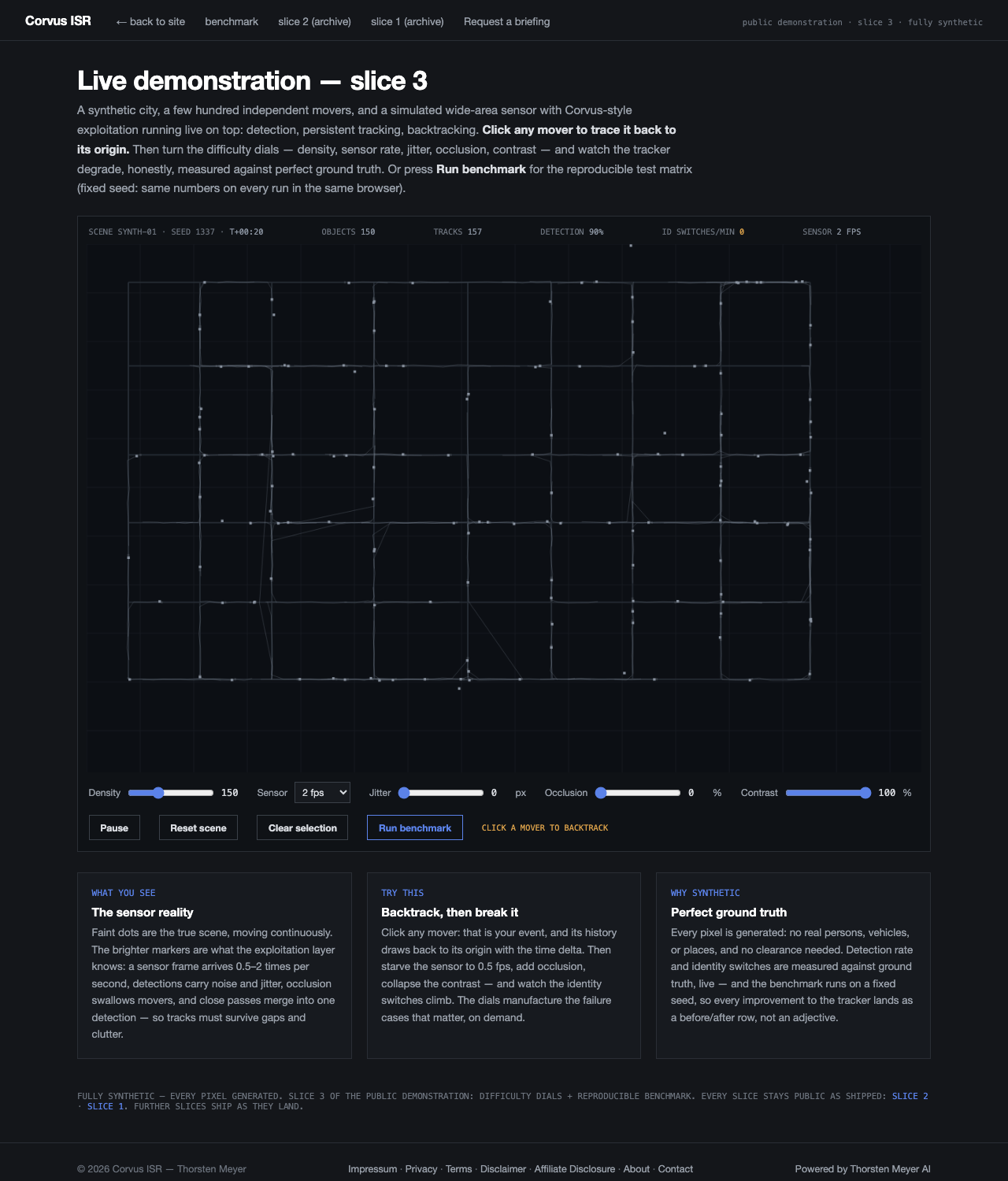
From an engineering perspective, v2 achieves an average processing time of approximately 1.2ms per sensor tick at 400 density, with a worst-case of about 5ms against a 10ms processing budget — demonstrating real-time capability in a browser environment. The entire test harness is built on a fixed-seed, byte-identical reproducibility framework, allowing anyone to verify the results. You can run the same benchmark yourself by visiting the demo page and clicking “Run benchmark” — no signup, no NDA required.
The development process for v2 was guided by an AI executor operating against a written acceptance contract and was independently reviewed before release. This rigorous approach ensures that every aspect of the tracker is documented and verifiable, emphasizing the importance of disciplined engineering and test integrity. Every pixel generated in this synthetic scene is artificial, making the benchmark a fully controlled environment for objective evaluation.
If you are interested in the cutting edge of tracking technology and rigorous testing standards, explore the results yourself. Corvus ISR’s open benchmark invites you to review the published data and reproduce it live. Experience firsthand how the latest models perform under strict, synthetic conditions and see the transparent progress in tracking performance for yourself.
real-time object tracker software
As an affiliate, we earn on qualifying purchases.
As an affiliate, we earn on qualifying purchases.
synthetic scene benchmarking tools
As an affiliate, we earn on qualifying purchases.
As an affiliate, we earn on qualifying purchases.
video tracking and analysis software
As an affiliate, we earn on qualifying purchases.
As an affiliate, we earn on qualifying purchases.
As an affiliate, we earn on qualifying purchases.
Fall Picks
fall essentials
As an affiliate, we earn on qualifying purchases.