
🔍 Read the full analysis: 15 AI Automation Tools That May Suit Your Small Business In 2027 on ThorstenMeyerAI.com

Get business pricing on monitors, keyboards and dev gear
- Business-only prices and quantity discounts
- Tax-exempt purchasing
- Multiple users, one account, clear invoices
TL;DR
A ThorstenMeyerAI.com roundup compares 15 books intended to help small-business owners learn about AI automation. It describes them as learning resources, not software platforms, and says the best fit depends on a business’s workflow needs, technical confidence and existing apps.
ThorstenMeyerAI.com has published a 15-title roundup of books for small-business owners exploring AI automation, comparing guides by their stated focus rather than by tested software features. The site says the books are learning resources, not automation platforms, so readers will still need to select, configure and supervise the tools that carry out any workflows.
The roundup names AI Automation for Small Businesses: A Practical Guide to Automating Marketing, Sales, Customer Service, Operations, and Everyday Work as its best overall pick, based on the title’s broad functional scope. It presents AI Automation Made Simple for Small Business as a possible beginner path because its title emphasizes no-code workflows, and ChatGPT for Business: The 10X Playbook as a source of workflow ideas that readers may adapt. For more guidance on selecting software, see how to compare AI automation software.
The source says its comparison covers 15 books as business learning resources, not working AI software. Its ranking relies on titles, stated audiences, promised formats and named topics. It gives weight to practical workflow coverage, an accessible entry point for nontechnical owners and relevance to marketing, sales, customer service and operations.
That method also limits what the roundup can establish. The source says title descriptions alone do not confirm specific tools, software integrations, setup detail or business results. It advises readers to inspect descriptions or sample pages and check compatibility with the services they already use, a consideration also covered in this small-business AI automation buying guide.
The 15 picks
- 1
 Smart AI for Small Business: 50 Simple Hacks to Grow Revenue, Cut Costs, and…View on Amazon →
- 2
 The Small Business Owner’s AI Handbook: How to Use Artificial Intelligence to…View on Amazon →
- 3
 AI Tools for Small Business: A Practical Guide to Automation, Saving Time, an…View on Amazon →
- 4
 AI-Powered Automation and Workflows for Small Business OwnersView on Amazon →
- 5
 ChatGPT for Business: The 10X Playbook — 100 AI Workflows to Save Time, Grow…View on Amazon →
- 6
 AI Automation for Small Businesses: Build Smarter Workflows, Save Time, Reduc…View on Amazon →
- 7
 Claude AI Made Practical: A Beginner’s Guide to Everyday Work, Small-Business…View on Amazon →
- 8
 AI Automation for Small Businesses: A Practical Guide to Save Time, Work Smar…View on Amazon →
- 9
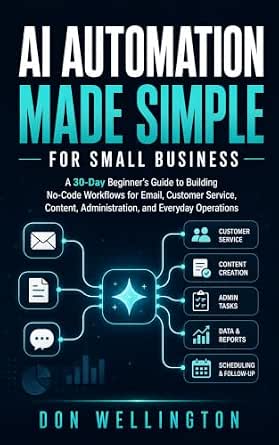 AI Automation Made Simple for Small Business: A 30-Day Beginner’s Guide to No…View on Amazon →
- 10
 AI Automation for Small Business: Simple AI Workflows for Everyday TasksView on Amazon →
- 11
 AI Automation for Small Business: A Practical Guide to Automating Marketing,…View on Amazon →
- 12
 AI for Small Business, Volume I: Getting Started — Set It Up Yourself, No Tec…View on Amazon →
- 13
 AI for Small Business: From Marketing and Sales to HR and OperationsView on Amazon →
- 14
 AI Automation for Small Businesses: Build Semi-Passive Income Systems Without…View on Amazon →
- 15
 AI for Entrepreneurs and Small Business Owners: How to Compete with Larger Bu…View on Amazon →
Choosing a Guide Before Automating
The roundup matters to owners who want to explore automation without confusing advice about workflows with software that performs them. A book may help a reader identify repetitive work or plan a process, but implementation depends on the business’s apps, configuration choices and ongoing review.
That distinction can help limit wasted spending and effort. Owners can start with a specific bottleneck—such as routine inquiry sorting or follow-up drafting—instead of buying several general guides or assuming an AI workflow will connect automatically to every service. The source also stresses setting human review rules for customer-facing messages and sensitive records.
Popular right now

Breville Bambino Espresso Machine, Brushed Stainless Steel (BES450BSS)

Ninja Prestige Smart XL Pro Cook System 10-in-1 Air Fryer and Countertop Oven, Stainless Steel, DT551

Roborock F25 XT Cordless Wet-Dry Vacuum Mop
As an affiliate, we earn on qualifying purchases.
How the 15 Books Were Compared
The source organizes the choices around a tradeoff between broad business coverage and a more guided starting point. General guides may name several departments, while titles focused on no-code setup, a particular AI assistant or a structured plan signal a narrower learning path. Those signals come from the titles and descriptions; they are not proof of the books’ full contents.
Its selection advice starts with the process that consumes the most time. Readers are urged to map the task and agree on its steps before automating it, then check whether a guide matches their technical confidence and existing software. The source cautions that an inconsistent process can remain difficult to automate, regardless of the tool chosen.
“These are learning resources, not automation platforms.”
— ThorstenMeyerAI.com roundup
What the Titles Cannot Confirm
The source material does not identify all 15 titles or provide a full description of each book’s contents. It also does not supply a publication date, independent testing, reader outcomes or evidence that any particular workflow produces savings. Its recommendations are based on stated scope and title cues, not a verified comparison of book instructions or automation products.
It remains unclear which specific applications, integrations and AI services each guide covers, how current its instructions are for 2027, and how much setup detail it offers. Those questions require checking the book listing, sample pages and relevant software documentation before purchase or implementation.
Check Fit Before Building Workflows
Small-business owners considering one of the guides can begin by listing their current email, calendar, customer database, payment and task-management services, then compare that stack with the book’s available description or sample. Before putting a workflow into use, they should verify integrations with the software providers and decide which outputs require approval.
The source gives no announced follow-up, testing schedule or next publication milestone. For readers, the next step is practical rather than editorial: choose one repeatable process, confirm that its steps are consistent, and test a small automation with appropriate human review before relying on it for customer communications or business records.
Key Questions
Are the 15 picks AI automation software?
No. The roundup describes them as books and learning resources. Readers must select and configure the software that performs the workflows.
Which book does the roundup favor overall?
It names AI Automation for Small Businesses: A Practical Guide to Automating Marketing, Sales, Customer Service, Operations, and Everyday Work as its best overall pick, citing the broad range of functions in its title.
Which titles are presented as beginner options?
The roundup points to AI Automation Made Simple for Small Business for its no-code framing. It also describes ChatGPT for Business: The 10X Playbook as emphasizing workflow ideas readers can adapt. The source says titles alone cannot confirm the depth of instructions.
How should a business choose a guide?
Identify a repetitive task, assess the team’s technical confidence and check whether the guide fits the business’s existing apps. The roundup recommends verifying tool coverage and setting human review rules before automating customer-facing work.
Source: ThorstenMeyerAI.com