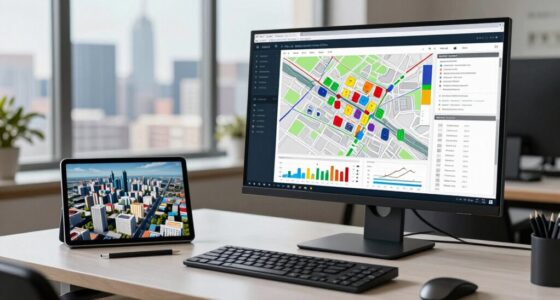

Psychometrics uses statistical methods to measure your mental traits like intelligence, personality, and abilities objectively. By turning subjective responses into measurable data, it helps you understand consistent patterns in your thoughts, feelings, and behaviors. These assessments rely on reliable and valid tools for accurate results. Whether for personal growth, career planning, or clinical insights, psychometrics creates detailed profiles that can reveal more about your mind. Keep exploring to discover how these tools can uncover deeper understanding.
Listen free for 30 days with Audible
Thousands of audiobooks and originals — cancel anytime.
As an affiliate, we earn on qualifying purchases.
Key Takeaways
- Psychometrics applies statistical methods to quantify human mental traits like intelligence and personality.
- It transforms subjective self-reports into objective, measurable data for consistent assessment.
- Reliability and validity ensure psychometric tools produce accurate and consistent results over time.
- Personality assessments quantify traits such as extraversion and emotional stability for various applications.
- Cognitive tests evaluate abilities like memory and reasoning, aiding in diagnosis and understanding mental functioning.

Have you ever wondered how psychologists measure traits like intelligence, personality, or abilities? It all comes down to psychometrics, a field that uses statistical methods to understand and quantify the complexities of the human mind. When you undergo a personality assessment, psychologists don’t just ask vague questions; they rely on carefully designed tests that produce measurable data. These assessments aim to uncover consistent patterns in your thoughts, feelings, and behaviors, which can then be interpreted to give insights into your personality type or traits. Similarly, cognitive testing evaluates your mental functions such as memory, reasoning, and problem-solving skills. These tests are structured to provide objective scores, making it easier for psychologists to compare results across individuals or track changes over time.
In personality assessments, psychometric tools like questionnaires or inventories are used to quantify traits such as extraversion, openness, or emotional stability. These tools are built on solid statistical foundations, ensuring that the results are reliable and valid. For example, when you complete a personality inventory, your responses are scored and analyzed to identify patterns that reflect your typical behavioral tendencies. This process allows psychologists to create detailed personality profiles, which can be useful in clinical settings, career counseling, or even personal development. The key advantage here is that psychometric assessments turn subjective self-reports into objective data, reducing bias and enhancing accuracy.
Cognitive testing, on the other hand, involves a range of tasks designed to measure specific cognitive abilities. These tests might include puzzles, memory exercises, or reasoning problems, all scored quantitatively. The results are then analyzed statistically to determine your strengths and weaknesses in areas like attention, processing speed, or verbal skills. Cognitive testing is especially important in diagnosing learning disabilities, brain injuries, or mental health conditions. Its scientific basis ensures that results are consistent and comparable across different populations. By applying complex statistical models, psychometricians can identify subtle differences and patterns that might be missed with informal assessments.
psychometric personality assessment kit
As an affiliate, we earn on qualifying purchases.
As an affiliate, we earn on qualifying purchases.
Frequently Asked Questions
How Reliable Are Psychometric Tests Across Different Cultures?
You might find psychometric tests less reliable across different cultures due to issues with cross-cultural validity and linguistic bias. These factors can skew results because tests may not account for cultural differences in expressions, values, or language nuances. To improve reliability, adapt tests to reflect diverse cultural contexts and minimize linguistic bias, ensuring that the assessments accurately measure what they’re intended to across various populations.
Can Psychometric Assessments Predict Future Behavior Accurately?
Psychometric assessments can predict future behavior with some accuracy, especially when they have high predictive validity. You should remember, though, that assessment accuracy varies depending on the test and context. While they offer valuable insights, they aren’t foolproof. You need to combine test results with other information for better predictions. Overall, they can be helpful tools, but their reliability depends on the quality and relevance of the assessment.
What Are the Ethical Concerns in Psychometric Testing?
You need to contemplate ethical concerns like obtaining informed consent, ensuring participants understand how their data will be used. Respect privacy rights by keeping results confidential and secure. Be transparent about the purpose of testing and avoid any misuse of data. Upholding these principles helps maintain trust, prevents harm, and promotes fairness in psychometric assessments, ensuring that testing benefits individuals without infringing on their rights.
How Do Psychometricians Ensure Test Fairness?
Did you know that over 80% of psychometric tests undergo bias mitigation? To guarantee test fairness, you actively implement standardization procedures, which include consistent administration and scoring methods. By doing so, you reduce biases related to culture, language, or socio-economic background. These steps help create equitable assessments, giving everyone an equal opportunity to demonstrate their abilities and ensuring the results truly reflect individual capabilities.
Are There Limitations to Using Statistics in Measuring the Mind?
Yes, there are limitations to using statistics in measuring the mind. You might encounter cultural bias, which can skew test results for diverse groups, and challenges in ensuring test validity across different populations. Statistics can’t fully capture the complexity of human cognition or account for individual differences. As a result, relying solely on statistical measures may oversimplify mental abilities, risking unfair assessments and incomplete understanding of a person’s true capabilities.
cognitive ability test for adults
As an affiliate, we earn on qualifying purchases.
As an affiliate, we earn on qualifying purchases.
Conclusion
As you explore psychometrics, you realize how seamlessly statistics reveal the intricacies of the mind. Coincidences whisper that behind every test score lies a hidden story, waiting to be uncovered. It’s almost as if the numbers themselves guide you toward understanding human complexity, reminding you that measurement and mystery often dance hand in hand. In this dance, you learn that the science of the mind isn’t just about data—it’s about uncovering the unexpected truths that lie beneath.
personality inventory questionnaire
As an affiliate, we earn on qualifying purchases.
As an affiliate, we earn on qualifying purchases.
As an affiliate, we earn on qualifying purchases.
NFL season / tailgating Picks
team gear
As an affiliate, we earn on qualifying purchases.