
Welch’s t-test helps you compare two groups when their variances aren’t equal, making it a better choice than the standard t-test in real-world data. It doesn’t assume equal variances or same group sizes, adjusting for differences in variances and sample sizes. This means you’ll get a more accurate p-value and trustworthy results. Want to understand exactly how it accounts for these differences and when to use it? Keep exploring for the details.
Key Takeaways
- Welch’s t-test compares two groups with unequal variances by adjusting degrees of freedom based on sample variances and sizes.
- It does not assume equal variances, making it suitable for real-world data with heteroscedasticity.
- The test provides more accurate p-values than the standard t-test under variance inequality.
- It is flexible with unequal or small sample sizes, ensuring reliable results in practical research.
- By explicitly accounting for variance differences, Welch’s t-test reduces false positives and negatives.

Have you ever wondered how to compare two groups when their variances are unequal? This is a common challenge in statistics, especially when the data doesn’t meet the assumptions of traditional t-tests. When variances differ markedly, using a standard Student’s t-test can lead to misleading results because it assumes equal variances across groups. Instead, you need a method that adjusts for this inequality—enter Welch’s t-test. This test is specifically designed for situations where the variance assumptions don’t hold, making it a reliable choice for many real-world comparisons. But to perform Welch’s t-test effectively, you need to pay attention to a few key factors, particularly sample size and the nature of the variances.
Sample size plays an essential role in the accuracy of the test. Unlike the standard t-test, Welch’s t-test is more flexible when sample sizes are unequal or small. It doesn’t require the groups to be the same size, which is often the case in practical research. When your sample sizes are very different, the test adjusts the degrees of freedom based on the variances and sizes of each group, providing a more precise p-value. This flexibility prevents the distortion that can happen when unequal sample sizes are paired with unequal variances, ensuring your results are more trustworthy.
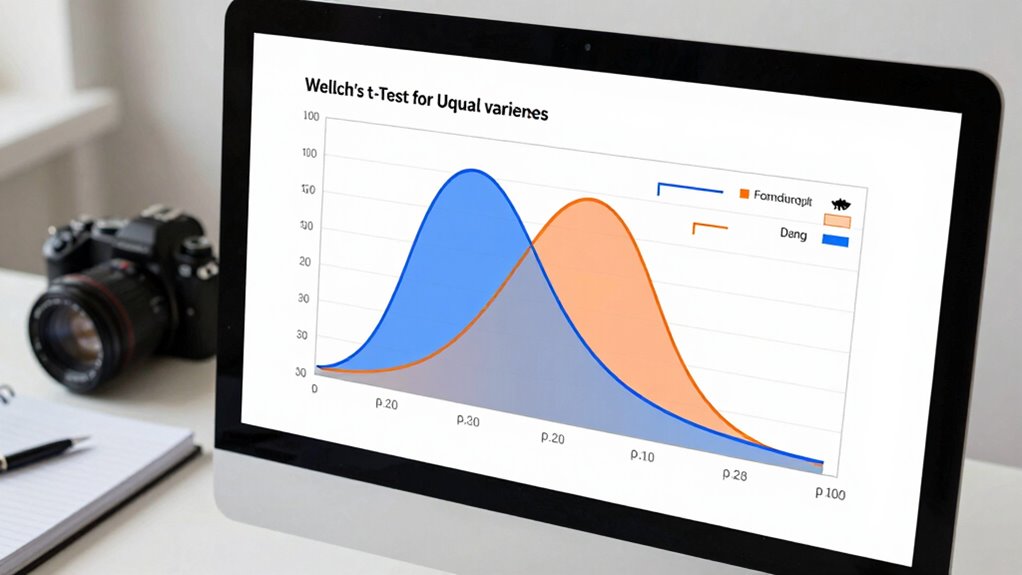
Understanding the variance assumptions is equally important. Welch’s t-test doesn’t assume equal variances, unlike the classic Student’s t-test. Instead, it explicitly accounts for variance differences by incorporating the individual variances of each group into its calculations. This means you can confidently compare groups with different spreadings of data without worrying about violating the test’s assumptions. When variances are unequal, the standard t-test can underestimate or overestimate the significance, leading to false positives or negatives. Welch’s t-test mitigates this issue by adjusting the degrees of freedom and the test statistic accordingly.
statistical analysis software
As an affiliate, we earn on qualifying purchases.
As an affiliate, we earn on qualifying purchases.
Frequently Asked Questions
When Should I Choose Welch’s T-Test Over Other Tests?
You should choose Welch’s t-test when you suspect that variances between your two groups aren’t equal, as it’s more robust in those situations. Unlike other tests, it doesn’t assume variance equality, making it reliable for real-world data where variances often differ. Use Welch’s t-test for better accuracy and test robustness, especially when your sample sizes vary or you have unequal variances, ensuring valid results without strict assumptions.
Can Welch’s T-Test Be Used With Small Sample Sizes?
Yes, you can use Welch’s t-test with small sample sizes, but keep in mind that sample size considerations impact test power. With very small samples, the test may have limited power, making it harder to detect true differences. To improve accuracy, make certain your data roughly meet the assumptions and consider using methods designed for small samples, like non-parametric tests, if the data are highly skewed or non-normal.
How Does Welch’s T-Test Handle Unequal Sample Sizes?
Welch’s t-test handles unequal sample sizes by not assuming variance equality, which is essential when your groups’ variances and sample sizes differ. It adjusts the degrees of freedom based on each group’s variance and sample size, providing a more accurate significance test. This flexibility guarantees you can compare groups reliably even if the sample sizes are vastly different, making it ideal when variance equality can’t be assumed.
Are There Assumptions I Need to Check Before Using Welch’s T-Test?
Before using Welch’s t-test, you should check that your samples are independent and that the variances are not necessarily equal, unlike in other t-tests. You don’t need to assume variance homogeneity, but ensuring sample independence is essential. Also, verify the data’s approximate normality, especially with small sample sizes, to make sure the test’s results are reliable.
What Software Can Perform Welch’s T-Test Easily?
You can easily perform Welch’s t-test using software like R, SPSS, or Python. These tools help you analyze data visualization and improve your statistical power, especially when variances are unequal. R packages like ‘stats’ or ‘WRS2’ make it straightforward, while SPSS offers a user-friendly interface. Python’s SciPy library has functions for Welch’s t-test, enabling quick, accurate analysis without complex coding.
SPSS for t-test analysis
As an affiliate, we earn on qualifying purchases.
As an affiliate, we earn on qualifying purchases.
Conclusion
With Welch’s t-test, you confidently compare two groups without worry of unequal variances. By embracing this method, you simplify statistical struggles and sharpen your analysis skills. So, step smoothly into your studies or surveys, and let Welch’s wisdom work wonders. Wield this powerful tool, and watch your results become clearer, your conclusions stronger, and your confidence soar — making your statistical journey a true triumph!
Excel add-in for t-test
As an affiliate, we earn on qualifying purchases.
As an affiliate, we earn on qualifying purchases.
statistics calculator for unequal variances
As an affiliate, we earn on qualifying purchases.
As an affiliate, we earn on qualifying purchases.