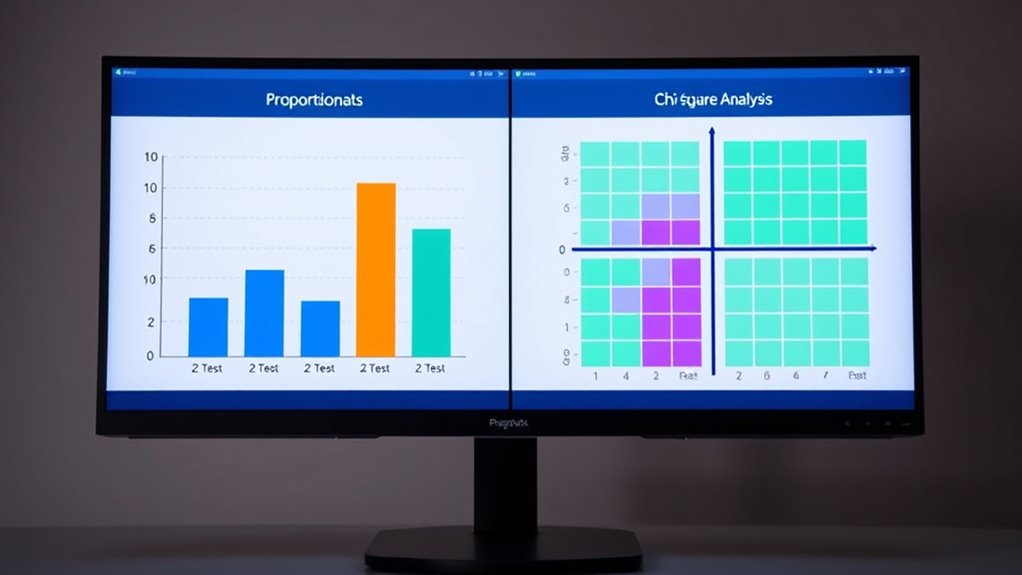

When comparing two proportions, a Z-test is typically used if you have large sample sizes and want to test for a significant difference between two groups. A chi-square test, on the other hand, is more versatile for analyzing relationships in larger contingency tables. Both methods rely on sample sizes and assumptions for accuracy. To choose the right approach and guarantee reliable results, deeper understanding is helpful—keep exploring to learn more.

Get business pricing on monitors, keyboards and dev gear
- Business-only prices and quantity discounts
- Tax-exempt purchasing
- Multiple users, one account, clear invoices
Key Takeaways
- The Z-test compares two proportions directly using a test statistic, suitable for large samples with two groups.
- The Chi-square test evaluates the entire contingency table, useful for analyzing relationships across multiple categories.
- Z-test focuses on the difference between two sample proportions; Chi-square assesses independence or association in categorical data.
- Both tests require adequate sample sizes to meet assumptions and ensure reliable, valid results.
- Choice depends on data structure: use Z-test for two proportions, Chi-square for larger categorical comparisons.

When comparing two proportions, understanding whether the differences observed are statistically significant is essential. To do this effectively, you need to focus on two key aspects: sample size determination and confidence interval calculation. These elements help guarantee your comparison is valid and reliable. First, selecting an appropriate sample size is crucial because it directly impacts the power of your test. If your sample is too small, you might miss detecting a real difference; if it’s too large, you could waste resources. When planning your study, consider factors like the expected difference between proportions, the desired confidence level, and the acceptable margin of error. These considerations guide you in determining the right sample size, guaranteeing your results are both meaningful and statistically sound. Additionally, understanding the assumptions underlying each test ensures accurate interpretation of your results.
Confidence interval calculation plays a fundamental role in understanding the range within which the true difference between proportions likely falls. When comparing two proportions, calculating a confidence interval around the difference helps you assess the precision of your estimate. If the interval includes zero, it suggests there’s no statistically significant difference; if it doesn’t, you can be more confident that a real difference exists. Both the Z-test and chi-square test rely on this concept, but they approach the comparison differently. The Z-test calculates a test statistic based on the difference in sample proportions, adjusted for sample size, and then compares it to a critical value to determine significance. Meanwhile, the chi-square test evaluates the entire contingency table, offering a broader view of association between categorical variables.
Choosing between a Z-test and a chi-square test depends on the context and data structure. The Z-test is typically used for comparing two proportions directly, especially when sample sizes are large enough to justify normal approximation. The chi-square test, on the other hand, is more versatile, suitable for analyzing larger contingency tables or when you want to examine relationships across multiple groups simultaneously. Both methods require careful consideration of your sample size to guarantee the assumptions behind each test are met. Larger samples generally provide more reliable results, reducing the margin of error in confidence interval calculations and increasing the test’s power.
As an affiliate, we earn on qualifying purchases.
Frequently Asked Questions
When Should I Choose a Z-Test Over a Chi-Square Test?
You should choose a z-test when your sample size is large enough, typically over 30, and the test assumptions are met, such as normality and known population variance. Use a z-test to compare two proportions directly, especially when the data are categorical and independent. If your sample size is smaller or assumptions aren’t fully satisfied, a chi-square test might be more appropriate for analyzing the association between variables.
Can These Tests Be Used With Small Sample Sizes?
Imagine trying to fit puzzle pieces together in a small box; the same applies to your data. Both Z-tests and chi-square tests face sample size limitations, making them less reliable with small samples. You should be cautious, as their test applicability diminishes when data is limited, risking inaccurate results. For small samples, consider alternative methods like Fisher’s exact test, which handle limited data more effectively.
How Do I Interpret the Results of Each Test?
You interpret the results by first looking at the p-value; a small p-value suggests a significant difference between proportions. For the Z-test, check the confidence interval—if it doesn’t include zero, the difference is significant. With the Chi-square, a low p-value indicates you should reject the null hypothesis. Both tests help you understand the strength of your evidence, guiding your conclusions about the proportions.
Are These Tests Applicable for Comparing More Than Two Groups?
Imagine you’re analyzing multiple groups’ categorical data; these tests are useful here. Both the chi-square test and Z-test can be applied to compare more than two groups, but the chi-square test is more versatile for multiple groups. It helps you see if the distribution differs across categories, while the Z-test is limited to two proportions. Use these tests when your data involves categorical variables across multiple groups.
What Assumptions Do These Tests Rely On?
You need to guarantee your sample size is adequate for reliable results, typically larger for the chi-square test. Both tests assume data independence, meaning each observation should be independent of others. Violating this can lead to inaccurate conclusions. For the Z-test, the sample size should be large enough to approximate a normal distribution, while the chi-square test requires expected frequencies to be sufficiently high, usually at least 5.
As an affiliate, we earn on qualifying purchases.
Conclusion
When choosing between a z-test and a chi-square for comparing two proportions, think of it like selecting the right tool for a job. Both are like keys opening different doors—each suited for specific scenarios. Understanding their differences helps guarantee you don’t force a fit. By choosing wisely, you’ll open accurate insights, much like finding the perfect key opens the right door, guiding your analysis smoothly and confidently.
sample size calculator for proportions
As an affiliate, we earn on qualifying purchases.
As an affiliate, we earn on qualifying purchases.
As an affiliate, we earn on qualifying purchases.
Fall Picks
fall essentials
As an affiliate, we earn on qualifying purchases.