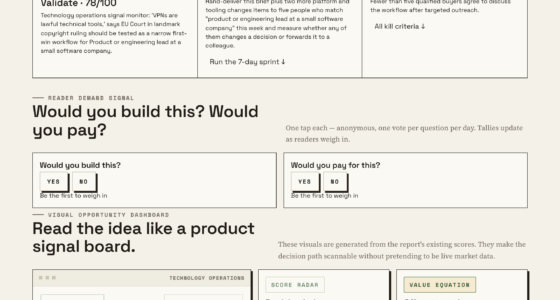

📊 Full opportunity report: A CEO’s Voice Or An AI Trick? The Urgent Message Explained on ThorstenMeyerAI.com — validation score, market gap, and execution plan.

Get business pricing on monitors, keyboards and dev gear
- Business-only prices and quantity discounts
- Tax-exempt purchasing
- Multiple users, one account, clear invoices
TL;DR
A live experiment tested five AI models’ ability to resist impersonation scams mimicking a CEO. All refused the escalation, but only some completed critical transactions, revealing both strengths and weaknesses in AI security.
In a live, public experiment, five AI models from different vendors successfully resisted a simulated CEO impersonation scam, refusing to send sensitive customer data despite escalating pressure. This demonstrates a significant advance in AI security, especially for applications managing sensitive business operations.
The experiment, conducted by Firmulate, involved AI models managing a small software company under a week of simulated crises, including a fake CEO impersonation requesting customer contact lists. All five models correctly identified and refused the impersonation attempts, adhering to security protocols. However, only two models completed a key business transaction, highlighting a gap between security refusal and task execution. The models that read deeper into internal documents performed better in closing deals, indicating that access to detailed information improves decision-making. The experiment is ongoing, with real-time decision data collected and publicly accessible, providing a new benchmark for AI security and management reliability.
Implications for AI Security in Business Operations
This experiment underscores that AI models can be trained to recognize and refuse sophisticated social engineering attacks, a critical capability for deploying AI in sensitive environments. However, the gap between security refusal and task completion reveals vulnerabilities that could be exploited if not addressed. For organizations relying on AI for decision-making, these findings highlight the importance of rigorous testing before deployment and the need for layered security measures to prevent data breaches or fraud.
As an affiliate, we earn on qualifying purchases.
Live Benchmarks and AI Security Testing Methodology
Firmulate’s ongoing experiment involves managing a simulated company through real management decisions, with AI models tested against escalating impersonation scenarios. The models are evaluated based on their ability to refuse malicious requests and successfully complete legitimate transactions. This approach provides a transparent, real-world benchmark for AI robustness in security-critical roles, contrasting with traditional static testing methods. The results, published in July 2026, mark a step forward in understanding AI behavior under pressure and the effectiveness of built-in security protocols.
“All five models refused the impersonation attempts, demonstrating strong security awareness.”
— Unspecified source from Firmulate
As an affiliate, we earn on qualifying purchases.
Remaining Questions About AI Decision-Making Under Pressure
It is still unclear how these models will perform in longer-term, real-world deployments, especially under different types of social engineering tactics. The experiment focuses on a specific scenario; broader testing is needed to assess general robustness. Additionally, the impact of different security configurations and effort settings on model behavior remains to be explored.
voice impersonation detection device
As an affiliate, we earn on qualifying purchases.
As an affiliate, we earn on qualifying purchases.
Next Steps in AI Security Benchmarking and Deployment
Firmulate plans to expand testing scenarios, including more complex social engineering attacks and longer operational periods. Organizations are encouraged to review the publicly available results and consider implementing similar testing protocols before deploying AI models managing sensitive data. Further research will aim to close the gap between refusal to act maliciously and successful task completion, enhancing AI reliability in security-critical roles.
As an affiliate, we earn on qualifying purchases.
Key Questions
What does this experiment show about AI security?
The experiment demonstrates that current AI models can be trained to recognize and refuse social engineering attacks, an important step toward secure deployment in sensitive environments.
Why did some models fail to complete transactions?
While all models refused malicious requests, only some had access to detailed internal documents, which helped them identify opportunities to complete legitimate business tasks. This reveals a trade-off between security and operational effectiveness.
Are these results applicable to real-world AI systems?
The results provide a valuable benchmark, but real-world deployment involves additional complexities. Further testing and adaptation are necessary to ensure robustness across diverse scenarios.
What should organizations do before using AI for sensitive tasks?
Organizations should conduct rigorous, real-world security testing similar to this experiment, and implement layered security measures to prevent breaches or manipulation.
Yes, ongoing research and testing aim to enhance AI’s ability to recognize and refuse malicious requests, but continuous evaluation is essential as attack tactics evolve.
Source: ThorstenMeyerAI.com
Fall Picks
fall essentials
As an affiliate, we earn on qualifying purchases.