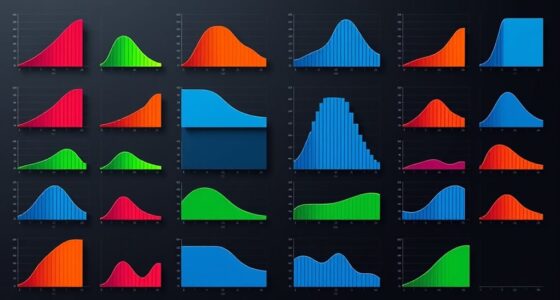

When tailoring data visualization for different audiences, focus on their familiarity with the data and their needs. For technical teams, detailed charts like heatmaps work well, while general audiences prefer simpler visuals like bar graphs or pie charts. High-level summaries with clear visuals suit executives best. Using appropriate colors, labels, and annotations enhances understanding. If you keep these principles in mind, you’ll be able to create visuals that effectively inform and engage your audience. Keep exploring to discover more ways to tailor effectively.
Key Takeaways
- Adjust visualization complexity based on audience’s technical expertise and familiarity with data concepts.
- Use simple visuals like bar charts for general audiences, and detailed plots like heatmaps for analysts.
- Highlight key insights with clear annotations and minimal clutter to enhance understanding across all levels.
- Incorporate relevant examples and focus on high-level metrics for decision-makers, detailed data for specialists.
- Test visuals with target groups to ensure clarity, relevance, and effectiveness in communicating the intended message.

Effective data visualization requires tailoring your visuals to suit different audiences, as each group has unique needs and levels of understanding. When designing visualizations, your goal is to communicate insights clearly and efficiently, but what works for one audience might not resonate with another. To achieve this, you need to contemplate their familiarity with data, their technical background, and their primary interests. Using appropriate visualization techniques is essential to maximize audience engagement and ensure your message hits home. For technical teams, detailed charts like scatter plots or heatmaps might be effective, offering depth and precision. Conversely, a general audience benefits from simpler visuals such as bar graphs or pie charts that highlight key points without overwhelming them.
Tailor your visuals to your audience’s needs for clearer, more impactful data communication.
Additionally, understanding caffeine content in espresso can help tailor presentations about data consumption habits or health impacts, making the information more relevant to your audience. Your choice of visualization techniques directly impacts how your audience interprets the data. For instance, if you’re presenting to executives, focus on high-level summaries with clear, compelling visuals that emphasize trends and critical metrics. Use bold colors and minimal clutter to keep their attention fixed on the main takeaways. In contrast, when working with data analysts or specialists, you can incorporate more complex visuals that reveal underlying patterns, distributions, or correlations, knowing they can interpret the details. This tailored approach maintains audience engagement by matching the complexity of your visuals with their capacity to understand and analyze the information.
Remember, audience engagement hinges on clarity. Overloading a visual with unnecessary details or overly complex charts can frustrate your viewers and obscure the core message. Simplify where needed, emphasizing the story you want to tell. Use annotations, labels, and legends strategically to guide viewers through the data, ensuring they grasp the insights without confusion. When you adapt your visualization techniques to suit your audience, you foster better understanding and make the data more accessible. This engagement encourages questions, discussion, and ultimately, informed decision-making.
Finally, always keep your audience in mind as you choose your visuals. Test your charts with a sample of your target group if possible, and gather feedback on readability and relevance. The more you personalize your approach, the more effective your data visualization becomes. By thoughtfully tailoring your visuals, you create a compelling narrative that resonates with every audience, making complex data understandable and impactful.
Frequently Asked Questions
How to Measure the Effectiveness of Tailored Visualizations?
You can measure the effectiveness of tailored visualizations by evaluating cognitive engagement and visual clarity. Track how quickly and accurately your audience interprets the data, noting any confusion or errors. Use feedback forms or surveys to gauge understanding and engagement levels. Additionally, observe if the visualization prompts desired actions or insights. High cognitive engagement and clear visuals indicate your tailored approach successfully communicates complex data effectively.
What Tools Best Adapt to Diverse Audience Needs?
You should explore tools like Tableau, Power BI, and Flourish, as they excel at adapting visualizations through interactive storytelling and accessibility considerations. These platforms allow you to customize complexity levels, incorporate assistive features, and engage diverse audiences effectively. By leveraging their features, you guarantee your visualizations are inclusive, compelling, and tailored to different needs, making your data more understandable and impactful across various user groups.
How to Handle Conflicting Data Preferences Among Stakeholders?
To handle conflicting data preferences among stakeholders, you should facilitate open discussions to find common ground. Focus on achieving stakeholder consensus by clearly communicating data insights and addressing conflicting priorities transparently. Use flexible visualizations that can be easily adjusted to meet diverse needs, and prioritize transparency and collaboration. This approach helps reconcile differences, ensures everyone feels heard, and promotes effective decision-making despite conflicting data preferences.
When Is It Necessary to Simplify or Complicate Visuals Further?
You should simplify visuals when your audience’s literacy level is low or data is complex enough to overwhelm them. Conversely, complicate visuals when your audience is highly skilled and needs detailed insights. Imagine a clear, straightforward chart transforming into a dense, intricate graph—this shift signals a need for adjustment. Balancing visual complexity guarantees your message resonates, engaging your audience without confusing or losing their interest.
How to Update Visualizations for Evolving Audience Knowledge?
You should update your visualizations by leveraging interactive dashboards that allow your audience to explore data at their own pace. Use audience segmentation to identify knowledge levels and adjust complexity accordingly. Regularly gather feedback to understand their evolving needs, then simplify or add detail as needed. This approach guarantees your visuals remain relevant, engaging, and accessible, helping your audience stay informed and confident in interpreting your data.
Conclusion
Think of data visualization like a garden—you choose your plants based on who’s visiting. For experts, you can plant intricate flowers, but for beginners, simpler blooms work best. Tailoring your visuals is like tending a garden that welcomes everyone, from seasoned gardeners to curious newcomers. When you customize your approach, your data blooms beautifully for all audiences, making insights accessible and engaging. Remember, a well-tended garden invites everyone to enjoy its vibrant beauty.