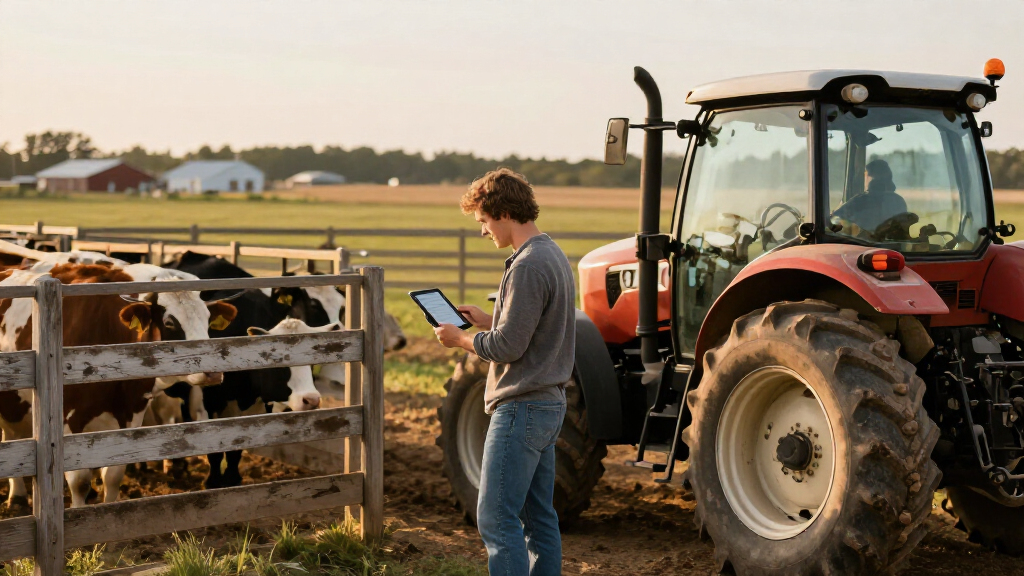
🔍 Read the full analysis: The Great Farm Shift: Tractors And 26.7 Million Animals on ThorstenMeyerAI.com

Get business pricing on monitors, keyboards and dev gear
- Business-only prices and quantity discounts
- Tax-exempt purchasing
- Multiple users, one account, clear invoices
TL;DR
A historical account published by ThorstenMeyerAI.com on November 4, 2026, traces the decline of working horses and mules on U.S. farms as tractors and other machinery spread. The animal population fell from 26.7 million in 1918 to 3.1 million in 1960, while the land used to grow their feed was redirected. The account presents the shift as a useful but limited comparison for thinking about automation and work today.
A new episode published by ThorstenMeyerAI.com on November 4, 2026, revisits the transformation of U.S. farming in which tractors and other machinery replaced most working horses and mules. The farm population of those animals peaked at 26.7 million on January 1, 1918, then fell to 3.1 million by 1960, a shift that freed farmland previously used to grow their feed and sharply reduced the need for animal-powered labor.
The figures cited in the episode come from the U.S. Census Bureau’s Historical Statistics of the United States, Colonial Times to 1970, which reprinted Department of Agriculture estimates. Horses alone peaked at 21.4 million in 1915; mules continued to increase, bringing the combined horse-and-mule total to 26.7 million three years later. In 1915, about 93 million acres of harvested cropland—more than a quarter of the total—grew feed for the animals.
Tractor numbers rose as the working-animal population declined. The episode reports about 1,000 tractors on U.S. farms in 1910, 246,000 in 1920, and 4.69 million in 1960. Around 1955, tractors first outnumbered horses and mules, with 4.35 million tractors compared with 4.31 million animals. By 1960, the acreage devoted to horse and mule feed had fallen to about five million acres.
Mechanization went beyond tractors. Combine harvesters, corn pickers, balers and milking machines also spread, alongside changes such as improved seed and fertilizer. The Department of Agriculture’s estimate of the number of people supplied by each farm worker rose from 7.1 in 1910 to 47.1 in 1970. That measure includes people abroad supplied through exports, according to the source.
The Land and Labor Released
The change was not only a story of one machine replacing one kind of work. Horses and mules required feed throughout the year, and the acreage devoted to them represented land that could not also grow crops for people or sale. As their numbers fell, that land could be put to other uses, while machinery helped fewer farm workers produce more.
Farm employment in the United States peaked at 13.6 million in 1916 and had fallen to 4.5 million by 1970, according to the episode. At the same time, the overall U.S. labor force doubled. That contrast points to a major economic consequence: workers left agriculture as productivity rose, while employment expanded elsewhere, particularly in cities. The shift involved relocation and changes in work, not simply an equivalent new farm job for every role made unnecessary.
The account connects this history to current debate about automation, but treats the comparison as an analogy rather than a forecast. It cites economist Wassily Leontief’s 1983 comparison between workers and horses displaced by tractors. The episode also stresses a difference Leontief identified: horses could not vote. Human workers can organize politically and influence policy, making the consequences of automation different from the decline of animal labor.
Popular right now

Roborock Robot Vacuum and Mop Combo with Self-Empty Dock

Apple AirPods Max 2 Wireless Over-Ear Headphones – Midnight

Sony BRAVIA XR8B 65-Inch 4K OLED Google TV (K-65XR8B)
As an affiliate, we earn on qualifying purchases.
From Fordson to Farm Automation
Tractors existed before World War I, but early models were heavy, expensive and better suited to large farms. The episode says Ford introduced the Fordson in 1917. The Henry Ford museum describes it as “the first mass-produced and inexpensive lightweight tractor”, designed for smaller farmers, and says it rapidly became the most popular tractor in America. The 100,000th Fordson left the assembly line on February 21, 1920.
The historical figures show a transition spanning decades, rather than an overnight replacement. The combined number of horses and mules remained high in 1920, even as tractor adoption accelerated. Around 1955, the two counts crossed; by 1960, the farm animal total had dropped by almost 90% from its 1918 peak. The source notes that tractor counts come from census years with somewhat different dates, and that the Department of Agriculture combined its horse and mule counts from 1951 onward.
The episode also points to modern examples, while describing their scope as limited. It says John Deere introduced a 16-camera autonomy kit in February 2025 for tillage on select large tractors. It also reports that China said about 74% of ploughing, sowing and harvesting was mechanized in 2023. These examples indicate ongoing mechanization, but they do not establish that today’s agricultural technology is replacing workers at the same rate or in the same way as tractors replaced animal power.
“Leontief compared workers to horses replaced by tractors and pointed to a key difference: horses could not vote.”
— Wassily Leontief, as summarized in the episode
Limits of the Automation Analogy
The historical totals describe changes in farm machinery and animal populations, but they do not provide a complete account of what happened to every person who left agricultural work. The episode gives aggregate farm-employment figures and says new jobs emerged in cities, but does not quantify how many displaced farm workers moved, what occupations they entered, or how the transition affected different communities.
The comparison with current automation also remains unsettled. The source describes Deere’s autonomy equipment as operating on select large tractors and reports a Chinese mechanization figure, but supplies no comparable measure of jobs displaced by those systems. It is not clear from the material how widely autonomous tractors are being used, how their adoption is changing employment, or whether their effects will resemble the effects of early tractors. The historical animal and tractor counts are also drawn from series with different counting dates and methods, as the source notes.
Tracking Machines and Farm Work
The episode does not announce a new policy, launch or upcoming milestone; it is a historical report published as part of the “Work After Work” series. The next step for readers assessing its present-day comparison is to look for comparable, dated data on the use of autonomous farm equipment, farm employment and productivity. The source identifies examples of current machinery, but does not set out a forecast or timetable for further adoption.
For the historical record, the source says the Department of Agriculture stopped its yearly horse-and-mule estimates soon after the population had fallen to about 3.1 million in 1960. Any account of what followed therefore needs to distinguish those historical estimates from modern measures of farm labor and automation, which may use different definitions and data sources.
Key Questions
How many horses and mules worked on U.S. farms at the peak?
The source reports a combined total of 26.7 million on January 1, 1918: 21.2 million horses and 5.5 million mules.
When did tractors outnumber horses and mules?
The episode says the counts crossed around 1955, when there were 4.35 million tractors and 4.31 million horses and mules on U.S. farms.
What happened to the land once used to grow feed?
The acreage used to grow horse and mule feed fell from about 93 million acres in 1915 to about five million acres in 1960. The source says the released land could be used to grow food for people.
Does the horse-to-tractor shift predict what AI will do to workers?
No direct prediction is established by the historical figures. The episode presents the shift as an analogy and notes a major difference: human workers, unlike horses, can vote and influence political decisions.
What current farm automation examples does the report cite?
It cites John Deere’s 16-camera autonomy kit, introduced in February 2025 for tillage on select large tractors, and a Chinese government-reported mechanization rate of about 74% for ploughing, sowing and harvesting in 2023. The source does not provide a comparable estimate of job losses from these technologies.
Source: ThorstenMeyerAI.com