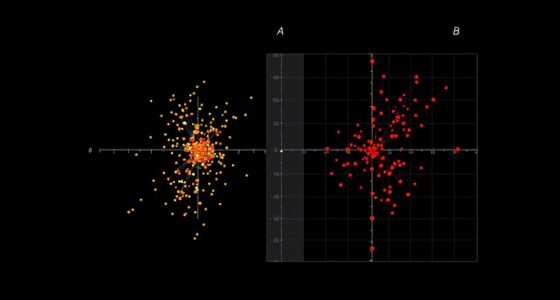

Simpson’s Paradox occurs when a trend apparent in separate groups disappears or reverses when the data is combined. You might see treatments or options look better within each subgroup, but overall, the opposite may seem true. This happens because ignoring underlying differences and confounding factors can mislead your conclusions. Recognizing this paradox helps you interpret data accurately and avoid pitfalls. Keep exploring—there’s more to uncover about how data can deceive without proper analysis.
Key Takeaways
- Simpson’s Paradox occurs when a trend in separate groups reverses or disappears when data is combined.
- It highlights how aggregated data can mask or distort true relationships between variables.
- Recognizing confounding factors and biases is essential to avoid misleading conclusions.
- Analyzing subgroups helps clarify true causal relationships and prevent misinterpretation.
- Understanding Simpson’s Paradox ensures more accurate decision-making and better interpretation of statistical data.

Simpson’s Paradox occurs when a trend that appears in several different groups reverses or disappears once the data is combined. This phenomenon can be confusing, especially when you’re trying to draw conclusions from statistical data. It highlights how important careful analysis is, particularly when it comes to causal inference—the process of figuring out whether one thing truly causes another. If you’re not cautious, statistical bias can creep in, leading you to incorrect or misleading conclusions about relationships within the data. Recognizing Simpson’s Paradox helps you understand that data can be deceptive if you don’t consider the underlying structure of the groups involved.
Imagine you’re examining the success rates of two treatments across different hospitals. In each hospital, Treatment A seems more effective than Treatment B. But when you pool all the data together, Treatment B looks better overall. This is a classic example of Simpson’s Paradox. It occurs because the different hospitals may have varying patient populations, sizes, or other factors that influence the overall outcome. When the data is combined, these differences can mask or reverse the original trends. If you ignore this, you might falsely conclude that one treatment is superior or inferior without understanding the full context.
This is where the importance of understanding statistical bias comes into play. Bias can distort the apparent relationships in your data, leading to flawed causal inferences. If you don’t account for lurking variables or confounding factors—variables that influence both the predictor and outcome—you risk falling into the trap of Simpson’s Paradox. For example, if a certain demographic is overrepresented in one group, it might skew the results, making it seem like a treatment is more or less effective than it truly is. Recognizing the potential for statistical bias and carefully controlling for such confounders helps you avoid false conclusions.
To navigate Simpson’s Paradox, you need to dig deeper into your data, breaking it down into meaningful groups before making any broad claims. Always ask yourself whether the trends you’re seeing hold within each subgroup or if they only appear when you aggregate the data. This approach improves your causal inference, ensuring you’re not misled by aggregated results that hide important nuances. Being aware of group differences sharpens your analytical skills and helps you make more accurate, evidence-based decisions. It reminds you that data isn’t just about numbers; it’s about understanding the story behind those numbers, with an eye toward avoiding statistical bias and making sound causal inferences.
Frequently Asked Questions
How Can Simpson’s Paradox Affect Real-World Decision Making?
You might make flawed decisions if you ignore Simpson’s Paradox, as data aggregation can hide true causal inference. When analyzing combined data sets, you risk misinterpreting relationships, leading to incorrect conclusions. Recognizing this paradox helps you avoid misleading trends, ensuring more accurate decision making. Always examine data carefully, breaking it down into relevant groups, so you can see the real cause-and-effect relationships without being fooled by misleading aggregate statistics.
Are There Common Fields Most Impacted by Simpson’s Paradox?
You’ll find Simpson’s Paradox most impactful in medical research and social sciences. In medical studies, it can lead you to incorrect conclusions about treatment effectiveness if you don’t account for confounding variables. Similarly, in social sciences, it influences your understanding of societal trends, affecting policies and interventions. Recognizing this paradox helps you interpret data more accurately, ensuring your decisions are based on true underlying patterns rather than misleading aggregated results.
What Are the Best Methods to Detect Simpson’s Paradox?
You can spot Simpson’s Paradox by carefully examining confounding variables and doing stratified analysis. Ironically, the best method involves breaking down your data into subgroups to see if trends flip when viewed separately. This reveals inconsistencies masked in aggregate data. Keep an eye on how relationships change across groups, and don’t forget to compare these insights to the overall picture—you might just catch the paradox before it surprises you.
Can Simpson’s Paradox Occur in Small Data Sets?
Yes, Simpson’s paradox can occur in small data sets. When the sample size is limited, data variability increases, making it easier for the paradox to appear due to chance fluctuations. Small data sets may not accurately represent the overall trend, leading to misleading conclusions. To avoid this, guarantee your sample size is sufficient and consider data variability when analyzing, so you spot potential paradoxes early.
How Do Statisticians Prevent Misinterpretation Due to Simpson’s Paradox?
Imagine a hospital report showing women have higher recovery rates, but when you look closer, younger women actually recover faster. Statisticians prevent misinterpretation by accounting for confounding variables and performing stratified analysis, which separates data into relevant groups. This approach helps identify true relationships, ensuring you don’t draw false conclusions. It’s essential to recognize hidden factors and analyze data carefully to avoid being misled by Simpson’s Paradox.
Conclusion
You might think the data always tells the full story, but Simpson’s Paradox proves it can deceive you. Don’t let confusion or frustration keep you from digging deeper. Recognizing this paradox can empower you to see the truth behind the numbers and avoid costly mistakes. Remember, understanding complexities like this isn’t just about stats—it’s about making smarter, more informed decisions that can genuinely impact your life. Stay curious and question what you see.