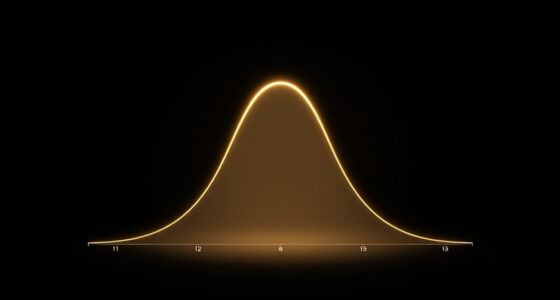

A random variable is a value that can change based on chance, like the outcome of a dice roll, and distributions show how likely each result is. Continuous variables have a range of possible values, described by a probability density function (PDF), which helps you see where outcomes are most likely. The cumulative distribution function (CDF) tells you the chance that the variable is below a certain point. If you want to understand these ideas better, there’s more to explore next.

Get business pricing on monitors, keyboards and dev gear
- Business-only prices and quantity discounts
- Tax-exempt purchasing
- Multiple users, one account, clear invoices
Key Takeaways
- Random variables represent uncertain outcomes, and their distributions show the likelihood of different values occurring.
- A probability density function (PDF) describes how outcomes are spread over a range, with the total area under the curve equal to one.
- Integrating the PDF over an interval gives the probability that the variable falls within that range.
- The cumulative distribution function (CDF) shows the total probability that the variable is less than or equal to a specific value.
- Both PDF and CDF help visualize and understand the behavior and likelihood of different outcomes for random variables.

Understanding random variables and distributions is essential for analyzing uncertain outcomes in probability and statistics. When you deal with real-world situations—like predicting the weather, estimating stock prices, or evaluating the likelihood of a machine breaking down—you’re working with variables that can take on different values. These are called random variables because their specific value is uncertain until you observe the outcome. To make sense of these variables, you need to understand how they behave, which is where probability distributions come into play. A probability distribution describes how likely different outcomes are for a random variable. It provides a complete picture of its behavior, allowing you to gauge the chance of various results.
For continuous random variables, the probability density function (or PDF) is a key concept. Think of the probability density as a curve that shows where the outcomes are most likely to occur. Unlike probabilities assigned directly to specific points, the probability density tells you how densely packed the outcomes are around any particular value. To find the probability that your variable falls within a certain range, you integrate the probability density over that interval. The total area under the curve of the probability density function always equals one, reflecting the certainty that the variable will fall somewhere within its range. This area calculation helps you understand the likelihood of different outcomes occurring within specific bounds.
Alongside the probability density is the cumulative distribution function (or CDF). The CDF is a running total that, for any value, tells you the probability that the random variable is less than or equal to that value. It’s a handy way to see how probabilities accumulate as you move along the possible outcomes. For example, if you want to know the probability that a measurement is below a certain threshold, you look at the CDF at that point. The CDF starts at zero for the lowest possible value and gradually increases to one as you move toward the maximum, giving you a clear picture of the distribution’s overall shape and probabilities.
probability density function calculator
As an affiliate, we earn on qualifying purchases.
As an affiliate, we earn on qualifying purchases.
Frequently Asked Questions
How Do I Choose the Right Distribution for My Data?
To choose the right distribution for your data, start with distribution fitting by visualizing your data through histograms or Q-Q plots. Then, perform parameter estimation to identify which distribution best matches your data. Consider trying different distributions and comparing their goodness-of-fit metrics, like AIC or BIC. This process helps you find the most appropriate distribution, ensuring accurate modeling and analysis of your data.
Can a Random Variable Be Both Discrete and Continuous?
A random variable can’t be both discrete and continuous at the same time. However, you can work with mixed types or hybrid variables, which combine discrete and continuous components. These are useful when your data has parts that are countable, like the number of cars, and parts that are measurable, like speed. Recognizing whether your data involves mixed types helps you choose the right analysis method and distribution for accurate results.
What Are Common Real-World Examples of Random Variables?
Imagine you’re trying to predict the future—your best clues come from real-world examples of random variables. Think about weather patterns, where temperature or rainfall varies unpredictably, or the stock market, where stock prices fluctuate daily. These are common real-world examples because they change in ways that can’t be perfectly forecasted, yet they follow certain probabilities. Understanding these helps you make smarter decisions amidst uncertainty.
How Do Distributions Change With Different Sample Sizes?
As your sample size increases, the distribution tends to become more stable and less variable. Larger samples reduce the effects of random fluctuations, leading to a distribution that more accurately reflects the true population. Conversely, smaller samples show greater distribution variability, making it harder to predict overall patterns. So, increasing your sample size generally results in a more reliable and consistent distribution, minimizing the effects of randomness.
Are There Software Tools to Visualize Probability Distributions?
A picture is worth a thousand words, so yes, many software tools exist for distribution visualization. You can explore options like R (with ggplot2), Python (using Matplotlib or Seaborn), or dedicated apps like GraphPad Prism. These tools help you see probability distributions clearly, making complex concepts easier to understand. Immerse yourself in them to visualize your data’s behavior and gain deeper insights into statistical patterns quickly and effectively.
statistics and probability textbooks
As an affiliate, we earn on qualifying purchases.
As an affiliate, we earn on qualifying purchases.
Conclusion
Now that you’ve uncovered the world of random variables and distributions, imagine stepping into a vast, dynamic landscape where each outcome is a different path you could take. Whether it’s rolling dice or predicting weather, these concepts help you navigate uncertainty with confidence. Think of them as your trusty map and compass, guiding you through the unpredictable terrain of chance, so you can make smarter, clearer decisions every time.
random variable simulation tools
As an affiliate, we earn on qualifying purchases.
As an affiliate, we earn on qualifying purchases.
discrete and continuous probability distributions
As an affiliate, we earn on qualifying purchases.
As an affiliate, we earn on qualifying purchases.
Fall Picks
fall essentials
As an affiliate, we earn on qualifying purchases.