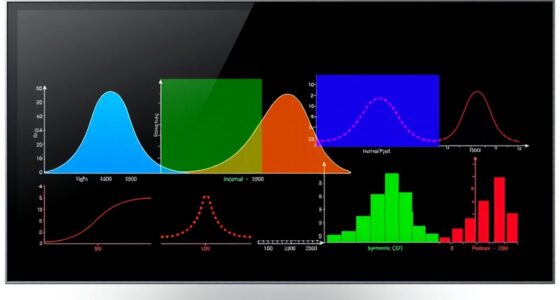

The null hypothesis (H0) suggests there’s no effect or difference in your data, serving as a baseline. The alternative hypothesis (Ha) proposes that a real effect or difference exists. When testing, you gather evidence to see if H0 can be rejected in favor of Ha. Whether you find significant results depends on your data’s strength, sample size, and p values. Keep exploring to understand how these hypotheses guide your conclusions more deeply.

Get business pricing on monitors, keyboards and dev gear
- Business-only prices and quantity discounts
- Tax-exempt purchasing
- Multiple users, one account, clear invoices
Key Takeaways
- The null hypothesis (H0) states there is no effect or difference; the alternative hypothesis (Ha) suggests a real effect exists.
- H0 is tested against data, while Ha proposes a specific effect or relationship.
- Rejecting H0 provides evidence supporting Ha; failing to reject H0 does not prove it is true.
- H0 serves as the default assumption; Ha indicates what researchers aim to prove or demonstrate.
- Both hypotheses guide analysis, with the p value helping determine whether to reject H0 based on data.

When conducting statistical tests, understanding the difference between the null hypothesis and the alternative hypothesis is essential. These two concepts form the foundation of hypothesis testing, guiding your analysis and helping you interpret data accurately. The null hypothesis, often denoted as H0, represents the default assumption that there’s no effect or difference in the population. It’s what you aim to test against, to see if your data provide enough evidence to challenge this assumption. Conversely, the alternative hypothesis, denoted as Ha or H1, suggests that there is a real effect or difference present. Your goal is to evaluate whether the data support rejecting the null hypothesis in favor of the alternative.
A critical aspect of hypothesis testing involves the sample size. The more data you collect, the more reliable your results become. A larger sample size reduces variability, making it easier to detect true effects if they exist. For example, with a small sample, random fluctuations might obscure a genuine difference or effect, leading to inconclusive or misleading results. When you have an adequate sample size, you increase the power of your test, which is the probability of correctly rejecting the null hypothesis when it’s false. This directly relates to the p value, a key metric in hypothesis testing. The p value indicates the probability of observing data as extreme as what you’ve collected if the null hypothesis is true. A small p value suggests that the observed data is unlikely under the null hypothesis, providing evidence to reject it.
Understanding the p value also helps you interpret your results in the context of your sample size. For instance, a very small p value in a large sample might confirm a statistically significant effect, but in a small sample, the same p value could be misleading due to variability. It’s crucial to consider both the p value and the sample size when drawing conclusions. If your p value is below your predetermined significance level, such as 0.05, you typically reject the null hypothesis, indicating that the evidence favors the alternative hypothesis. However, if the p value is high, you fail to reject the null, but this doesn’t necessarily mean the null is true—it might simply mean you don’t have enough evidence, possibly due to a small sample size. Additionally, understanding Speaks 4 Me Online can help enhance your communication of statistical concepts effectively.
statistics hypothesis testing kit
As an affiliate, we earn on qualifying purchases.
As an affiliate, we earn on qualifying purchases.
Frequently Asked Questions
How Do I Choose Between Null and Alternative Hypotheses?
You choose between null and alternative hypotheses based on your research design and what you aim to prove. The null hypothesis assumes no effect or difference, acting as a baseline, while the alternative suggests a significant effect. To determine which to test, consider your research question and whether you seek to establish statistical significance. Your choice guides your analysis, helping you decide if the data supports rejecting the null hypothesis.
What Are Common Mistakes in Formulating Hypotheses?
Ever wonder why your research results might be misleading? You might be making common mistakes like vague hypotheses or unclear assumptions. To prevent errors, focus on hypothesis clarity—state your null and alternative hypotheses precisely. Are you overcomplicating? Keep it simple and specific. Clear hypotheses ensure accurate testing and interpretation, helping you avoid errors that can skew your conclusions. Don’t overlook the importance of properly formulated hypotheses—they’re the foundation of solid research.
How Does Sample Size Affect Hypothesis Testing?
You should know that a larger sample size increases statistical power, making it easier to detect true effects. With a small sample, your test might lack the power needed to identify significant differences, leading to a higher chance of Type II errors. Consequently, increasing your sample size improves the reliability of your hypothesis test, ensuring you can more confidently accept or reject your null hypothesis based on stronger evidence.
Can Hypotheses Be Changed After Testing Begins?
You can change hypotheses after testing begins, but it’s generally discouraged because it affects the test’s integrity. Hypotheses should be flexible enough to adapt if new evidence arises, but changing them mid-test can lead to biased results. To maintain validity, plan your hypotheses carefully beforehand, and only adjust them if absolutely necessary, documenting the reasons for any modifications to guarantee transparent test adaptation.
What Role Do P-Values Play in Hypothesis Testing?
P-values act as your guide in hypothesis testing, revealing whether your data considerably supports or challenges your null hypothesis. When you interpret a p-value, compare it to your significance level; a small p-value suggests strong evidence against the null, while a larger one indicates weak evidence. This juxtaposition helps you decide if your results are statistically significant, shaping your conclusions based on the strength of the evidence.
As an affiliate, we earn on qualifying purchases.
Conclusion
Now that you understand the difference between the null and alternative hypotheses, imagine what could happen if you choose the wrong one in your analysis. Will you confidently accept your findings or stumble upon a surprising result that challenges your assumptions? The choice is vital, and the stakes are higher than you think. Stay curious, because uncovering the truth might just depend on how well you grasp these two powerful concepts. The next step could change everything you thought you knew.
p value calculator for hypothesis testing
As an affiliate, we earn on qualifying purchases.
As an affiliate, we earn on qualifying purchases.
As an affiliate, we earn on qualifying purchases.
Fall Picks
fall essentials
As an affiliate, we earn on qualifying purchases.