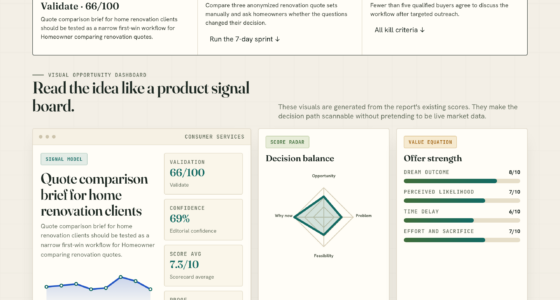

📊 Full opportunity report: The OAuth Permission Apocalypse. on ThorstenMeyerAI.com — validation score, market gap, and execution plan.

Get business pricing on monitors, keyboards and dev gear
- Business-only prices and quantity discounts
- Tax-exempt purchasing
- Multiple users, one account, clear invoices
TL;DR
A critical security flaw in OAuth deployment patterns, specifically the widespread use of permissive ‘Allow All’ permissions, has led to significant supply chain breaches in 2026. This vulnerability is akin to SQL injection, driven by default permissive settings and shadow AI integrations, affecting hundreds of organizations.
Security researchers have confirmed that a widespread pattern of permissive OAuth consent — notably the ‘Allow All’ permissions — is causing major supply chain breaches in 2026, including the recent Vercel incident. This flaw allows attackers to inherit broad enterprise access through stolen OAuth tokens, posing a significant threat to corporate security.
The recent Vercel breach involved an employee granting a third-party AI tool, Context.ai, broad access to their Google Workspace account via an ‘Allow All’ consent. When the OAuth tokens from this app were stolen, attackers gained access to sensitive corporate data, including Google Drive, Gmail, and internal environments. This incident is part of a pattern where default OAuth deployment practices favor permissiveness, creating an expansive attack surface.
Experts emphasize that OAuth itself is secure; the problem lies in how organizations deploy and authorize third-party apps. Most enterprise environments allow users to authorize apps without administrative review, and developer ecosystems often promote broad permissions as standard. Shadow AI tools, which connect to corporate identities, further amplify the risk, as they often require wide data access by design. The 2025 Drift/Salesloft breach, involving 700+ organizations and 1.5 billion records, set a precedent for this pattern, which is now recurring in 2026.
The OAuth permission
apocalypse.
“Allow All” is the new SQL injection. Shadow AI is the multiplier turning a known structural risk into the most consequential attack surface of 2026.
OAuth as a protocol is fine. OAuth as deployed across enterprise productivity stacks is structurally broken. The “Allow All” consent pattern has the same anatomy that made SQL injection OWASP #1 from 2003-2017 — well-known risk, ubiquitous deployment, slow remediation. Average enterprise user connects 50+ third-party apps to corporate identity. One click. One token theft. 700+ organizations.
SQL injection sat at OWASP #1 for 14 years. Same structural anatomy.
Both vulnerabilities have a protocol that’s fine in isolation and a deployment pattern that favors exploitability. Both have well-known mitigations. Both persist because deployment patterns spread faster than remediation. OAuth permission abuse is on year 3-4 of its dominance.
14 years of SQL injection at OWASP #1 is the historical baseline. OAuth permission abuse is on year 3-4 of dominance. Without structural intervention, expect another decade as the dominant supply-chain attack vector.
Same pattern. Different vendors. Recurring.
Drift/Salesloft was the precedent. Vercel was the recapitulation. LiteLLM was the parallel. The structural pattern — OAuth supply chain compromise leveraging “Allow All” permission grants — produces breach after breach across vendors and attack methods.
Shadow AI is not shadow IT. Three structural differences make it worse.
Shadow IT has been a known governance problem for two decades. Shadow AI is categorically different in three ways that turn a manageable problem into the dominant supply-chain attack pattern.
The platforms are responding. Incrementally.
Google and Microsoft both shipped meaningful improvements in 2026. But the default deployment behavior remains permissive. Until platform defaults change, individual employees can grant enterprise-wide access without admin review.
- Google granular OAuth consent · web apps Jan 7 · Chat apps Jan 20 · checkbox scopes
- Microsoft Agent 365 GA May 1 · Shadow AI page · prompt injection blocking · Entra controls extended to Copilot Studio
- Okta adaptive MFA for OAuth grants · centralized OAuth grant management
- ITDR vendor maturation · Push Security, Permiso, Reco AI, Obsidian, AppOmni, Nudge Security, Adaptive Shield
- Google Admin API controls · Trusted/Limited/Specific/Blocked categories
- Default platform behavior favors permissiveness. Google Workspace + M365 still ship with user-level OAuth consent enabled by default
- Granular consent applies only to new grants. Pre-existing grants unaffected
- Developer opt-in required. Many apps don’t yet support granular consent
- No automatic scope minimization for AI tools at platform layer
- No OAuth token rotation enforcement · tokens valid indefinitely
- No default audit logging surfaced in security dashboards
- No periodic re-consent requirement · forgotten grants persist
“Most Google Workspace and Microsoft 365 environments are still configured to let any employee grant third-party apps access to their enterprise account. Move to admin-managed consent. New apps get reviewed before they can touch corporate data. That one change would have blocked a Vercel employee from granting Context.ai enterprise-wide scopes in the first place.”
Six priorities. Highest-leverage first.
Don’t wait for platform defaults to change. The single highest-leverage configuration change is admin-managed consent. Each enterprise that switches removes their employees from being the next Vercel-style entry vector.
LEVERAGE
SELECTION
gmail.readonly · gmail.send · drive · calendar + contacts · Salesforce api · Slack users:read.email + channels · GitHub repo · cloud broad-scope service accounts. Each represents a potential Drift-style or Vercel-style blast radius.REVIEW
AWARENESS
PLAYBOOKS
OAuth as a protocol is fine. OAuth as deployed is structurally broken. Same anatomy as SQL injection. Same multi-year dominance ahead unless platform defaults change. One configuration change blocks the entire Vercel attack chain.
Why Permissive OAuth Permissions Are a Critical Threat
This pattern matters because it transforms OAuth from a secure protocol into a major attack surface. The ‘Allow All’ consent pattern is the equivalent of SQL injection in web applications — a well-understood vulnerability that persists due to default settings and deployment practices. As shadow AI tools become more prevalent, the potential impact of token theft expands dramatically, threatening hundreds of organizations and their data integrity.
Without intervention, this structural flaw could persist for years, enabling a new wave of supply chain attacks. The economic and reputational consequences for affected companies could be severe, especially as attackers leverage stolen tokens to access entire enterprise environments.
As an affiliate, we earn on qualifying purchases.
Historical Patterns of Structural Security Failures
The analogy of SQL injection illustrates how a protocol itself can be secure while deployment patterns create vulnerabilities. SQL injection was the top web application vulnerability from 2003 to 2017, despite well-known mitigations like parameterized queries. The persistent vulnerability was due to widespread deployment of insecure coding patterns, not protocol flaws.
Similarly, OAuth as a protocol (RFC 6749 and OAuth 2.0) remains secure. The vulnerability arises from how organizations implement OAuth, often requesting broad scopes and defaulting to permissive consent flows like ‘Allow All.’ This pattern has been reinforced by developer documentation and ecosystem practices, making it a systemic issue. The risk is compounded by shadow AI tools that require broad permissions for functionality, creating a large-scale attack surface that is difficult to audit or remediate quickly.
“OAuth as a protocol is secure; the vulnerability lies in deployment patterns favoring permissiveness, which creates an attack surface comparable to SQL injection.”
— Thorsten Meyer
enterprise OAuth permission management software
As an affiliate, we earn on qualifying purchases.
As an affiliate, we earn on qualifying purchases.
Extent and Future of OAuth Permission Exploits
While recent breaches confirm the risk posed by permissive OAuth permissions, the full extent of affected organizations remains unclear. It is also uncertain how quickly organizations will adopt structural fixes or whether new attack vectors leveraging shadow AI will emerge before remediation efforts take hold.
As an affiliate, we earn on qualifying purchases.
Expected Industry Responses and Mitigation Strategies
Industry stakeholders, including platform providers like Google, Microsoft, and Okta, are expected to implement stricter default permissions, improve audit capabilities, and promote better developer and user education. Regulatory pressure and security audits may accelerate adoption of granular consent practices. The next major step involves establishing standardized controls for permission review and revocation at scale, aiming to reduce the attack surface and prevent future supply chain breaches.
identity and access management (IAM) solutions
As an affiliate, we earn on qualifying purchases.
As an affiliate, we earn on qualifying purchases.
Key Questions
What is the main cause of the OAuth breaches in 2026?
The primary cause is the widespread deployment of permissive ‘Allow All’ OAuth consent patterns, which allow attackers to inherit broad access through stolen tokens.
How does this compare to SQL injection vulnerabilities?
Both are structural vulnerabilities that arise from deployment patterns rather than flaws in the underlying protocol. Like SQL injection, the risk persists due to default permissive configurations and widespread adoption of insecure practices.
What can organizations do to prevent these breaches?
Organizations should audit existing OAuth permissions, enforce granular consent, disable default ‘Allow All’ settings, and implement centralized controls for permission review and revocation.
Are OAuth protocols inherently insecure?
No. OAuth itself is secure; the vulnerabilities are in how it is deployed and configured within enterprise environments.
Will shadow AI tools be regulated to reduce risk?
Regulatory and platform-level measures are expected to improve oversight, but the proliferation of shadow AI remains a challenge, emphasizing the need for better security practices.
Source: ThorstenMeyerAI.com
Evergreen bestsellers Picks
bestsellers
As an affiliate, we earn on qualifying purchases.