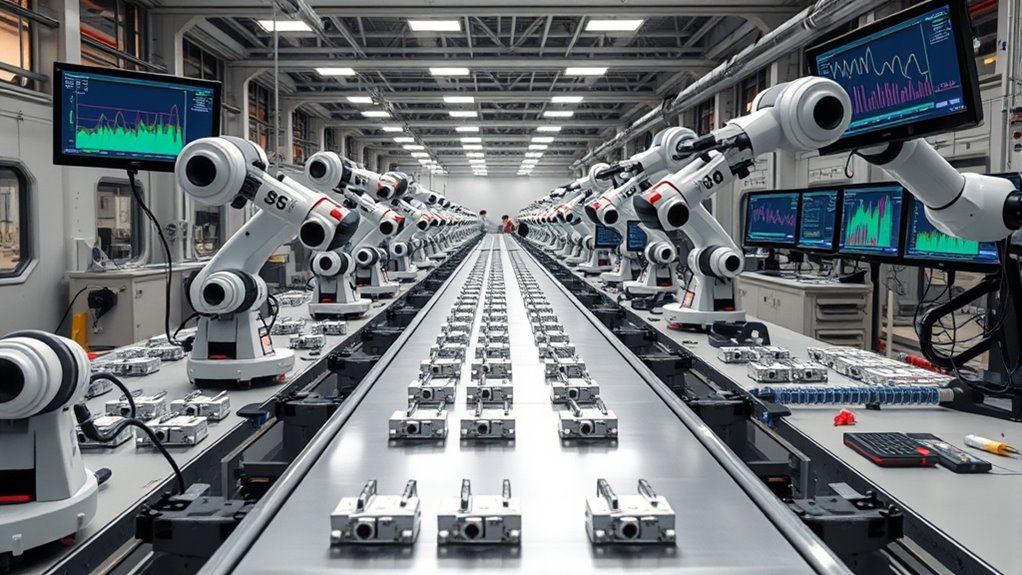

To reduce manufacturing defects, leverage data-driven quality assurance practices. Use detailed inspection protocols and real-time monitoring to identify issues early. Training your team ensures they recognize defects quickly and follow standards consistently. Incorporate techniques like Free Floating inspections and encourage open communication among staff. Continuously analyze data to pinpoint root causes and implement improvements. Embracing these strategies helps prevent defects before they reach customers, and exploring more will reveal how data can transform your quality efforts.

Get business pricing on monitors, keyboards and dev gear
- Business-only prices and quantity discounts
- Tax-exempt purchasing
- Multiple users, one account, clear invoices
Key Takeaways
- Utilize data analytics to identify defect patterns and root causes for targeted process improvements.
- Implement real-time monitoring and inspection data to detect deviations early and prevent defective products.
- Leverage statistical process control (SPC) tools to maintain consistent quality levels and reduce variability.
- Analyze historical inspection data to refine standards and optimize inspection protocols continually.
- Foster data-driven decision making among staff to enhance defect prevention and promote continuous quality improvement.

Quality assurance plays a essential role in manufacturing by ensuring products meet specified standards and customer expectations. When you focus on rigorous inspection protocols, you create a systematic approach to identify defects early in the production process. These protocols serve as a set of detailed procedures that guide your team in checking materials, components, and finished products. By adhering to well-defined inspection standards, you minimize the risk of defective items reaching customers, which ultimately boosts product reliability and brand reputation. Implementing effective inspection protocols requires consistency and discipline. You need to establish checkpoints at critical stages, utilize the right testing tools, and enforce strict documentation practices. This guarantees that every product undergoes thorough evaluation, reducing the chances of overlooking issues that could lead to costly recalls or warranty claims later.
Alongside robust inspection protocols, employee training plays a indispensable role in maintaining high-quality standards. When your workforce understands the importance of quality assurance, they become proactive contributors to defect reduction. Training sessions should focus on familiarizing employees with inspection techniques, quality standards, and the specific requirements of each product. You want your team to recognize potential defects, understand how to operate testing equipment properly, and be aware of common issues that could arise during production. Well-trained employees are more confident and efficient, which translates into fewer mistakes and better adherence to inspection protocols. Continuous training also keeps your team updated on new inspection methods, quality benchmarks, and industry best practices. This ongoing education creates a culture of quality, where everyone feels responsible for detecting and preventing defects. Additionally, integrating Free Floating inspection techniques can further enhance defect detection efficiency by allowing flexible and adaptive evaluations across different production stages.
You should also foster open communication and feedback loops between your inspectors, production staff, and quality managers. When employees are well-trained and understand the significance of their role, they’re more likely to report abnormalities or suggest improvements. Combining thorough inspection protocols with comprehensive employee training ensures that quality isn’t just a checkpoint but an ongoing commitment. It empowers your team to catch issues before they escalate, reducing waste and enhancing overall efficiency. Remember, quality assurance isn’t a one-time effort; it’s a continuous process that relies on clear protocols and well-informed personnel. When you prioritize these elements, you create a resilient manufacturing environment where defects are minimized, customer satisfaction increases, and your reputation for excellence remains intact.
statistical process control tools for manufacturing
As an affiliate, we earn on qualifying purchases.
As an affiliate, we earn on qualifying purchases.
Frequently Asked Questions
How Does Real-Time Data Influence Defect Detection Accuracy?
Real-time data markedly boosts defect detection accuracy by enabling you to quickly identify issues. With sensor integration, you get continuous, precise insights into manufacturing processes, allowing immediate responses. Predictive analytics analyzes this data to forecast potential defects before they happen. This combination helps you catch defects early, reduce waste, and improve overall product quality, making your quality assurance process more proactive and effective.
What Are the Latest Technologies Used in Manufacturing Quality Assurance?
Did you know that AI Inspection now reduces defect rates by up to 50%? You can leverage the latest technologies like AI Inspection, which uses machine learning to identify flaws faster and more accurately. Predictive Analytics helps you anticipate potential issues before they occur, minimizing downtime and waste. By adopting these innovations, you’ll improve product quality, streamline processes, and stay ahead of competitors in today’s fast-paced manufacturing environment.
How Can Small Manufacturers Implement Effective Data-Driven QA?
You can implement effective data-driven QA by focusing on process standardization and supplier collaboration. Standardize procedures to guarantee consistency and make data collection easier. Work closely with your suppliers to share quality data, identify issues early, and address them collaboratively. Use simple analytics tools to monitor defect trends and improve processes continually. This approach helps reduce defects, enhances product quality, and streamlines your manufacturing operations efficiently.
What Training Is Needed for Staff to Interpret QA Data Effectively?
Did you know that companies with strong data literacy are 3 times more likely to make better decisions? To interpret QA data effectively, you need training that boosts your analytical skills and understanding of data. Focus on teaching staff how to read charts, identify trends, and use data tools. This way, you’ll empower your team to spot issues early and improve product quality consistently.
How Do Data Privacy Concerns Impact Manufacturing Quality Data Sharing?
Data privacy concerns profoundly impact manufacturing quality data sharing. You must follow confidentiality policies to protect sensitive information and prevent leaks. Implement data anonymization techniques to remove identifiable details, ensuring that sharing insights doesn’t compromise privacy. By doing so, you balance transparency with security, enabling effective collaboration and continuous improvement without risking data breaches or violating privacy regulations.
real-time inspection monitoring devices
As an affiliate, we earn on qualifying purchases.
As an affiliate, we earn on qualifying purchases.
Conclusion
So, after all this talk about data and precision, you might think quality assurance is foolproof. Yet, even with the best systems, defects still sneak through—proof that no process is perfect. Ironically, it’s often the relentless pursuit of perfection that reminds you how imperfect manufacturing can be. But hey, at least with data, you’re better equipped to catch those flaws… or so you hope. After all, perfection remains just out of reach.
manufacturing defect detection equipment
As an affiliate, we earn on qualifying purchases.
As an affiliate, we earn on qualifying purchases.
quality inspection tools for production lines
As an affiliate, we earn on qualifying purchases.
As an affiliate, we earn on qualifying purchases.
Fall Picks
fall essentials
As an affiliate, we earn on qualifying purchases.