📊 Full opportunity report: Mac vs GPU Tower for Local LLMs: The Heat-and-Noise Tradeoff on ThorstenMeyerAI.com — validation score, market gap, and execution plan.

Get business pricing on monitors, keyboards and dev gear
- Business-only prices and quantity discounts
- Tax-exempt purchasing
- Multiple users, one account, clear invoices
TL;DR
This article compares Mac Silicon machines and GPU towers for local large language model inference, focusing on heat, noise, capacity, and performance. The choice depends on model size and operational priorities.
Apple Silicon machines like the Mac Studio are near-silent and produce minimal heat, contrasting sharply with GPU towers that generate significant heat and noise. This fundamental difference influences the choice of hardware for local large language model (LLM) inference, depending on model size and performance needs.
Recent analysis highlights that GPU towers, such as those equipped with RTX 5090 cards, deliver high memory bandwidth (~1,792 GB/s) and are capable of running models that fit within their VRAM (24–32GB per card), offering 3–4 times faster token generation than Macs. However, they consume substantial power (575–800W+) and produce heat requiring complex cooling solutions, often involving multiple fans and thermal management strategies.
In contrast, Apple Silicon machines like the Mac Studio with M3 Ultra chips leverage a unified memory architecture, supporting up to 512GB of shared memory. While their memory bandwidth (~819 GB/s) is lower, they can load and run large models (e.g., 70B parameters) that exceed GPU VRAM capacities, albeit at slower inference speeds. Their design results in near-silent operation and minimal heat output, making them ideal for continuous, quiet use.
Mac vs GPU tower
for local LLMs.
What if you sidestep the heat entirely with a different kind of machine? A tower is a high-bandwidth furnace you spend five levers quieting. Apple Silicon is near-silent by design — but asks for different tradeoffs. Match your priority in Part 2.
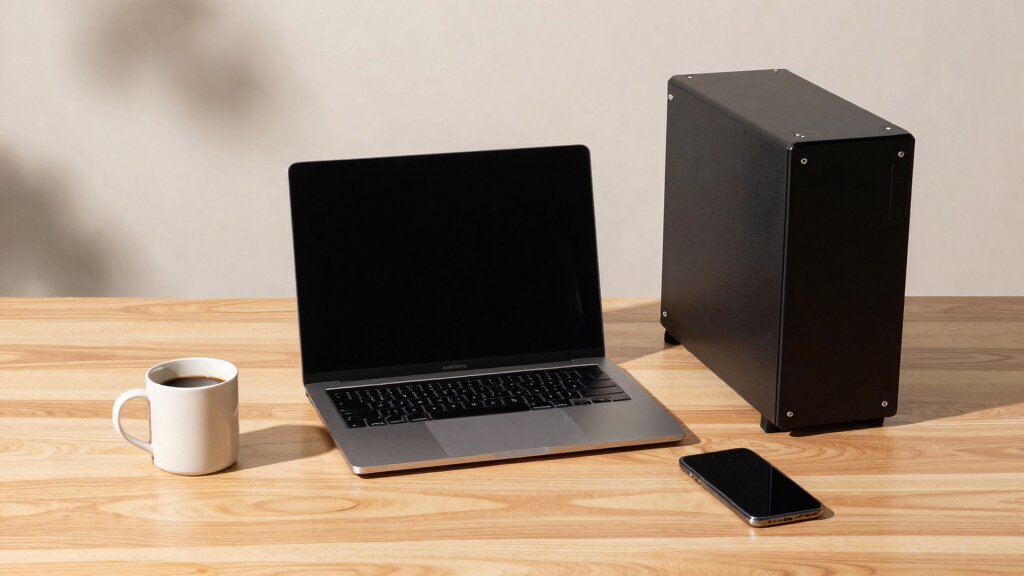
Put the loud, hot machine where its noise doesn’t matter, and the quiet one where you do. SSH into the tower when you need raw power; let the Mac handle everything else, silently.
Why Heat and Noise Are Critical in AI Hardware Choices
The heat and noise profiles of these architectures directly impact operational costs, comfort, and practicality. GPU towers demand active thermal management, which can be noisy and energy-intensive, while Mac Silicon's silent operation offers a compelling alternative for users prioritizing low noise and power efficiency. This distinction influences deployment decisions for AI practitioners, startups, and enterprises considering local inference solutions.
As an affiliate, we earn on qualifying purchases.
Evolution of Hardware for Local Large Language Models
Traditionally, GPU-based systems have dominated high-performance AI workloads due to their superior bandwidth and ecosystem support, enabling fast inference and training. Recent developments in Apple Silicon, with increased memory capacity and optimized architectures, have begun to challenge this paradigm, especially for models that exceed GPU VRAM but fit within the unified memory pool. The debate centers on whether speed or silence and low power are more critical for specific use cases.
"The architectural crux: bandwidth versus capacity is the key to understanding the Mac versus GPU tower debate."
— Thorsten Meyer
quiet Mac Studio for machine learning
As an affiliate, we earn on qualifying purchases.
As an affiliate, we earn on qualifying purchases.
Unanswered Questions About Long-Term Performance and Scalability
It remains unclear how future GPU and Apple Silicon hardware updates will shift these tradeoffs, particularly regarding multi-GPU scaling, ecosystem support, and real-world inference speeds for increasingly large models. Additionally, the long-term durability and maintenance costs of high-power GPU rigs versus low-power Macs are still to be fully evaluated.
As an affiliate, we earn on qualifying purchases.
Expected Developments in Hardware for Local AI Inference
Upcoming GPU releases may improve power efficiency and noise profiles, while Apple Silicon chips are expected to continue increasing memory capacity and inference performance. The industry will likely see more hybrid approaches, and further comparisons will clarify which hardware suits specific workloads best. Users should monitor these advancements to inform their hardware investments.
As an affiliate, we earn on qualifying purchases.
Key Questions
Can a Mac run large language models as effectively as a GPU tower?
Macs can run models larger than their VRAM capacity by leveraging shared memory, but inference speeds are generally slower compared to GPU towers for models that fit entirely within GPU VRAM.
Is the heat and noise difference significant enough to choose a Mac over a GPU tower?
Yes, for users prioritizing a quiet, low-power setup, the near-silent operation of Macs is a decisive advantage, especially for continuous or office environments.
Will future GPU hardware reduce heat and noise issues?
Potentially, as new GPU architectures focus more on power efficiency and integrated cooling solutions, but current high-performance GPUs remain power-hungry and noisy compared to Macs.
What are the limitations of using a Mac for large AI models?
The primary limitation is slower inference for models that exceed GPU VRAM and less mature ecosystem support for training and fine-tuning compared to NVIDIA's CUDA ecosystem.
Source: ThorstenMeyerAI.com
Fall Picks
fall essentials
As an affiliate, we earn on qualifying purchases.