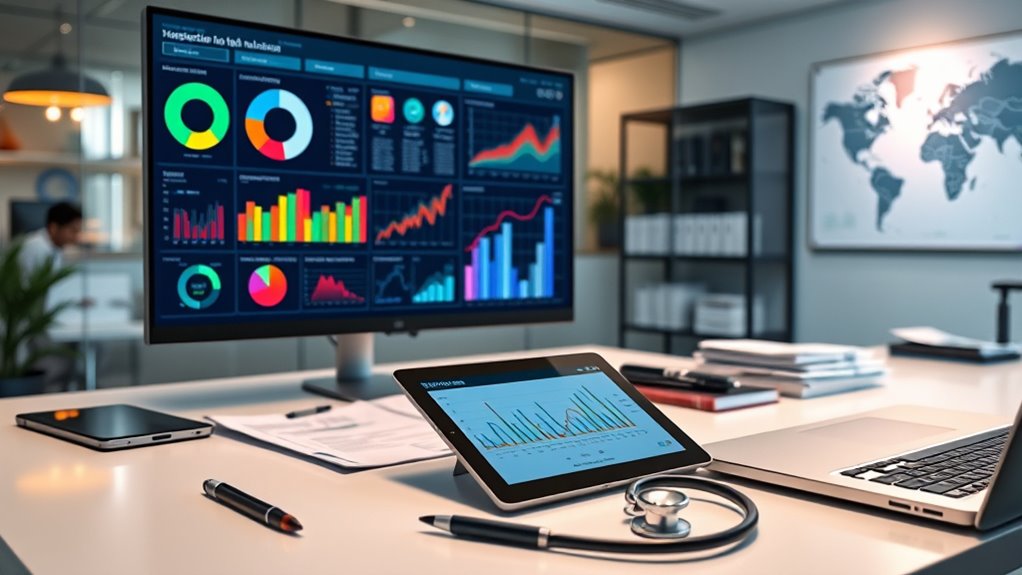

Healthcare analytics uses data to improve patient outcomes and streamline operations. By applying predictive modeling, you can identify high-risk patients early and tailor treatments to individual needs. Data visualization tools like charts and dashboards help you quickly understand trends, outliers, and resource demands. Combining these techniques supports proactive decisions, reducing guesswork and bias. If you want to learn how these strategies can transform healthcare delivery, keep exploring the key concepts that make it all possible.

Get business pricing on monitors, keyboards and dev gear
- Business-only prices and quantity discounts
- Tax-exempt purchasing
- Multiple users, one account, clear invoices
Key Takeaways
- Healthcare analytics leverages data to improve patient outcomes through predictive modeling and data-driven insights.
- Predictive modeling identifies high-risk patients and supports personalized, proactive treatment plans.
- Data visualization simplifies complex healthcare data, enabling quick interpretation and informed decision-making.
- Integration of predictive models and dashboards optimizes resource allocation and streamlines healthcare operations.
- The future of healthcare analytics promises enhanced patient care, efficiency, and technological advancements.

Have you ever wondered how healthcare providers use data to improve patient outcomes? It all begins with healthcare analytics, a powerful tool that transforms raw information into actionable insights. At the core of this process lies predictive modeling, a technique that leverages historical data to forecast future events or trends. By analyzing patterns in patient records, lab results, and treatment histories, predictive modeling helps clinicians identify individuals at high risk for certain conditions, such as heart disease or diabetes. This proactive approach allows for earlier interventions, personalized treatments, and ultimately better health outcomes. As these models become more sophisticated, they can incorporate various factors—demographics, lifestyle, genetics—to refine their predictions, ensuring care is tailored to each patient’s unique profile.
But making sense of complex data isn’t just about numbers and calculations; it’s about presenting information in a way that’s easy to understand and act upon. This is where data visualization plays an essential role. Visual tools like charts, graphs, heat maps, and dashboards distill vast amounts of data into visual formats that reveal trends and relationships at a glance. Imagine a healthcare provider reviewing a dashboard that highlights rising infection rates across different regions or patient groups. These visual cues allow for quick decision-making and resource allocation, especially during public health emergencies. Data visualization not only makes data more accessible but also helps identify outliers, track progress over time, and communicate findings effectively to both clinical staff and administrators.
In practice, healthcare analytics combines predictive modeling and data visualization to create an extensive picture of patient health and system performance. For example, predictive models might flag patients who are likely to need hospitalization soon, while visual dashboards display real-time data on bed occupancy, staffing levels, and patient flow. This integrated approach enables healthcare teams to prioritize interventions, optimize workflows, and improve overall efficiency. It also facilitates evidence-based decision-making, reducing guesswork and bias. Additionally, understanding the importance of high contrast ratios in data presentation can significantly enhance the clarity and impact of visual reports.
In essence, healthcare analytics empowers providers to move from reactive to proactive care. By harnessing the power of predictive modeling and data visualization, you can anticipate challenges before they escalate, allocate resources more effectively, and deliver personalized treatment plans. This not only enhances patient experiences but also streamlines healthcare operations, making the entire system more responsive and efficient. As technology advances, the potential of healthcare analytics will only grow, transforming how care is delivered and how outcomes are achieved.
Frequently Asked Questions
How Does Healthcare Analytics Improve Patient Outcomes?
Healthcare analytics improves your patient outcomes by leveraging predictive modeling to identify risks early and tailor treatments accordingly. Data visualization helps you spot trends and patterns quickly, enabling proactive interventions. You can make more informed decisions, optimize resource allocation, and enhance care quality. By understanding these insights, you’re empowered to provide personalized, timely care that leads to better recovery rates and overall patient satisfaction.
What Are the Biggest Challenges in Implementing Healthcare Analytics?
Implementing healthcare analytics faces key challenges like data integration, which can be complex due to disparate systems and formats. You also need to invest in staff training to guarantee your team understands how to interpret and use analytics effectively. Overcoming these obstacles requires careful planning and resource allocation, but doing so will ultimately help you improve patient outcomes and streamline healthcare delivery.
How Is Patient Privacy Protected in Healthcare Data Analysis?
You might think patient privacy is just about avoiding leaks, but it’s more about active protection. Data encryption safeguards sensitive information by making it unreadable without proper keys, while access controls ensure only authorized personnel can view or handle data. These measures work together to keep patient data secure during analysis, helping you comply with regulations and maintain trust, all while allowing valuable insights to improve healthcare outcomes.
What Future Trends Will Shape Healthcare Analytics?
You’ll see future healthcare analytics driven by AI integration and advanced predictive modeling. These trends will enable you to anticipate patient needs more accurately and personalize treatments effectively. As AI becomes more sophisticated, expect real-time data analysis to improve decision-making. Embracing these innovations helps you stay ahead, making healthcare more efficient and patient-centered while steering through evolving technologies and data challenges in the industry.
How Can Small Clinics Leverage Healthcare Analytics Effectively?
You can leverage healthcare analytics effectively by focusing on electronic health records and data interoperability. By integrating patient data seamlessly across systems, you improve care coordination and decision-making. Use analytics tools to identify patterns, optimize resource allocation, and enhance patient outcomes. Embracing these technologies enables small clinics to compete with larger organizations, providing personalized care while streamlining operations and making informed, data-driven decisions that benefit both your practice and your patients.
Conclusion
Don’t let hesitation hold you back from harnessing healthcare analytics. It might seem complex, but with the right tools, you can make smarter decisions that improve patient outcomes and streamline operations. Embracing analytics isn’t just a trend; it’s a necessity in today’s fast-paced healthcare world. Start small, learn as you go, and watch how data-driven insights transform your practice. The future of healthcare is here—are you ready to take the leap?
Fall Picks
fall essentials
As an affiliate, we earn on qualifying purchases.