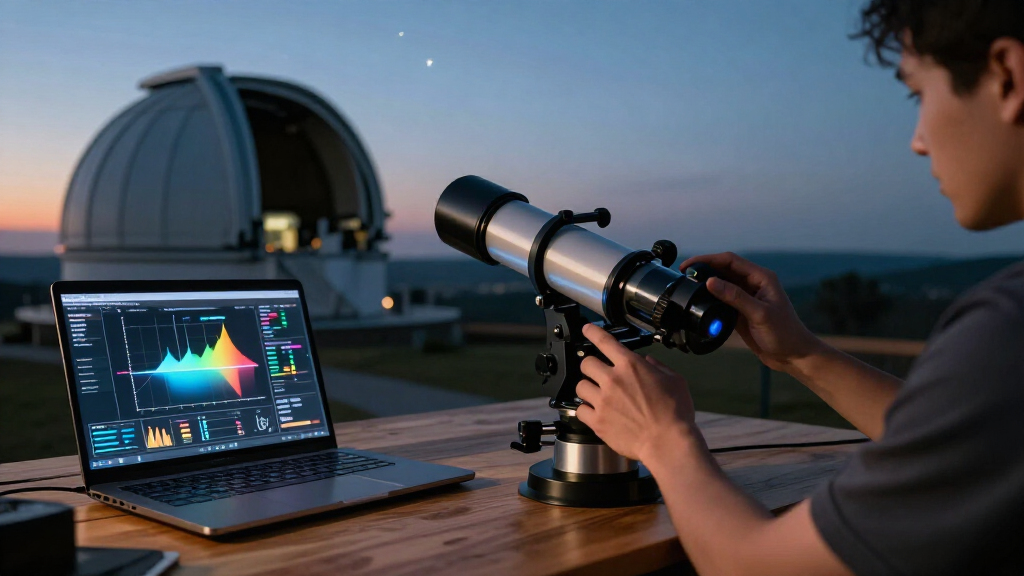
🔍 Read the full analysis: What Can Astra Reveal About Planets Beyond Our Reach? on ThorstenMeyerAI.com

Get business pricing on monitors, keyboards and dev gear
- Business-only prices and quantity discounts
- Tax-exempt purchasing
- Multiple users, one account, clear invoices
TL;DR
Two amateur astronomers used AI tools to search public telescope archives and flag possible exoplanet signals. An independent SETI Institute search found two of the same Kepler signals, but researchers have not confirmed that either is caused by a planet.
Two amateur astronomers have used AI tools to search public telescope observations for possible planets, flagging signals in data from NASA’s Kepler and TESS missions. An astronomer at the SETI Institute independently found two of the Kepler signals, but the overlap does not confirm planets: researchers are still testing whether the recurring dips in starlight have other explanations.
OpenAI engineer Kevin Bond used Codex to build and run a search of Kepler observations covering about 100,000 stars. The program flagged more than 200 signals, including 10 associated with planets already confirmed. Two additional signals drew attention: one from star KIC 5689121, with a dip in brightness every 13.8 days, and another from KIC 6691030, with a dip every 4.8 days.
If the first signal is caused by a planet, the amount of light blocked would be consistent with a world about 2.4 times Earth’s diameter. The second is consistent with a planet smaller than Neptune. Those are interpretations of the signals, not established descriptions of confirmed planets. A SETI Institute astronomer’s independent search also found both signals in Kepler data, making them candidates for further assessment rather than verified discoveries.
Ethan Byrd, founder of the email infrastructure startup Primitive, used the AI tool Astra to design two searches drawing on TESS observations and other public telescope archives. One search looked broadly for possible candidates; the other focused on stars’ habitable zones. Its first pass returned 49 candidates. Byrd sent one of his strongest candidates to TESS mission researchers for analysis, while two others are awaiting submission. His search is continuing.
Searching for distant planets with Astra
Amateur astronomers used AI tools to search public telescope data and surface possible exoplanet signals. Every candidate still needs analysis and confirmation.
Two searches, one shared signal
An independent SETI Institute search found the same two signals in Kepler data.
- Reviewed observations from about 100,000 stars.
- Flagged more than 200 signals, including 10 linked to confirmed planets.
- Searched TESS observations and other public telescope archives.
- Sent one candidate to TESS researchers; two more await submission.
What a light curve can show
A planet passing in front of a star can create a dip in its brightness.
AI tools scan many stellar brightness records for recurring dips.
Repeated dimming can suggest an orbiting world, but other causes can look similar.
Researchers analyze the signals and seek follow-up observations.
Why confirmation matters
The repeated dips have not established that either signal comes from a planet.
Orbiting planet
A planet crossing its star can block a small amount of starlight.
Another event
A second star or changes in telescope instruments can also produce apparent dimming.
AI Can Widen the Search
The searches show how AI-assisted tools can help individuals examine large public archives and bring possible signals to researchers’ attention. A program can apply search methods across many stellar light curves, identify patterns that may merit attention, and help prioritize them for human review. That may help researchers revisit data through new searches, but a flagged pattern is only a starting point.
The practical value will depend on what survives independent analysis. Astronomers must test whether the signals are best explained by planets and rule out competing causes. In this case, the independent match for Bond’s two signals is a reason to investigate them further; it does not, by itself, establish their origin. No confirmation rate for the candidate lists is provided, so the number of signals that will withstand review remains unknown.
Popular right now

KitchenAid Artisan 5-Qt Tilt-Head Stand Mixer, Cardamom

De'Longhi La Specialista Touch Semi-Automatic Espresso Machine with Grinder

Bose QuietComfort Ultra Earbuds (2nd Gen), Wireless Noise-Cancelling Earbuds, Black
As an affiliate, we earn on qualifying purchases.
How Telescope Dips Become Candidates
NASA’s Kepler Space Telescope, which operated from 2009 to 2018, measured changes in stars’ brightness. When a planet crosses in front of its star as seen from Earth, it blocks a small amount of light. The resulting dip appears in a graph called a light curve. Dips recurring at regular intervals can point to an orbiting planet, but they can also result from other events or instrument effects.
Computational searches have already contributed to exoplanet research. In 2017, researchers trained a neural network using 15,000 signals astronomers had previously examined. Applying it to weaker Kepler signals helped identify an eighth planet orbiting Kepler-90. That prior result provides context for AI-supported searches, but it does not validate the current candidates. The Bond and Byrd projects’ signals still require their own analysis and evidence.
Signals Still Need Verification
None of the candidates described here is confirmed as a planet. A dip in starlight can also occur when two stars pass in front of one another, and temperature changes can affect a telescope’s instruments. The available information does not give the full status of every candidate or identify a confirmed cause for the two signals found by both Bond’s search and the SETI Institute astronomer.
Researchers can use statistical analysis to compare possible explanations and seek further observations. One approach is to measure a star’s slight motion under a planet’s gravity, which can show up as shifts in the color of its light. The source material gives no fixed resolution schedule; it says that settling candidates may take months to years. It also does not report how many of the flagged signals are likely to survive expert review.
Researchers Begin Candidate Checks
TESS mission researchers are expected to analyze the candidate Byrd submitted. Two additional candidates from his Astra search are awaiting submission, and the search is continuing. For Bond’s two Kepler signals, further analysis and, if needed, follow-up observations can test whether the dimming repeats at the reported intervals and whether stellar or instrumental effects offer a better explanation.
The next meaningful milestone is independent assessment of the data, followed by observations that can distinguish a planetary transit from other causes where necessary. Any claim that one of these signals represents a planet would require stronger evidence and scrutiny from other researchers. Until that work is reported, the results remain candidate signals identified through AI-assisted searches.
Key Questions
Have the searches discovered new planets?
No. The searches identified potential candidates, and researchers have not confirmed that the signals come from planets.
What did the independent SETI Institute search find?
A SETI Institute astronomer independently found the same two Kepler signals flagged by Kevin Bond’s program. That overlap supports further investigation, but it does not prove the signals are planetary.
What did the Astra search identify?
Ethan Byrd’s first Astra-assisted search pass returned 49 candidates using TESS observations and other public telescope archives. One was sent to TESS mission researchers for analysis; two others are awaiting submission.
What can cause a recurring dip in a star’s light?
A planet crossing in front of its star is one possible cause. A pair of stars passing in front of one another or changes affecting telescope instruments can also produce dimming signals.
When will the candidates be resolved?
No specific date is available. The source material says assessment could take months to years, depending on the analysis and any follow-up observations needed.
Primary source: OpenAI · via ThorstenMeyerAI.com