
🔍 Read the full analysis: How “OORT — Comet Vigil For P/2043 K1 Vesper” Uses Held Light To Build Atmosphere on ThorstenMeyerAI.com

Get business pricing on monitors, keyboards and dev gear
- Business-only prices and quantity discounts
- Tax-exempt purchasing
- Multiple users, one account, clear invoices
TL;DR
OORT — Comet Vigil for P/2043 K1 Vesper is an AI-built web exhibition about a fictional observatory watching a fictional comet. Its star trails accumulate while a visitor stays, and its interactive instruments make waiting—not a simulated discovery—the central experience.
OORT — Comet Vigil for P/2043 K1 Vesper, an online exhibition identified as room 170 of 175 in the FABLE/175 series, turns a visitor’s time on its page into part of the artwork. The AI-built site imagines an observatory tracking a fictional comet, using accumulating star trails and interactive orbital graphics to make the act of waiting visible rather than presenting a real astronomical observation.
The site’s central device is a canvas star field whose curved trails lengthen as time passes. A repeatable seed keeps the sky consistent on the same device, while local storage preserves elapsed time so the display can resume when a visitor returns. The page’s hidden-tab behavior pauses the animation loop, and a reduced-motion setting provides a still version, according to the project description.
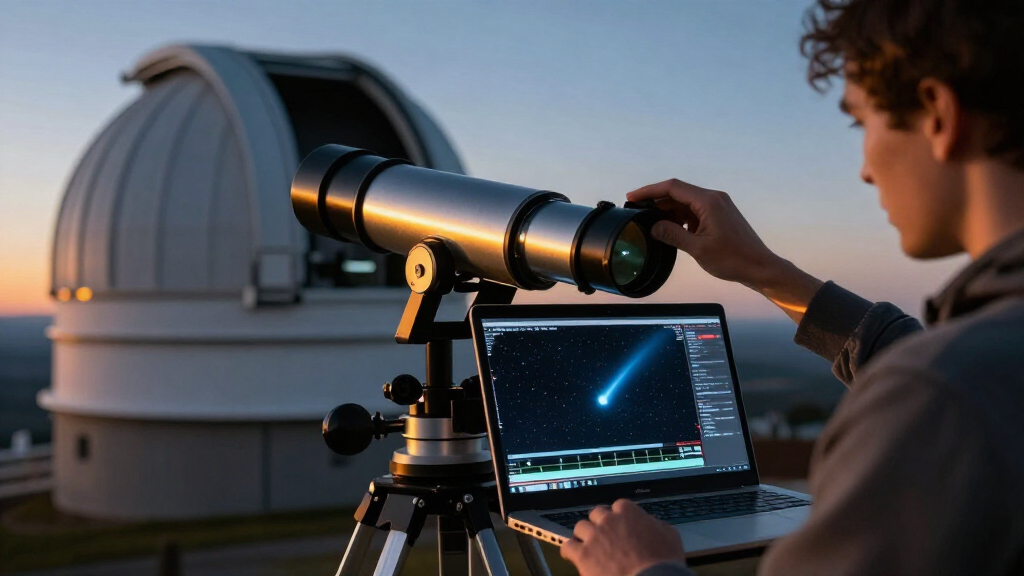
A second instrument uses scrolling to move the imagined comet through an inline SVG orbit. Its ion tail is drawn pointing away from the sun, while the dust tail curves along the fictional orbit; both respond to a shared progress value. A range control adjusts a defocused view and an associated brightness estimate. Visitors can also hold a control briefly to trigger a simulated shutter: the site records a timestamp, but does not pretend to show a newly captured comet image.
The exhibition’s visual language evokes a dark-adapted observatory: black backgrounds, cyan for the ion tail and readings, red-orange for actions, and pale text for longer passages. Display lettering and monospaced coordinates reinforce the feel of an instrument log. The project description says the room was built with HTML, CSS and JavaScript without frameworks or external requests; its footer links to the art-direction prompt, and a separate design guide discusses how the visual and interactive elements work together.
How “OORT — Comet Vigil For P/2043 K1 Vesper” Uses Held Light To Build Atmosphere
Your visit is the exposure. This AI-built web exhibition turns time on the page into part of the artwork: star trails accumulate, orbital instruments respond, and a simulated shutter records attention without claiming a real discovery.
When a visit becomes an exposure
OORT makes waiting visible instead of treating it as a delay. Each interaction extends the fiction of a shared vigil around an unseen comet.
A sky that remembers
A seeded canvas keeps the star field consistent on the same device. Curved trails lengthen with elapsed time; local storage can preserve that time so the display resumes on return.
A comet in transit
Scrolling advances an imagined comet through an inline SVG orbit. The ion tail points away from the sun; the dust tail curves along the fictional path.
Attention, not evidence
Holding a control briefly triggers a simulated shutter and records a timestamp. It does not reveal a newly captured image: the comet remains unseen.
One shared sense of progress
The page links duration, movement and observation into a small set of responsive instruments.
Elapsed time leaves a trace
A repeatable seed anchors the sky. A local elapsed-time record supports continuity on return. The description says animation pauses in a hidden tab and offers a still presentation for reduced-motion settings.
Movement changes the instrument
Scroll progress moves the fictional comet through its orbit. A range control adjusts a defocused view and its associated brightness estimate; the tail directions reinforce the imagined geometry.
From brief to observatory
The creative brief supplies a fictional world. Its astronomical language is a narrative device, not a report about a verified object.
Invent the vigil
A fictional observatory watches P/2043 K1 Vesper as a decades-long communal vigil.
Build the instruments
HTML, CSS and JavaScript create trails, orbital graphics and simulated readings.
Refine in three passes
Initial build and critique, critique-led revision, then final art-direction review.
Make time the medium
Visitor presence becomes the exposure; the comet stays in transit and unseen.
“Your visit is the exposure.”
The art-direction brief pairs long-exposure effects with invented observer logs, an ephemeris-style table, magnitude-estimation material and a backstory about a last sighting in 1608. These belong to the fictional setting, not independently verified records.
What the project does not verify
P/2043 K1 Vesper is described as fictional. The available project description outlines intended behavior and links to the room and design guide, but it does not provide independent technical testing, performance measurements or an accessibility audit. It also does not establish how local persistence behaves across browsers or devices. Reduced-motion support and hidden-tab pausing are described design features, not independently confirmed results.
At a glance
Keep the boundary between the artwork’s fiction and real astronomical evidence clear.
Is P/2043 K1 Vesper a real comet?
No. The project describes it as a fictional object in an imagined observatory.
What changes while someone stays?
Curved star trails lengthen over time. The seeded sky and local time record are described as supporting continuity on the same device.
Does the shutter show a comet image?
No. It records a timestamp after a simulated shutter action; it does not capture a comet.
Where can readers explore?
The source points to the live OORT room, its design guide and the wider FABLE/175 collection.
When a Visit Becomes an Exposure
OORT’s main point is not a claim about astronomy but a design choice: time spent on the page changes what visitors see. Many websites treat waiting as a delay before content loads; this one makes duration its subject. Returning to a locally preserved sky gives the visitor’s session a visible trace, while the shutter action records attention without manufacturing a discovery.
That distinction matters because the interface borrows the authority and vocabulary of scientific observation. The fictional framing, simulated readings and explicitly staged shutter help separate artistic interaction from real evidence. The result can be read both as an online artwork and as a demonstration of how code, motion and persistence can carry a narrative without relying on photographs or a real comet event.
The piece also brings accessibility and browser behavior into its stated design brief. It describes reduced-motion support and pausing animation when the tab is hidden. Those details show how an artwork built around motion can offer a quieter presentation and avoid continuing its animation when it is not visible, though the supplied source does not report independent testing of those features.
As an affiliate, we earn on qualifying purchases.
A Fictional Vigil, Built in Code
The source describes OORT as part of a series of 175 AI-built exhibition rooms, with this installation numbered 170. Its fictional observatory watches P/2043 K1 Vesper, a made-up comet, and presents the premise as a decades-long communal vigil. The title’s astronomical framing is therefore a narrative device, not an announcement of a newly identified object.
The project’s art-direction brief calls for long-exposure effects, invented observers’ logs, an ephemeris-style table, magnitude-estimation material and a backstory involving a last sighting in 1608. These are elements of the fictional setting in the brief, not independently verified historical or astronomical records. The source also describes a three-pass production process: an initial build and self-critique, a critique-and-revision stage, and a final art-direction review. It says the original brief is exposed through the room’s footer and that the accompanying guide documents the design.
“The page makes duration part of the artwork instead of treating it as time spent before the content.”
— Project description on ThorstenMeyerAI.com
As an affiliate, we earn on qualifying purchases.
What the Project Does Not Verify
The source presents OORT as a fictional observatory tracking a fictional comet; it does not establish that P/2043 K1 Vesper is a real astronomical body. The invented logs, orbital framing and historical provenance in the creative brief should not be treated as factual observing records.
The available description outlines intended behavior and links to the live room and design guide, but it does not provide independent technical testing, performance measurements or accessibility audit results. It is also not clear from the supplied material how the site’s local persistence behaves across different browsers or devices, or whether the implementation differs from the brief in any details.
As an affiliate, we earn on qualifying purchases.
Explore the Room and Its Guide
Readers can visit the live OORT room to see how its star field changes over time and use the scrolling and shutter interactions. The project points to a design guide for further detail on the seeded canvas, orbit graphic, palette and typography, and to the FABLE/175 hub for the wider collection. No new release, observing milestone or update schedule is specified in the supplied material.
As an affiliate, we earn on qualifying purchases.
Key Questions
Is P/2043 K1 Vesper a real comet?
No. The project describes P/2043 K1 Vesper as fictional, part of an imagined observatory and an artwork about waiting.
What changes while a visitor stays on the page?
A canvas field’s curved star trails lengthen over elapsed time. The description says the sky uses a repeatable seed and stores elapsed time locally so it can resume when the visitor returns on the same device.
Does the shutter interaction reveal an image of the comet?
No. Holding the control triggers a simulated shutter and records a timestamp; the comet remains unseen in the project’s fiction.
How does the comet illustration move?
Scrolling advances the comet through an inline SVG diagram. The described ion tail points away from the sun, while the dust tail curves along the imagined orbit.
Where can visitors find the project?
The source links to the live OORT room and its design guide, and identifies it as room 170 in the FABLE/175 collection.
Source: ThorstenMeyerAI.com
Halloween Picks
halloween
As an affiliate, we earn on qualifying purchases.