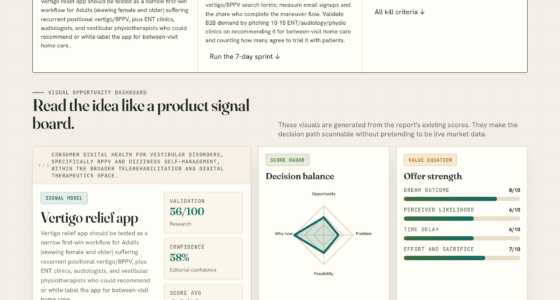

📊 Full opportunity report: When One Agent Isn’t Enough: Claude Now Builds Its Own Team of Agents on the Fly on ThorstenMeyerAI.com — validation score, market gap, and execution plan.

Get business pricing on monitors, keyboards and dev gear
- Business-only prices and quantity discounts
- Tax-exempt purchasing
- Multiple users, one account, clear invoices
TL;DR
Anthropic’s Claude introduces a new feature allowing it to dynamically assemble and orchestrate its own team of agents for complex tasks. This development aims to address limitations of single-agent workflows, especially for high-value, multi-step projects. The capability is currently in testing and targeted at advanced use cases.
Anthropic’s Claude has introduced a new feature that enables it to build its own team of specialized agents on the fly during complex tasks, a development aimed at improving performance on high-value, multi-step projects.
This new capability, called dynamic workflows, allows Claude to generate a custom orchestration harness—essentially a mini-program—that manages multiple subagents, each with a focused goal and isolated context. This approach addresses common failure modes in single-agent setups, such as agentic laziness, self-preferential bias, and goal drift.
Mechanically, Claude writes and executes a small JavaScript program that spawns, coordinates, and manages subagents, selecting appropriate models for each task and ensuring parallel agents do not interfere with each other. This system can resume interrupted workflows and tailor the orchestration to the specific task, making it more adaptable than static, hand-built workflows.
According to Anthropic, this feature is primarily intended for complex, high-value tasks, and is not recommended for simple operations like fixing typos. The feature is currently in testing, with plans for broader deployment as the technology matures.
When one agent isn’t enough: Claude now builds its own team on the fly
Skills package what you know; loops decide how far you delegate over time. Dynamic workflows are the third axis — within a single task, Claude writes its own harness and assembles a temporary team of subagents. Think of it as Claude drawing an org chart for one job.
The shift is from prompting a worker to commissioning a team — more output, more cost, and a manager’s judgment required. Reach for a workflow when a task is big, parallel, adversarial, or judgment-heavy — and when you can feel a single agent getting lazy, grading its own homework, or losing the plot. Bound it (token budgets, pilot first) — workflows can spawn hundreds of agents and burn far more tokens. For everything else, don’t hire five people to change a lightbulb.
Implications for AI Workflow Management
This development marks a significant step forward in AI orchestration, enabling models like Claude to autonomously manage multi-agent workflows. It addresses core limitations of single-agent approaches, such as incomplete or biased outputs, and enhances the AI’s ability to handle complex, multi-step projects with greater reliability and precision. For organizations, this could translate into more robust automation, better quality control, and reduced need for human oversight in high-stakes tasks.
As an affiliate, we earn on qualifying purchases.
Evolution of Multi-Agent AI Systems
Anthropic’s recent work on Claude has focused on expanding its capabilities beyond simple prompts. Previous updates introduced skills packages and looping mechanisms, but the addition of dynamic workflows completes a trilogy aimed at creating more autonomous and versatile AI systems. The concept of orchestrating multiple subagents has been explored in AI research, but Anthropic’s implementation emphasizes real-time, on-the-fly construction tailored to specific tasks, a notable advancement in practical AI deployment.
This feature builds on earlier efforts to mitigate common AI failures such as partial completion, bias, and goal drift, by mimicking the management strategies used by human team leads. The ability for Claude to self-assemble its own team is a novel step in making AI more autonomous and capable of managing complex workflows without constant human intervention.
“The ability for Claude to dynamically build and orchestrate its own team of agents is a game-changer for complex AI workflows, especially in high-stakes environments.”
— Thorsten Meyer, AI researcher at Anthropic
multi-agent AI orchestration software
As an affiliate, we earn on qualifying purchases.
As an affiliate, we earn on qualifying purchases.
Unanswered Questions About Deployment and Limits
It is not yet clear how broadly this feature will be deployed, what specific safeguards will be in place to prevent misuse, or how it performs outside controlled testing environments. The full range of tasks suitable for dynamic workflows and the potential for unintended behaviors remain under evaluation.
As an affiliate, we earn on qualifying purchases.
Upcoming Tests and Broader Rollout Plans
Anthropic plans to continue testing this feature with select partners, gather performance data, and refine the orchestration algorithms. A wider rollout is anticipated once the system demonstrates reliability and safety in diverse high-stakes scenarios. Further updates on capabilities and restrictions are expected in the coming months.
AI programming for complex workflows
As an affiliate, we earn on qualifying purchases.
As an affiliate, we earn on qualifying purchases.
Key Questions
How does Claude build its own team of agents?
Claude writes a small JavaScript program—called a dynamic workflow—that spawns and manages multiple subagents, each with a specific goal and isolated context, to handle complex tasks more effectively.
What types of tasks are suitable for this new feature?
High-value, multi-step projects such as research synthesis, complex verification, and large-scale automation are the primary targets. It is not recommended for simple or low-stakes operations.
Are there risks associated with autonomous agent teams?
While designed with safeguards, the full scope of potential risks is still under review. The system’s behavior in unpredictable or adversarial environments remains an area of ongoing testing.
When will this feature be available to all users?
A broad deployment timeline has not been announced. Currently, it is in testing with select partners, with wider availability expected after further validation.
Can this technology replace human oversight entirely?
Not yet. While it enhances autonomous capabilities, human oversight remains essential for high-stakes and safety-critical tasks.
Source: ThorstenMeyerAI.com
Halloween Picks
halloween
As an affiliate, we earn on qualifying purchases.