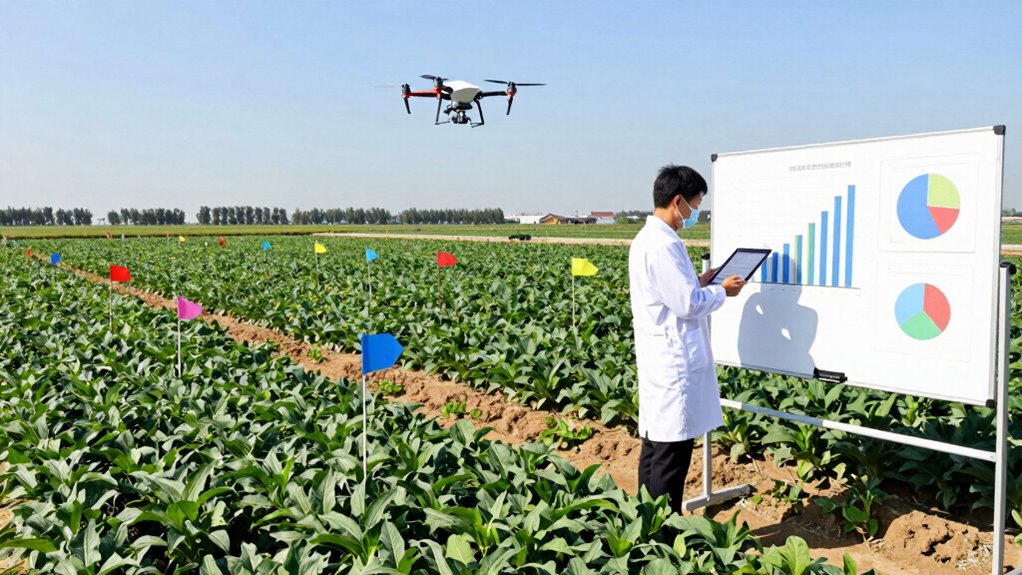

To effectively analyze agricultural field trials, you should use statistical methods like ANOVA and regression analysis to determine the significance of your results. Proper experimental design, including controls and replication, guarantees your data is reliable and valid. Recording crop yields, pest populations, and soil parameters allows you to identify the best practices for improving productivity. Continuing will help you discover how these techniques can be applied to optimize your farming strategies.

Get business pricing on monitors, keyboards and dev gear
- Business-only prices and quantity discounts
- Tax-exempt purchasing
- Multiple users, one account, clear invoices
Key Takeaways
- Use randomized complete block designs to control variability and ensure unbiased comparison of treatments.
- Apply statistical tests like ANOVA to determine significant differences among crop treatments or pest control methods.
- Incorporate replication and control plots to improve the reliability and validity of experimental results.
- Analyze data with regression models to understand relationships between variables such as crop yield and soil health.
- Track and interpret pest populations, crop yields, and soil parameters statistically to inform sustainable farming practices.
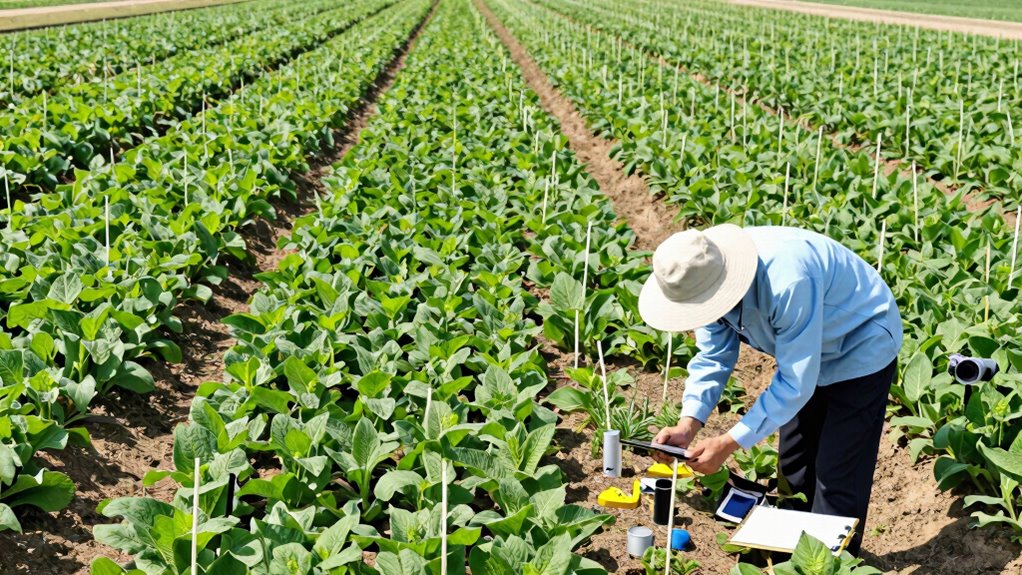
Agricultural experiments play a crucial role in improving farming practices and increasing crop yields. When you conduct field trials, you gather essential data that helps you make informed decisions about how to optimize your land. One key aspect of these experiments involves testing different crop rotation schedules. By rotating crops, you can break pest and disease cycles, reduce soil exhaustion, and improve overall soil health. For example, planting legumes after cereal crops enriches the soil with nitrogen, which benefits future plantings. Tracking the results of various crop rotation strategies allows you to identify the most effective sequences for your specific conditions, ultimately boosting productivity and sustainability.
Crop rotation studies help improve soil health, reduce pests, and increase yields for sustainable farming.
Pest management is another critical component of agricultural experiments. You want to evaluate different pest control methods to determine which are most effective and environmentally friendly. This might involve testing chemical pesticides, biological controls, or cultural practices like crop residue management. When you set up field trials, you record pest populations, crop damage, and yield outcomes across different treatment plots. Using statistical analysis, you can pinpoint which pest management strategies minimize pest damage while maintaining crop health. This data helps you reduce reliance on harmful chemicals, adopt integrated pest management practices, and improve crop resilience.
In your experiments, collecting accurate data is fundamental. You need to design your trials carefully, with proper controls and replication, to ensure the results are statistically significant. For instance, you might compare plots with different crop rotation plans side by side, keeping other variables like soil type and weather consistent. Similarly, testing pest management methods across multiple seasons helps account for variability and strengthens your conclusions. Recording details such as crop yields, pest counts, and soil health parameters provides an all-encompassing picture of how each treatment performs. Incorporating statistical methods ensures your analysis is robust and your results are reliable.
Analyzing this data involves applying statistical tools to assess the significance of your findings. You might use analysis of variance (ANOVA) to compare treatments or regression analysis to understand relationships between variables. These methods allow you to determine if observed differences are meaningful or just due to chance. To ensure your experiments are scientifically sound, it is essential to understand and apply experimental design principles. With solid statistical evidence, you can confidently recommend practices that improve crop rotation schedules and pest management strategies, leading to better yields and more sustainable farming.
Ultimately, your goal with these experiments is to develop practical, data-driven solutions tailored to your farm. By systematically testing and analyzing different approaches, you can refine your practices, reduce risks, and enhance productivity. The insights gained from well-designed field trials empower you to make smarter decisions, ensuring your farming methods are both effective and sustainable for the long term. Incorporating robust statistical methods into your analysis ensures your conclusions are reliable and actionable.
agricultural field trial data logger
As an affiliate, we earn on qualifying purchases.
As an affiliate, we earn on qualifying purchases.
Frequently Asked Questions
How Do I Choose the Right Statistical Method for My Experiment?
To choose the right statistical method for your experiment, consider your objectives, data type, and experimental design. If you’re testing crop rotation or pest management strategies, use methods like ANOVA to compare treatments or regression analysis for relationships. Make certain your data meets assumptions like normality. This approach helps you accurately evaluate how different practices impact yields or pest control, guiding effective decisions in your field trials.
What Sample Size Is Ideal for Reliable Results?
Think of your experiment like baking a cake; choosing the right sample size is like selecting the perfect amount of ingredients. If your sample size is too small, the results are like a cake with uneven layers—lacking data accuracy. Aim for a larger sample to reduce variability, ensuring your results are reliable. Balancing sample size minimizes variability, guarantees data accuracy, and gives you confidence in your findings.
How to Handle Missing Data in Field Trials?
When handling missing data in field trials, you should first perform outlier detection to identify anomalies. Then, use data imputation methods, like mean or regression imputation, to fill in gaps. This approach guarantees your dataset remains robust and reliable. Always document your imputation process, so your results stay transparent and reproducible, which helps maintain the integrity of your statistical analysis.
Can I Apply These Statistical Methods to Organic Farming Experiments?
Yes, you can apply these statistical methods to organic farming experiments, especially when evaluating soil health and organic certification outcomes. These techniques help analyze data accurately despite the unique challenges organic practices present. By doing so, you guarantee your field trials produce reliable results, supporting organic certification processes and improving soil health management. Just adapt the methods to suit specific organic trial parameters for maximum insights.
What Software Options Are Best for Analyzing Agricultural Data?
You should consider software like R or SAS for analyzing agricultural data, especially when focusing on crop yield and pest resistance. R offers free, powerful tools for statistical analysis and visualization, making it ideal for field trials. SAS provides robust options for modeling and data management, helping you interpret complex results. Both options enable you to compare treatments effectively, ensuring your findings on crop performance and pest resistance are accurate and meaningful.
As an affiliate, we earn on qualifying purchases.
Conclusion
As you analyze your field trials, remember that good statistics are like a reliable compass guiding you through unpredictable terrain. Just like a farmer who counts his crops at harvest time, accurate data guarantees you’re planting success, not just hope. When you track and interpret your results carefully, every experiment becomes a step closer to a bountiful harvest. Embrace the numbers—they’re your best allies in turning soil and seeds into thriving fields.
pest population monitoring equipment
As an affiliate, we earn on qualifying purchases.
As an affiliate, we earn on qualifying purchases.
As an affiliate, we earn on qualifying purchases.
Fall Picks
fall essentials
As an affiliate, we earn on qualifying purchases.