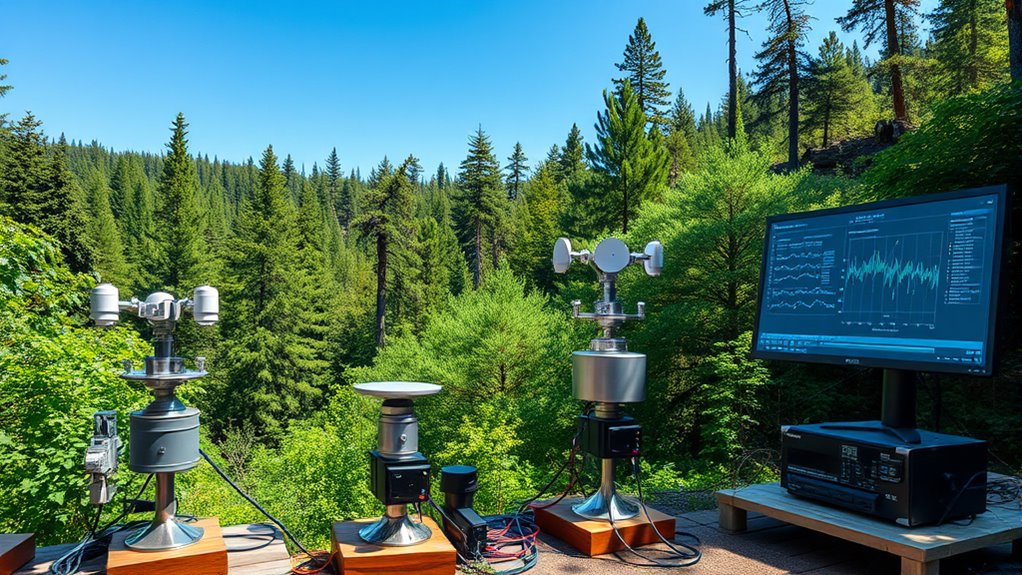

Environmental statistics involve modeling climate and ecological data to assess planetary health and track changes over time. You combine information like carbon footprints, biodiversity metrics, and climate data to understand ecosystem health and resilience. These models help pinpoint areas needing conservation and guide policies to reduce emissions. By analyzing vast datasets, you gain insights into future scenarios and sustainable solutions. Keep exploring this topic to discover how these tools shape environmental actions worldwide.
Key Takeaways
- Advanced modeling integrates satellite imagery, sensor data, and field surveys to analyze climate and ecological patterns.
- Statistical tools transform raw environmental data into actionable insights for policy and conservation strategies.
- Ecosystem health metrics like biodiversity and carbon footprints are modeled to assess resilience and stress levels.
- Scenario simulations forecast future climate impacts and biodiversity changes under various intervention scenarios.
- Data integration enhances understanding of interlinked climate and ecological trends, informing sustainable decision-making.
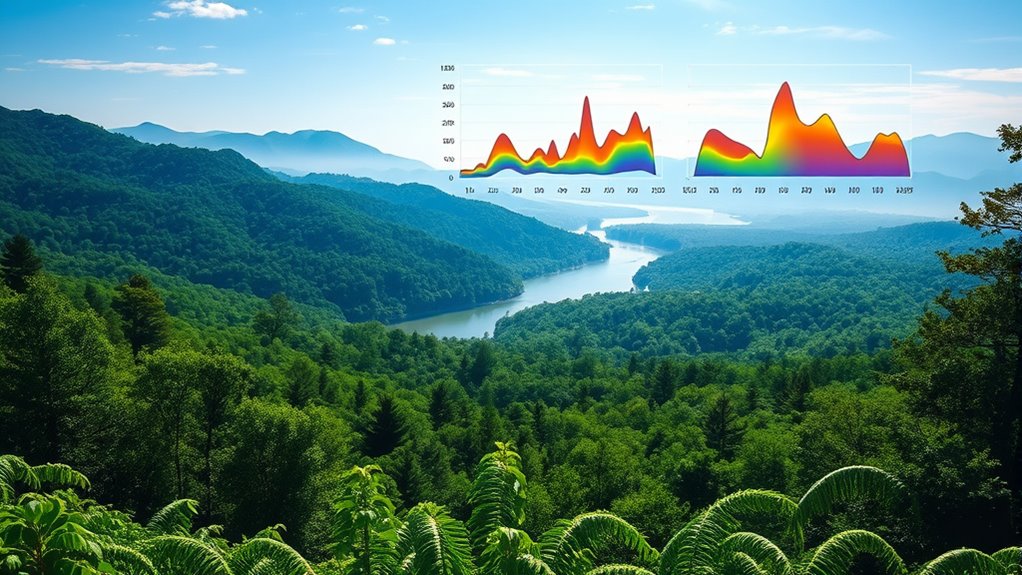
Have you ever wondered how we measure the health of our planet? It’s a complex task that involves tracking various indicators, with the carbon footprint and biodiversity metrics leading the way. Your carbon footprint reflects the total greenhouse gases you emit directly and indirectly through activities like transportation, energy use, and consumption. By analyzing these emissions, scientists can gauge how human actions contribute to climate change. It’s not just about individual behavior—aggregated data helps policymakers understand broader trends. When they examine carbon footprints across communities, industries, or countries, they get a clearer picture of where reductions are most needed. Biodiversity metrics, on the other hand, measure the variety and abundance of species within ecosystems. These metrics serve as essential signs of ecological health, revealing how well ecosystems are functioning and adapting. When biodiversity declines, it often signals environmental stress, habitat loss, or pollution. By quantifying species richness and population sizes, researchers can track changes over time and identify vulnerable habitats. Additionally, standardized communication of road signs plays a crucial role in ensuring safety and consistency on the roads. Combining these metrics with climate data creates a powerful model for evaluating overall environmental health. For example, high carbon emissions paired with declining biodiversity metrics indicate ecosystems under severe stress from climate change and human activity. You might not realize it, but these data points influence policies and conservation efforts worldwide. They help set priorities for protecting endangered species, restoring habitats, and reducing emissions. Advances in modeling allow scientists to integrate vast datasets—satellite imagery, sensor networks, and field surveys—to produce detailed climate and ecological maps. These models make it possible to simulate future scenarios based on current trends, helping decision-makers plan effective interventions. As you become more aware of these metrics, you’ll see how interconnected everything is. Reducing your own carbon footprint, for example, not only lowers greenhouse gases but can also lessen pressure on ecosystems, aiding biodiversity. It’s a cycle that emphasizes the importance of data-driven decisions. Ultimately, environmental statistics are crucial tools that turn raw data into actionable insights, guiding us toward a more sustainable future. They help us understand the delicate balance of our planet’s ecosystems and the impact of our actions, empowering you to make informed choices. In the end, the health of our planet depends on continuous monitoring, accurate modeling, and collective effort—each of us playing a role in safeguarding biodiversity and reducing carbon footprints for generations to come.
Frequently Asked Questions
How Do Climate Models Predict Future Ecological Changes?
Climate models predict future ecological changes by using climate projections to simulate how variables like temperature, precipitation, and CO2 levels will evolve. You can rely on ecological forecasting to understand potential impacts on ecosystems, species distribution, and biodiversity. These models incorporate data and assumptions to generate scenarios, helping you anticipate changes and plan conservation efforts effectively. By analyzing these projections, you gain insights into how climate change may reshape ecological systems.
What Are the Best Practices for Collecting Environmental Data?
You should prioritize sampling strategies that mimic natural variability, like random or stratified sampling, to capture diverse ecological conditions. Use reliable tools and standardized methods to guarantee data quality, like calibrated sensors and consistent protocols. Picture collecting samples as gathering puzzle pieces—each must be precise and representative to build an accurate environmental picture. This approach helps you obtain trustworthy data, essential for analyzing climate and ecological trends effectively.
How Does Statistical Modeling Address Data Uncertainty?
You address data uncertainty by using statistical modeling to account for measurement error and incorporate probabilistic inference. When you model data, you explicitly include potential errors, which helps you estimate true values more accurately. Probabilistic inference allows you to quantify uncertainty in your predictions, giving you a clearer understanding of the confidence in your results. This approach guarantees your conclusions are robust despite imperfect or noisy data.
Can Environmental Statistics Inform Policy Decisions Effectively?
Policy impacts profoundly when you prioritize precise data integration. Environmental statistics inform decisions by providing evidence that connects climate and ecological insights to policy actions. When you effectively analyze and interpret data, you can predict potential outcomes and craft policies that are both practical and impactful. Ultimately, your use of integrated data empowers policymakers to make smarter, more sustainable decisions, ensuring positive policy impact and better environmental stewardship.
What Emerging Techniques Are Transforming Ecological Data Analysis?
Emerging techniques like remote sensing and machine learning are transforming ecological data analysis. You can now collect vast amounts of data from satellites and drones, giving you real-time insights into ecosystems. Machine learning algorithms help you identify patterns, predict changes, and model complex ecological processes more accurately. These tools enable you to make informed decisions quickly, enhancing conservation efforts and sustainable management of natural resources.
Conclusion
By mastering environmental statistics, you empower yourself to tackle climate and ecological challenges with confidence. Think of it as your secret weapon—like having a compass in uncharted waters. As you analyze data and build models, remember that every insight brings us closer to a sustainable future. So, don’t let this knowledge be lost in the sands of time; embrace it now, and be the hero the planet needs, just like those brave explorers of yore.