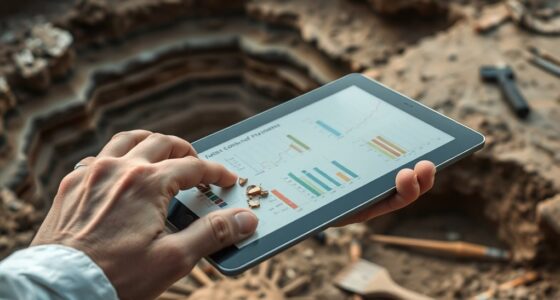

Business analytics helps you turn raw data into strategic decisions, giving your organization a competitive edge. It involves collecting, processing, and analyzing data using techniques like predictive modeling and data visualization. These tools enable you to forecast trends, identify patterns, and communicate insights clearly through visual dashboards. By integrating these methods, you can make smarter decisions faster and foster a data-driven culture. If you want to discover how these techniques work together, there’s more to explore.
Key Takeaways
- Business analytics transforms raw data into strategic insights through collection, processing, and analysis to support decision-making.
- Predictive modeling uses statistical and machine learning techniques to forecast future outcomes like sales and customer behavior.
- Data visualization creates visual tools such as dashboards and charts to communicate complex data insights quickly and effectively.
- Integrating predictive modeling with visualization enhances scenario analysis, risk assessment, and strategic planning.
- Business analytics is vital for rapid adaptation, informed decisions, and maintaining competitive advantage in dynamic markets.

Have you ever wondered how companies turn vast amounts of data into actionable insights? It all begins with business analytics, a discipline that transforms raw data into strategic decisions. At its core, business analytics involves collecting, processing, and analyzing data to understand past performances and forecast future trends. One of the key techniques used is predictive modeling, which harnesses statistical algorithms and machine learning to identify patterns and predict future outcomes. Imagine being able to forecast customer behavior, sales trends, or operational risks with a high degree of accuracy—that’s the power of predictive modeling. It enables you to make proactive decisions, optimize resources, and stay ahead of competitors.
Business analytics transforms raw data into strategic decisions through predictive modeling and data analysis.
But understanding data isn’t enough; you need effective ways to interpret and communicate it. This is where data visualization comes into play. Data visualization tools help you create clear, compelling visual representations of complex datasets, making insights easier to grasp. Instead of sifting through endless rows of numbers, you can see trends, outliers, and relationships at a glance through charts, graphs, and dashboards. Visualizations help you and your team quickly identify issues or opportunities, facilitating faster decision-making. Whether it’s a heat map highlighting sales hotspots or a line graph showing revenue trends over time, data visualization transforms raw numbers into stories that drive action.
Integrating predictive modeling with data visualization amplifies your ability to make informed decisions. For instance, you might develop a predictive model that forecasts customer churn and then visualize these predictions on a dashboard, allowing sales or customer service teams to focus their efforts where they’re needed most. This synergy not only streamlines your workflow but also enhances strategic planning. You can simulate different scenarios, assess risks, and evaluate potential outcomes visually, which makes complex analyses more accessible to everyone involved. Additionally, understanding the importance of contrast ratio can significantly improve the clarity and depth of your visualizations and display technologies, ensuring that your insights are as impactful as possible.
In today’s fast-paced business environment, leveraging these tools is vital. Without predictive modeling, you’re fundamentally flying blind, relying solely on historical data that might no longer be relevant. Meanwhile, data visualization ensures that insights are communicated effectively across teams, fostering a data-driven culture. Together, these techniques empower you to turn raw data into strategic action, helping your organization adapt quickly, seize new opportunities, and maintain a competitive edge. Business analytics isn’t just about crunching numbers—it’s about transforming data into a powerful decision-making engine that propels your business forward.
Frequently Asked Questions
How Does Business Analytics Differ From Data Analytics?
You might wonder how business analytics differs from data analytics. Business analytics focuses on using data to make strategic decisions through techniques like predictive modeling and data visualization. Data analytics, in contrast, often emphasizes examining raw data to uncover patterns and insights. While both overlap, business analytics applies these methods specifically to improve business performance, helping you forecast trends and visualize data for clearer decision-making.
What Skills Are Essential for a Business Analyst?
Think of yourself as a bridge builder—your skills connect data and decision-makers. You need strong analytical skills to interpret data, data visualization expertise to present insights clearly, and stakeholder communication abilities to explain findings effectively. Being adaptable and curious helps you stay ahead. Mastering these skills guarantees you translate complex data into actionable strategies, making you an essential link in any organization’s success.
Which Industries Benefit Most From Business Analytics?
You’ll find that various industries benefit greatly from business analytics, especially the retail sector and healthcare industry. In retail, analytics help you understand customer behavior and optimize inventory. In healthcare, it enables you to improve patient outcomes and manage resources efficiently. By leveraging data-driven insights, you can make smarter decisions, streamline operations, and stay ahead of competitors in these sectors.
How Can Small Businesses Implement Analytics Effectively?
Implementing analytics is like planting seeds for growth. You can start small by focusing on customer segmentation to understand your audience better. Use simple tools to gather data and explore predictive modeling to forecast trends. This approach helps you target your marketing and optimize operations. Keep it manageable, learn as you go, and gradually integrate more advanced analytics to boost your small business’s success.
What Are Common Challenges Faced in Business Analytics Projects?
When tackling common challenges in business analytics projects, you often face issues like data quality and change management. Poor data quality can lead to inaccurate insights, so you need to guarantee your data is clean and reliable. Change management is vital, too, as you must get your team on board with new analytics processes. Address these challenges early, communicate clearly, and provide training to make your analytics initiatives successful.
Conclusion
With business analytics blazing a bright trail, you’re now better equipped to boost your business boosts. By embracing data-driven decisions and delving into detailed depths, you’ll discover smarter strategies, stronger solutions, and sustained success. Don’t delay—dive into data, decipher patterns, and dominate your domain. Remember, mastering metrics means maximizing your market moves. So, seize the science, spark your success, and set your sights on a smarter, sharper, more strategic tomorrow.