
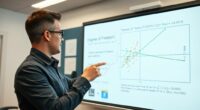
To balance theory and practice in studying statistics, focus on mastering core concepts first, then apply them to real datasets through projects and exercises. This approach helps you understand why methods work while building practical skills. Be sure to evaluate data critically and recognize limitations in your models. Consistently merging theory with hands-on experience sharpens your analysis skills and boosts confidence—you’ll discover how to navigate complex data challenges when you put these strategies into action.
Key Takeaways
- Prioritize mastering fundamental concepts before applying them to real-world datasets for better understanding.
- Use practical exercises and projects to reinforce theoretical knowledge and develop problem-solving skills.
- Balance studying formulas with analyzing actual data to connect theory with real-world applications.
- Recognize the limitations of methods through hands-on work, fostering critical evaluation skills.
- Continuously integrate ethical considerations and data evaluation to ensure responsible and effective statistical practice.

Studying statistics effectively requires more than just mastering formulas and concepts; it’s about finding the right balance between theory and practice. While understanding the theoretical foundations gives you a solid framework, applying those principles to real-world scenarios makes your knowledge meaningful and memorable. Without practical application, the abstract concepts can feel disconnected from everyday problems, making it harder to retain and utilize what you’ve learned. Conversely, if you focus solely on real-world application without understanding the underlying theories, you risk misinterpreting data or relying on guesswork rather than solid statistical reasoning. Striking this balance ensures you develop both a deep comprehension of fundamental principles and the ability to implement techniques confidently.
When you explore the theoretical foundations of statistics, you gain insights into why certain methods work and when to use them. This understanding helps you avoid common pitfalls, such as misinterpreting correlation as causation or overfitting models to data. The theory provides a lens through which you can critically evaluate data and choose appropriate techniques. However, theory alone can sometimes feel detached from the messiness of real data, which often contains noise, missing values, or unexpected patterns. That’s where real-world application becomes essential. By working on actual datasets—be it from your field of interest or publicly available sources—you see how statistical concepts translate into tangible insights. These experiences solidify your understanding and improve your problem-solving skills. Additionally, engaging with ethical hacking principles, such as reconnaissance and scanning, can enhance your ability to handle complex data environments more securely and ethically, bridging the gap between statistical theory and cybersecurity practices.
To effectively bridge theory and practice, start by studying foundational concepts thoroughly. Once you grasp the basics, challenge yourself with practical exercises. For example, after learning about regression analysis, apply it to a dataset related to your interests or industry. This hands-on approach helps you see the limitations and strengths of different techniques, reinforcing your theoretical knowledge through experience. Additionally, participating in projects, internships, or competitions can expose you to real-world data complexities, sharpening your ability to adapt statistical methods to diverse situations.
Top picks for "balanc theory practice"
Open Amazon search results for this keyword.
As an affiliate, we earn on qualifying purchases.
Frequently Asked Questions
How Can I Apply Statistical Theory to Real-World Problems Effectively?
You can apply statistical theory effectively by analyzing real-world problems through data visualization to identify patterns and insights. Use case studies to understand how others have tackled similar issues and adapt their methods to your situation. Practice translating theoretical concepts into practical solutions, ensuring you interpret results accurately. This approach helps bridge the gap between theory and practice, making your statistical skills more impactful and relevant to real-world challenges.
What Are Common Pitfalls When Balancing Theory and Practice in Statistics?
You should watch out for misinterpretation pitfalls, where you might misunderstand statistical results, and overgeneralization risks, which can lead you to apply findings too broadly. To avoid these, stay critical of your assumptions, validate your methods with real data, and remember that theory often needs adjustment for practical contexts. Keep a balanced perspective, questioning whether your models truly reflect the complexities of the real world.
Which Practical Tools Best Complement Statistical Learning?
You might think fancy statistical software is enough, but don’t overlook data visualization tools. They turn complex data into clear stories, making concepts stick. Programs like R, Python, or Tableau help you analyze and present data effectively. Ironically, these practical tools often reveal gaps in your theory, but that’s the real learning. Embrace them, and you’ll find theory and practice dance together more smoothly.
How Do I Stay Motivated When Theoretical Concepts Seem Abstract?
When theoretical concepts seem abstract, remind yourself of their conceptual relevance to real-world problems. Focus on how understanding theoretical motivation can improve your practical skills, making your learning more meaningful. Break down complex ideas into smaller parts, and relate them to examples you find interesting. Keep connecting theory to applications you care about, which boosts your motivation and helps you see the value behind the abstract concepts, making studying more engaging.
What Resources Help Bridge the Gap Between Theory and Application?
Think of learning statistics as exploring a new city; case studies act as guided tours, showing you real-world applications, while online tutorials are your map and compass. These resources help you connect abstract concepts to tangible examples, making the material easier to grasp. By engaging with case studies and following online tutorials, you bridge the gap between theory and practice, transforming complex ideas into practical skills.
Conclusion
Remember, if you only stick to theory, you’ll be like a chef who knows all the recipes but never tastes the food—boring and disconnected. Conversely, only practicing without understanding the principles is like building a house on quicksand—unstable and doomed to collapse. To truly master statistics, you need to strike a perfect balance. Embrace both, and you’ll become a statistical wizard capable of conjuring insights out of thin air—basically, a superhero of data!