

To review formula sheets effectively, focus on understanding the concepts behind each formula, rather than just memorizing them. Organize your sheets by topics, use color-coding, and create quick summaries for easy reference. Practice applying formulas in different problems to reinforce your grasp and recognize patterns. Regularly revisit your organized materials, connecting concepts across topics. Keep active engagement at the core, and you’ll deepen your comprehension—there’s much more to discover as you explore further.

Get business pricing on monitors, keyboards and dev gear
- Business-only prices and quantity discounts
- Tax-exempt purchasing
- Multiple users, one account, clear invoices
Key Takeaways
- Focus on understanding the underlying concepts and principles behind each formula rather than rote memorization.
- Organize formulas by topics, themes, or applications, and use visual aids like color-coding for quick reference.
- Practice applying formulas in various problems to reinforce comprehension and identify patterns and relationships.
- Create concise summaries or cheat sheets highlighting key formulas and their derivations for efficient review.
- Regularly revisit and test yourself with problem-solving to strengthen recall and deepen understanding over time.
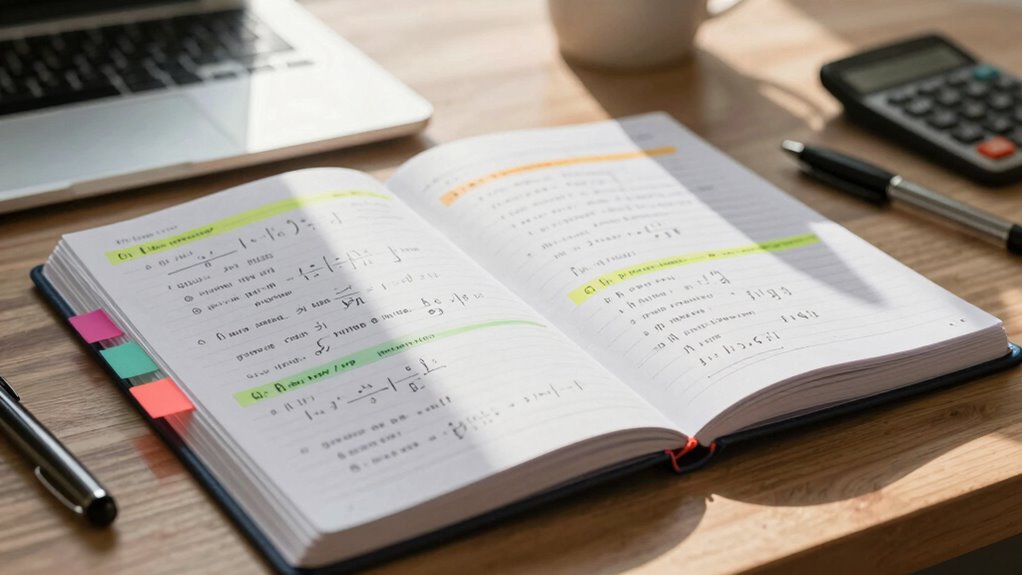
Memorizing formula sheets blindly often leads to forgetfulness and frustration, especially when you need to apply concepts quickly. Instead of trying to commit every detail to memory, you should focus on developing effective strategies for reviewing and understanding your formulas. Using memory techniques can help reinforce your knowledge, but they work best when paired with effective organization of your materials. When your formulas are well-organized, it becomes easier to locate the information you need and grasp how different formulas connect to each other.
Organizing formulas enhances understanding and quick retrieval, reducing frustration and boosting confidence during exams.
Start by categorizing your formulas based on topics or themes. For example, group all the physics equations together, separate from calculus formulas. This effective organization reduces the cognitive load, making it simpler to find and recall relevant formulas during exams or practice problems. Once your formulas are organized, use visual aids like color-coding or charts to create a mental map of your sheet. Color-coding formulas by their application areas or difficulty levels helps your brain visualize where each formula belongs and how they relate. This visual association is a powerful memory technique that enhances recall.
Next, focus on understanding the underlying concepts behind each formula rather than just memorizing symbols and numbers. When you understand the “why” and “how,” it becomes easier to derive or adapt formulas during problem-solving, reducing the need for rote memorization. Practice applying formulas in different contexts, as this reinforces your grasp of their practical use. Instead of passively reviewing your sheet, actively challenge yourself by solving problems that require you to recall and implement formulas on the spot. Incorporating effective content organization can significantly improve your ability to review efficiently and retain information better.
Additionally, recognizing common patterns and relationships among formulas allows you to see connections that can simplify your understanding and recall. This broader perspective helps in building a more cohesive mental framework, making it easier to navigate complex problems. Developing a structured review process that systematically revisits formulas and concepts also supports long-term retention. Finally, create quick-reference summaries or cheat sheets that highlight the most crucial formulas and concepts. Use these summaries during practice tests to simulate exam conditions, training yourself to retrieve information rapidly. When your review process emphasizes understanding, effective organization, and active recall, you’ll find yourself relying less on rote memorization and more on your ability to think critically and apply formulas efficiently.
color-coded formula sheets for students
As an affiliate, we earn on qualifying purchases.
As an affiliate, we earn on qualifying purchases.
Frequently Asked Questions
How Often Should I Review My Formula Sheet for Optimal Retention?
You should review your formula sheet regularly using spaced repetition, ideally every day or every few days, to strengthen your memory. Incorporate active recall by testing yourself on formulas rather than just passively reading them. This consistent practice helps you retain information longer and minimizes cramming. Adjust the frequency based on how well you remember the formulas, gradually increasing the intervals as your recall improves.
Can Using Color-Coding Improve My Understanding of Formulas?
Yes, using color-coding can markedly improve your understanding of formulas through visual learning. By highlighting different formula categories or key variables, you create visual cues that enhance memory retention. Color-coding makes it easier to quickly identify and differentiate formulas, strengthening your memory. This method engages your visual senses, making review sessions more effective and helping you recall formulas more effortlessly during exams or practice.
What Mistakes Do Students Commonly Make When Reviewing Formula Sheets?
You often make the mistake of relying solely on passive review, which leads to rote memorization instead of understanding. Students tend to skim over formulas without truly grasping their application, causing gaps in knowledge. To avoid this, actively engage with your formula sheet by practicing problems, explaining formulas aloud, and testing yourself regularly. This approach helps reinforce concepts and prevents the pitfalls of passive review and shallow memorization.
Is It Better to Review Formulas Alone or With Peers?
Like a knight with a trusty sword, you’ll find group discussion often beats solo practice. Reviewing formulas with peers helps clarify tricky concepts and reveals gaps in your understanding. While solo practice allows deep focus, discussing with others encourages active learning and different perspectives. Combining both methods maximizes your mastery, turning rote memorization into genuine comprehension. So, engage with classmates regularly, and you’ll sharpen your skills more effectively than working alone.
How Do I Adapt My Review Method for Different Subjects?
You adapt your review method by applying subject-specific strategies and visual learning techniques. For math or science, use diagrams, charts, and color-coded notes to reinforce concepts. For language or history, create timelines or mind maps. Tailor your approach to each subject’s nature, combining active recall with visual aids. This keeps your review engaging and helps you understand the material deeply, making it easier to remember during exams.
organized math formula cheat sheets
As an affiliate, we earn on qualifying purchases.
As an affiliate, we earn on qualifying purchases.
Conclusion
Think of your formula sheet as a treasure map, guiding you through the labyrinth of problems. Instead of memorizing blindly, navigate with curiosity and understanding, letting each symbol and equation reveal its story. When you approach it as a storyteller, not just a memorizer, you’ll access a deeper mastery. Your confidence will shine brighter than gold, turning exam stress into a thrilling adventure where you’re the explorer uncovering hidden gems of knowledge.
As an affiliate, we earn on qualifying purchases.
problem-solving practice books for exams
As an affiliate, we earn on qualifying purchases.
As an affiliate, we earn on qualifying purchases.
Fall Picks
fall essentials
As an affiliate, we earn on qualifying purchases.