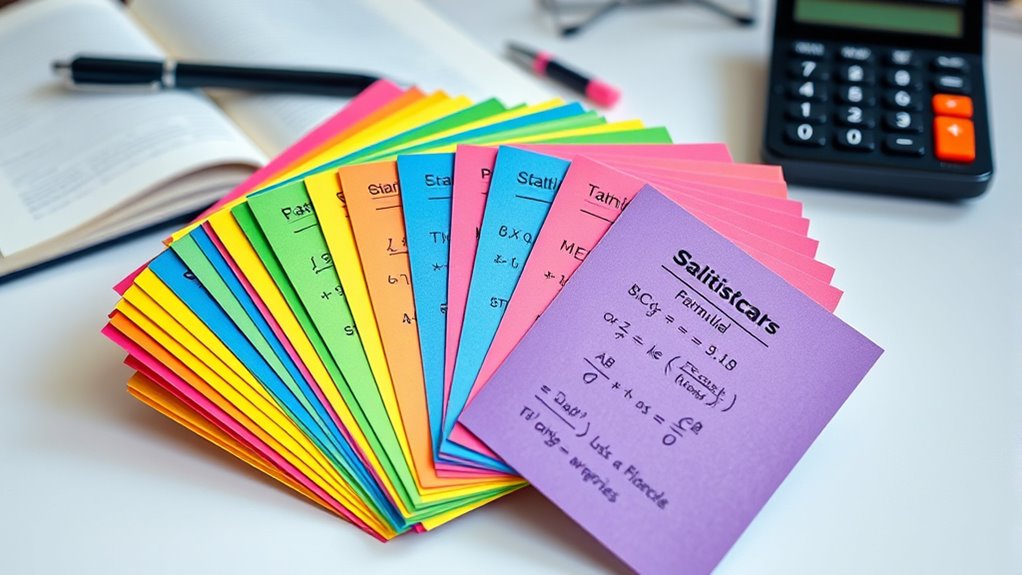

To use flashcards effectively for statistics formulas, break down each formula into manageable parts and focus on one per card. Write the formula clearly on one side and add brief explanations, visuals, or color coding on the other to reinforce understanding. Employ spaced repetition and mnemonic devices to boost retention. Incorporate visual aids like charts to strengthen memory associations. Keep improving your cards—continue exploring tips that make memorization easier and more engaging.
Key Takeaways
- Focus on one statistical formula per flashcard, clearly writing the formula and brief explanation on separate sides.
- Incorporate visual aids like diagrams, charts, or graphs to illustrate the formula’s application.
- Use color coding to differentiate variables, constants, and operations for quick recognition.
- Apply spaced repetition by reviewing flashcards at increasing intervals to strengthen long-term memory.
- Create mnemonic devices or catchy phrases to help recall complex formulas more easily.

Have you ever struggled to memorize complex statistics formulas? If so, you’re not alone. Many students find themselves overwhelmed by the sheer number of formulas they need to remember for exams or practical applications. One effective way to tackle this challenge is by using flashcards, but to maximize their potential, you should incorporate proven memorization techniques and visual aids. Flashcards are versatile tools that can break down complicated formulas into manageable parts, helping you reinforce your understanding step by step. The key is to design your flashcards thoughtfully, making sure each card focuses on a single formula or concept. Write the formula clearly on one side and include a brief explanation or a visual cue on the other. This not only simplifies recall but also engages your brain differently, making the memorization process more active and effective.
Memorization techniques come into play when you create your flashcards. Instead of passively reviewing, you want to employ methods like spaced repetition, which involves reviewing the cards at increasing intervals to strengthen long-term memory. For example, review a new formula after one day, then after three days, a week, and so on. This helps prevent forgetting and cements the formulas in your mind. Mnemonic devices are also powerful; you can turn complex parts of a formula into a catchy phrase or acronym that’s easier to remember. When combined with flashcards, these techniques turn passive review into an engaging activity that boosts retention.
Visual aids are another essential element. Incorporate diagrams, charts, or color coding into your flashcards to make the information more memorable. For instance, use different colors for variables, constants, and operations, or include small graphs illustrating the formula’s application. Visual aids help you grasp the relationships between different components and enable quicker recall during exams or problem-solving sessions. When you see a flashcard with a colorful diagram or a visual cue, your brain is more likely to associate that image with the formula, making it easier to retrieve later. Additionally, understanding asset division principles can help you visualize how different components of a problem relate, enhancing your overall comprehension.
Frequently Asked Questions
How Often Should I Review My Flashcards for Maximum Retention?
You should review your flashcards with spaced repetition, ideally every day at first, then gradually increasing the interval between reviews. Use active recall during each session to strengthen your memory. As you become more confident with certain formulas, extend the time between reviews. This approach maximizes retention by challenging your brain to recall information actively and reinforcing your knowledge over spaced intervals.
Can I Customize Flashcards for Different Difficulty Levels?
Yes, you can customize flashcards for different difficulty levels by utilizing personalization options and difficulty adjustment features. Instead of one-size-fits-all cards, you tailor your cards to challenge yourself or simplify concepts as needed. This approach keeps your learning engaging and effective, allowing you to focus more on complex formulas when needed and reinforce basic ones effortlessly. Adjusting difficulty levels makes your study sessions smarter and more aligned with your progress.
Are Digital Flashcards More Effective Than Physical Ones?
Digital flashcards are often more effective than physical ones because they offer greater accessibility considerations, allowing you to study anytime and anywhere. They also let you customize content, include multimedia, and track your progress easily. However, some prefer physical cards for tactile engagement and reduced screen time. Consider your learning style and accessibility needs to decide which format helps you learn statistics formulas more efficiently.
How Do I Handle Confusing or Incorrect Formulas on My Cards?
When you encounter confusing or incorrect formulas on your flashcards, focus on error correction and formula verification. Cross-check the formulas with reliable textbooks or trusted online sources. If you find errors, correct them immediately and add notes to clarify the correct version. Regularly review and test yourself to make certain you understand each formula. This proactive approach helps prevent confusion and reinforces your understanding effectively.
Should I Include Example Problems on My Flashcards?
Yes, you should include example problems on your flashcards to improve formula clarity and enhance understanding. Integrating examples helps you see how formulas apply in real situations, making concepts more concrete. When you practice with examples, you also reinforce your memory and identify areas needing review. Keep your examples simple and directly related to the formula, so they serve as quick, effective references during study sessions.
Conclusion
So, next time you’re tempted to skip your flashcards, remember they’re your secret weapon—saving you from those all-night cramming sessions. Ironically, the very simplicity of flashcards might be what makes them so powerful. Instead of endless notes, a few quick flips could make all the difference. Don’t underestimate these tiny cards; they might just be your best shot at mastering those tricky formulas and avoiding last-minute panic. Happy studying!