

A Z-test is used when you have a large sample size, usually over 30, and know the population variance, allowing you to rely on the standard normal distribution. A T-test, however, is better for smaller samples or when the population variance is unknown; it uses the Student’s t-distribution to account for increased uncertainty. Understanding these differences helps you choose the right test, and if you keep exploring, you’ll gain even more clarity.
Key Takeaways
- Z-tests require known population variance and are suitable for large samples (>30), while T-tests are used when variance is unknown or for small samples (<30).
- Z-tests use the standard normal distribution; T-tests rely on the Student’s t-distribution with heavier tails.
- T-tests account for additional uncertainty by estimating variance from the sample, making them more accurate with small datasets.
- For large samples with known variance, Z-tests provide more straightforward calculations; T-tests are more flexible for unknown variance.
- Proper test selection depends on sample size and whether the population variance is known, ensuring reliable and valid results.
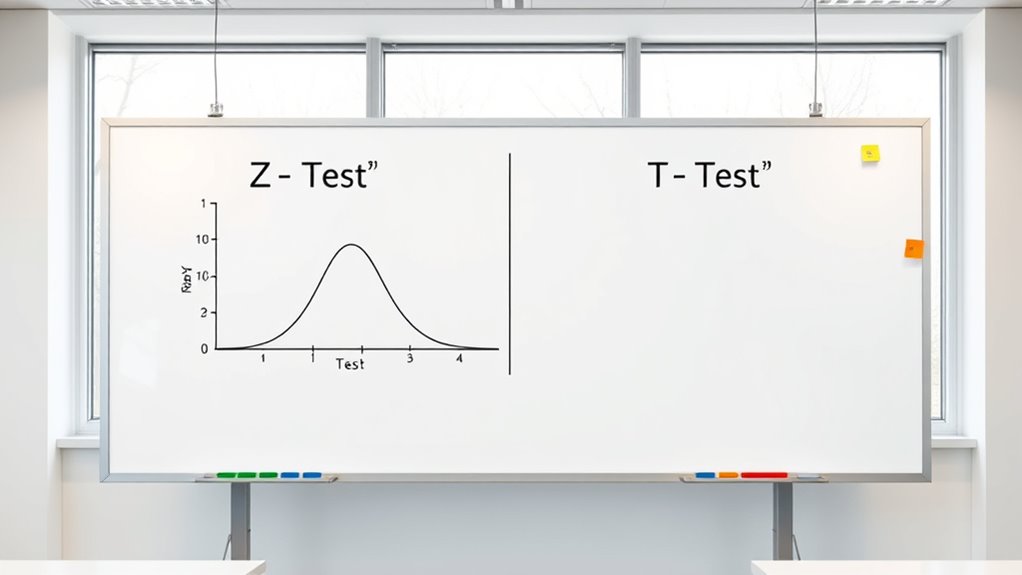
When deciding between a Z-test and a T-test, understanding their differences is essential for accurate statistical analysis. Your choice hinges largely on factors like sample size and knowledge of population variance. If you’re working with a large sample size—typically over 30—and you know the population variance, a Z-test is often the appropriate choice. This test relies on the assumption that the population variance is known, which simplifies calculations because it allows you to use the standard normal distribution. In such cases, the sample size provides enough data to confidently estimate how the sample mean relates to the population mean, making the Z-test both reliable and efficient. Additionally, understanding the properties of the normal distribution is vital when applying a Z-test accurately.
However, if your sample size is small—say, less than 30—and you don’t know the population variance, a T-test becomes the better option. Small samples tend to have more variability, and without a known population variance, you need a method that accounts for this extra uncertainty. The T-test uses a different distribution, called the Student’s t-distribution, which adjusts for the increased variability inherent in small samples. This distribution has heavier tails than the normal distribution, meaning it’s more forgiving of the extra uncertainty you face with limited data. By using the sample variance as an estimate for the population variance, the T-test accommodates the unknown variability, providing more accurate results under these circumstances.
Small samples with unknown variance require the T-test for more accurate results and better uncertainty management.
Another key distinction lies in how each test handles the parameters involved. The Z-test assumes you have precise knowledge of the population variance, which simplifies the calculation of the test statistic. The T-test, on the other hand, replaces the population variance with the sample variance, reflecting the estimation process when the actual population variance isn’t available. This difference impacts the shape of the distribution used to determine significance: the normal distribution for Z-tests, and the t-distribution for T-tests, which varies depending on the degrees of freedom tied to your sample size.
In essence, your decision should be guided by the size of your sample and whether you know the population variance. For large samples with known variance, the Z-test works well and provides straightforward calculations. But when working with small samples or unknown variance, the T-test offers a more reliable approach by adjusting for the increased uncertainty. Recognizing these differences ensures you select the right test, leading to more accurate and meaningful statistical conclusions.
As an affiliate, we earn on qualifying purchases.
Frequently Asked Questions
When Should I Prefer a Z-Test Over a T-Test?
You should prefer a z-test over a t-test when your population variance is known and your sample size is large, typically over 30. In this case, the z-test provides more accurate results because it uses the population variance directly. When the population variance is unknown or your sample size is small, a t-test is better, as it accounts for the extra uncertainty from estimating the variance.
How Does Sample Size Influence the Choice Between Z and T Tests?
You should consider sample size considerations when choosing between a z-test and a t-test. If your sample size is large, typically over 30, the z-test becomes appropriate because the sampling distribution approximates normality, meeting test selection criteria. For smaller samples, the t-test is preferred since it accounts for increased variability and uses the t-distribution, ensuring more accurate results.
Can Z and T Tests Be Used Interchangeably? Why or Why Not?
Think of z and t tests as different tools in your toolbox. You can’t always use them interchangeably because their sample applicability varies. If your sample size is large and the population variance known, you can confidently choose a z-test. But for smaller samples or unknown variances, a t-test is your better option. Using them interchangeably risks inaccurate results, like trying to fix a watch with a hammer.
What Assumptions Do Both Z and T Tests Require?
You need to assume that the population variance is recognized for a Z-test, while for a T-test, it’s unknown. Both tests require a normality assumption, meaning your data should follow a normal distribution, especially with small sample sizes. These assumptions ensure the tests’ validity, so check your data’s distribution and whether you know the population variance before choosing between a Z-test and a T-test.
How Do I Interpret the Results of Each Test Correctly?
When interpreting your test results, look at the p-value to determine significance—if it’s below your chosen alpha level, your results are statistically significant. Check the confidence interval to see the range where the true population parameter likely falls; if it doesn’t include the null value, that supports your conclusion. Remember, a smaller p-value indicates stronger evidence against the null hypothesis, guiding your decision-making effectively.
As an affiliate, we earn on qualifying purchases.
Conclusion
Now that you understand the differences between z-tests and t-tests, you can confidently select the right one for your data. For example, if a company wants to compare employee satisfaction scores from a small sample, a t-test is ideal due to the limited data. Remember, using the correct test guarantees accurate results. So, next time you’re analyzing data, ask yourself: do I know my sample size and population variance? That’s the key to choosing wisely.
sample size calculator for t-test
As an affiliate, we earn on qualifying purchases.
As an affiliate, we earn on qualifying purchases.
statistics hypothesis testing kit
As an affiliate, we earn on qualifying purchases.
As an affiliate, we earn on qualifying purchases.