

To assess if your logistic regression model fits well, you can use the Hosmer-Lemeshow test. It compares observed and expected event counts across groups based on predicted probabilities. A high p-value suggests your model fits the data adequately, while a low p-value indicates possible discrepancies needing attention. Keep in mind, results can be influenced by sample size and group selection. If you’re curious about interpreting these results more deeply, there’s more to explore beyond this overview.
Key Takeaways
- The Hosmer-Lemeshow test compares observed and expected event counts across groups of predicted probabilities to assess model calibration.
- A high p-value indicates good fit; a low p-value suggests the model may not adequately fit the data.
- The test’s sensitivity depends on sample size; large samples may flag trivial discrepancies as significant.
- Grouping decisions and number of groups can influence the test’s results and interpretation.
- Use the Hosmer-Lemeshow test alongside other measures like ROC AUC for comprehensive model assessment.
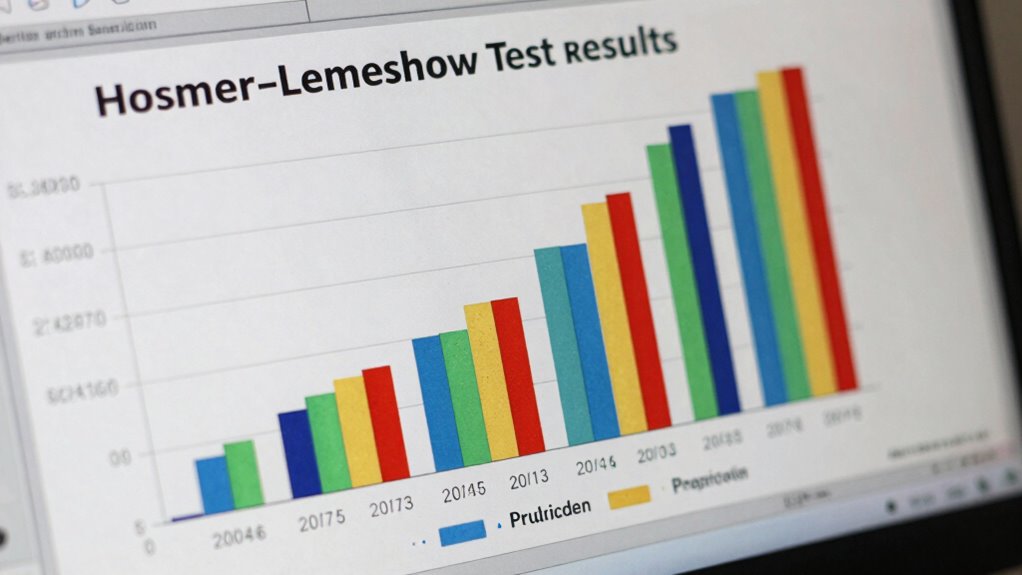
Have you ever wondered how to assess whether a logistic regression model fits your data well? The Hosmer-Lemeshow test is a popular method that helps you determine the goodness of fit for your model. Before diving into the test itself, it’s essential to understand some key concepts. For instance, model assumptions play a pivotal role in logistic regression. Your model assumes that the relationship between predictors and the log-odds of the outcome is linear, and that observations are independent. Violating these assumptions can lead to misleading results, so ensuring they hold is a critical first step. Additionally, sample size considerations are indispensable when applying the Hosmer-Lemeshow test. A very small sample might not provide enough power to detect poor fit, while a large sample could make trivial deviations appear significant. Thus, your sample size influences the reliability of the test’s outcomes. You should also be aware that understanding the underlying model assumptions is crucial for interpreting the test results accurately. When you perform the Hosmer-Lemeshow test, you fundamentally split your data into groups based on predicted probabilities, often deciles. The test then compares the observed number of events in each group with the expected number, based on the model’s predictions. If your model fits well, these observed and expected counts should be close across all groups. The test produces a chi-square statistic and a p-value, which you interpret to determine goodness of fit. A high p-value indicates no significant difference between observed and expected outcomes, suggesting your model fits the data adequately. Conversely, a low p-value signals discrepancies that may warrant model revision. It’s important to remember that the Hosmer-Lemeshow test isn’t perfect. It can be sensitive to sample size—with large datasets, even minor deviations can produce a significant p-value, falsely suggesting poor fit. Conversely, with small samples, the test might not detect meaningful lack of fit. Also, the number of groups chosen can influence the results—more groups may increase sensitivity but reduce power within each group. Furthermore, understanding how different goodness-of-fit measures complement each other can provide a more comprehensive evaluation of your model. For example, considering model calibration and residual analysis alongside the Hosmer-Lemeshow test can yield a more nuanced understanding of model performance. Consequently, you should consider supplementing the Hosmer-Lemeshow test with other measures like the area under the ROC curve or residual analysis for a thorough evaluation.
statistical analysis software for logistic regression
As an affiliate, we earn on qualifying purchases.
As an affiliate, we earn on qualifying purchases.
Frequently Asked Questions
Can the Test Be Used for Small Sample Sizes?
You should be cautious when using the Hosmer-Lemeshow test for small sample sizes because sample size considerations impact its effectiveness. The test’s robustness diminishes with fewer observations, making it less reliable for evaluating model fit. Smaller samples can lead to misleading results, so, if you’re working with limited data, consider alternative methods like graphical assessments or other goodness-of-fit tests better suited for small datasets.
How Does the Test Handle Multiple Predictor Variables?
Predictor proliferation can pose problems for the Hosmer-Lemeshow test. It handles multiple predictor variables by grouping predicted probabilities, but when you include many predictors, especially with predictor interactions or continuous variables, the test can become less reliable. Variable categorization helps, but too many categories or complex interactions may distort the test’s accuracy, making it less suited for models with numerous predictors or intricate interactions.
Is the Test Applicable to All Types of Logistic Models?
The Hosmer-Lemeshow test isn’t applicable to all types of logistic models. It assumes your model meets basic assumptions, like linearity in the logit and independence of observations. Also, a sufficient sample size is vital—small samples can lead to unreliable results. If your model involves complex predictors or small datasets, you might need alternative goodness-of-fit tests, as the Hosmer-Lemeshow test may not be suitable or effective.
What Are Common Alternatives if the Test Indicates Poor Fit?
If the Hosmer-Lemeshow test indicates poor fit, you can explore alternative methods like examining residuals, using the Akaike Information Criterion (AIC), or conducting the Brier score. These approaches help assess model assumptions and identify areas where your logistic model may be misfitting. You might also consider using calibration plots or applying other goodness-of-fit tests, such as the C-statistic, to better understand and improve your model’s performance.
How Sensitive Is the Test to Data Outliers?
Outlier impact can profoundly influence the Hosmer-Lemeshow test‘s results, making it quite sensitive to data sensitivity. When outliers are present, they can distort groupings and skew the chi-square statistic, leading to misleading conclusions about model fit. You should carefully examine your data for outliers before trusting the test outcomes, as even a few extreme points can disproportionately affect the test’s reliability and interpretation.
goodness of fit testing tools
As an affiliate, we earn on qualifying purchases.
As an affiliate, we earn on qualifying purchases.
Conclusion
Imagine your logistic model is like a tailor fitting a suit. The Hosmer-Lemeshow test checks if the fit is just right or if there are loose threads. When the test shows a good fit, it’s like slipping into a perfectly tailored jacket—comfortable and reliable. But if it indicates a poor fit, it’s time to remeasure and adjust. Trust this test to guarantee your model is sharp, precise, and ready to make confident predictions.
model calibration assessment software
As an affiliate, we earn on qualifying purchases.
As an affiliate, we earn on qualifying purchases.
ROC AUC calculator for logistic models
As an affiliate, we earn on qualifying purchases.
As an affiliate, we earn on qualifying purchases.