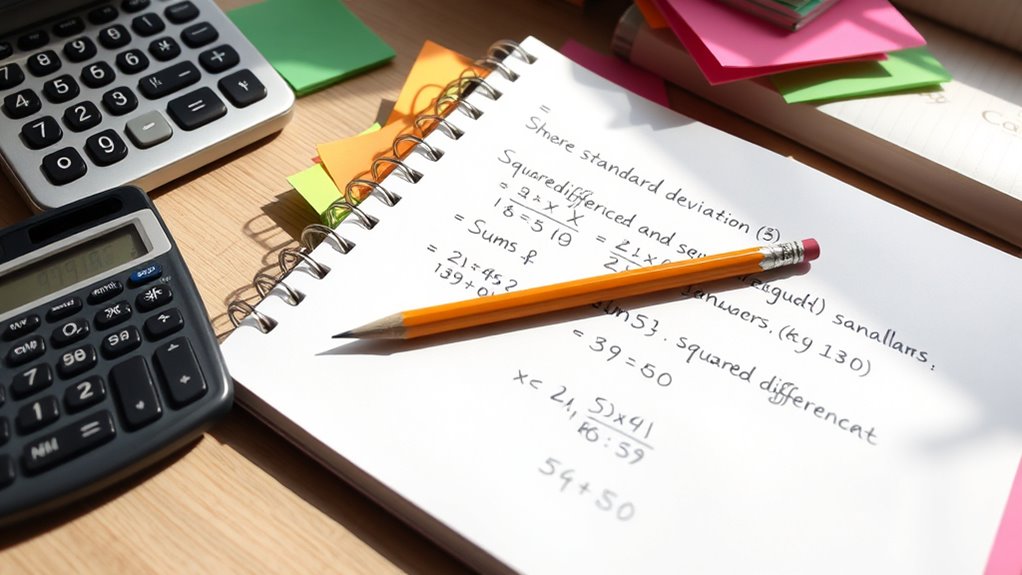

To compute the standard deviation for your homework, first find the mean by adding all your scores and dividing by the number of assignments. Then, subtract the mean from each score to find the deviations, and square each deviation. Next, find the average of these squared deviations—divide by the total number of data points for population, or by one less for a sample. Finally, take the square root of that average to get the standard deviation. If you keep going, you’ll understand the process even better.

Get business pricing on monitors, keyboards and dev gear
- Business-only prices and quantity discounts
- Tax-exempt purchasing
- Multiple users, one account, clear invoices
Key Takeaways
- Calculate the mean by summing all data points and dividing by the total number of values.
- Subtract the mean from each data point to find deviations.
- Square each deviation to emphasize larger differences.
- Find the average of squared deviations (divide by N for population or N-1 for sample).
- Take the square root of this average to get the standard deviation.

Understanding how to compute standard deviation is essential for analyzing data sets and measuring variability. When you’re working on homework assignments that involve data analysis, knowing how to find the standard deviation helps you interpret the data more accurately. It provides a clear picture of how spread out the data points are around the mean, which is critical for understanding the overall distribution. To do this effectively, you’ll need to incorporate data visualization techniques, like histograms or box plots, which can make the variability more tangible. These visual tools often reveal patterns or outliers that might not be obvious from just numbers, giving you a better grasp of the data’s spread. Additionally, understanding the standard deviation is fundamental for probability calculations, as it helps you determine the likelihood of certain outcomes within a data set. For example, if the data points cluster tightly around the mean, the probability of observing values far from the average is low, which is important in many statistical applications. Recognizing the importance of performance tuning can help you better understand how adjustments affect the overall data variability. To compute the standard deviation, start by finding the mean of your data set. Add all the data points together and divide by the total number of points. Next, subtract the mean from each data point to find the deviation of each value from the average. Square each of these deviations to eliminate negative numbers and emphasize larger differences. Then, calculate the average of these squared deviations. If you’re working with the entire population, divide by the total number of data points. If you’re analyzing a sample, divide by one less than the total number of data points to get an unbiased estimate—this is called calculating the sample standard deviation. The square root of this average gives you the standard deviation, which is expressed in the same units as your original data.
scientific calculator for statistics
As an affiliate, we earn on qualifying purchases.
As an affiliate, we earn on qualifying purchases.
Frequently Asked Questions
What Is the Difference Between Population and Sample Standard Deviation?
You should know that population standard deviation uses population parameters, meaning it considers all data points in the entire group. Sample standard deviation, however, relies on sample estimates, which are calculated from a subset of data. This difference impacts the calculation method, especially the denominator: population uses N, while a sample uses N-1 to correct bias. Understanding this helps you choose the right formula for accurate analysis.
How Does Outliers Affect the Standard Deviation Calculation?
Outliers markedly skew standard deviation calculations, causing considerable variance inflation. When you encounter outlier impact, these extreme data points distort the overall spread, making the standard deviation appear larger than it truly is. This exaggeration can lead you to overestimate variability. To counteract this, you might consider trimming outliers or using robust measures, helping you achieve a more accurate assessment of your homework assignment data’s true dispersion.
Can Standard Deviation Be Negative? Why or Why Not?
No, standard deviation can’t be negative because it measures variability and dispersion in your data. Since deviations are squared, they always produce positive values, reflecting how much scores differ from the mean. Negative values don’t make sense in this context because they would imply less variability than zero, which isn’t possible. So, you can only have zero or positive standard deviation, indicating no or some level of variability in your data.
What Are Common Mistakes When Calculating Standard Deviation?
Calculating standard deviation is like baking a cake—you need precise ingredients. Common mistakes include data entry errors that skew results and using incorrect formulas, like forgetting to divide by the number of data points or their minus one. Double-check your data and formulas carefully. If you rush or overlook details, your calculation can be off, leading to inaccurate insights. Always review your work to guarantee accuracy.
How Do I Interpret the Meaning of a High or Low Standard Deviation?
A high standard deviation indicates greater variance in your data, meaning your homework scores vary widely and show less consistency. A low standard deviation suggests your scores are close together, reflecting more consistency. Think of it as a measurement of how spread out your data is; the smaller the deviation, the more reliable and stable your performance, while larger deviations highlight inconsistency or unpredictability.
data analysis software for students
As an affiliate, we earn on qualifying purchases.
As an affiliate, we earn on qualifying purchases.
Conclusion
Now that you know how to calculate standard deviation, you’re like a detective uncovering hidden patterns in your homework data. Think of it as shining a spotlight on how spread out your scores are, revealing the story behind the numbers. With this tool, you can confidently navigate your assignments, turning chaos into clarity. Keep practicing, and before long, you’ll be weaving statistics into your daily academic adventures with ease and flair.
graphing calculator for standard deviation
As an affiliate, we earn on qualifying purchases.
As an affiliate, we earn on qualifying purchases.
statistics workbook for homework
As an affiliate, we earn on qualifying purchases.
As an affiliate, we earn on qualifying purchases.
Fall Picks
fall essentials
As an affiliate, we earn on qualifying purchases.