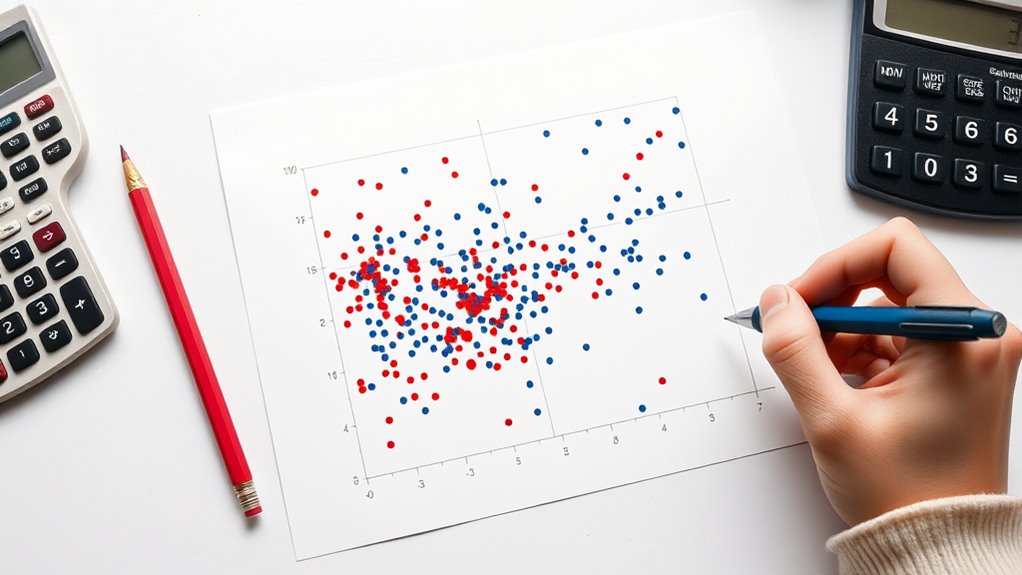

When interpreting scatter plots, look for how closely data points cluster along a pattern to gauge the strength of the relationship. A clear, straight-line pattern indicates a strong correlation, while scattered points suggest weak or no correlation. Watch for outliers that stand apart from the main data; they can distort your view of the connection. By combining these observations, you’ll better understand the data’s story—continue to explore to develop more confidence in your analysis skills.
Key Takeaways
- Look for the overall pattern and direction of data points to assess the relationship type and strength.
- Evaluate how closely data points cluster along a line to determine the correlation’s strength.
- Identify any outliers that deviate significantly from the main pattern, which may affect interpretation.
- Consider the impact of outliers on the correlation coefficient and overall data reliability.
- Combine observations of pattern, correlation strength, and outliers to draw accurate conclusions from the scatter plot.

A scatter plot is a powerful tool that helps you visualize the relationship between two variables. When you look at a scatter plot, one of the first things to consider is the correlation strength—the degree to which the data points tend to follow a clear pattern. If the points are closely clustered along a straight line, either rising or falling, the correlation is strong. This indicates that as one variable increases or decreases, the other tends to do the same. Conversely, if the points are widely scattered without a discernible pattern, the correlation is weak or nonexistent. Recognizing the correlation strength allows you to understand how strongly the variables are related, which is vital when making predictions or drawing conclusions.
Another important aspect to focus on is outlier detection. Outliers are data points that deviate markedly from the overall pattern of the data. As you examine the scatter plot, look for points that stand apart from the main cluster—these are your potential outliers. Detecting outliers is essential because they can distort the perceived relationship between variables. For example, a single outlier might suggest a weak correlation where none exists or falsely imply a strong correlation. Identifying outliers helps you decide whether to investigate further, exclude them from analysis, or understand if they represent unusual but valid data points. This process enhances the accuracy of your interpretation and guarantees your conclusions are based on representative data.
When interpreting a scatter plot, consider both the correlation strength and the presence of outliers together. A strong correlation with no outliers suggests a reliable relationship, making it easier to predict one variable based on the other. However, if the correlation appears weak or moderate, and there are outliers present, you need to be cautious. Outliers may be influencing the correlation coefficient, leading you to misinterpret the relationship. In homework practice, you might be asked to describe the correlation strength by observing how tightly the data points cluster along a line, and to identify any outliers that could impact your analysis. Doing so helps you develop a more nuanced understanding of the data and enhances your ability to communicate findings clearly. Additionally, understanding the potential side effects of misinterpreting scatter plots can help you avoid incorrect conclusions.
Frequently Asked Questions
How Do I Identify Outliers in a Scatter Plot?
To identify outliers in a scatter plot, look for data points that stand apart from the main cluster. These points don’t follow the overall pattern and are distant from other data points. Outlier detection involves spotting these unusual data points, which may indicate variability or errors. By observing where data points deviate markedly from the trend, you can effectively identify outliers in your scatter plot.
What Does a Negative Correlation Indicate?
A negative correlation shows that as one variable increases, the other decreases, illustrating an inverse relationship. Remember, a picture is worth a thousand words, so a decreasing trend in the scatter plot clearly indicates this inverse relationship. It’s like a see-saw—when one side goes up, the other goes down. This pattern helps you understand how two variables move in opposite directions, revealing important insights.
How Can I Determine Causation From a Scatter Plot?
You can’t determine causation from a scatter plot alone because correlation doesn’t imply causation. To establish causation, you need a well-designed experiment that controls variables and isolates the effect of one factor on another. By comparing experimental results with the scatter plot data, you can better understand if a causal relationship exists, rather than just a correlation, which might be coincidental or influenced by other factors.
What Are the Limitations of Scatter Plot Analysis?
A picture is worth a thousand words, but beware of correlation caveats and pattern pitfalls. Scatter plots can show relationships, yet they don’t prove causation. Limitations include misinterpreting correlation, overlooking outliers, or assuming a pattern implies causation. You must consider other factors like data quality and context. Relying solely on scatter plots risks drawing misleading conclusions, so always combine visual analysis with additional evidence to make informed decisions.
How Do I Interpret Nonlinear Relationships?
When you see nonlinear patterns in a scatter plot, you should consider curve fitting to better understand the relationship. Look for curves or bends instead of straight lines, which indicate more complex connections. Use methods like polynomial or exponential fitting to model these patterns accurately. This helps you interpret the data more precisely, revealing trends that linear analysis might miss, and provides deeper insights into how variables interact nonlinearly.
Conclusion
Now that you’ve practiced interpreting scatter plots, remember how important these graphs are for spotting trends. For example, did you know that in a recent study, students who studied more hours tended to score higher on tests? That correlation highlights how scatter plots help you see relationships between variables. Keep practicing, and you’ll become confident in uncovering stories hidden within data. Understanding these connections will make analyzing information much easier and more insightful.