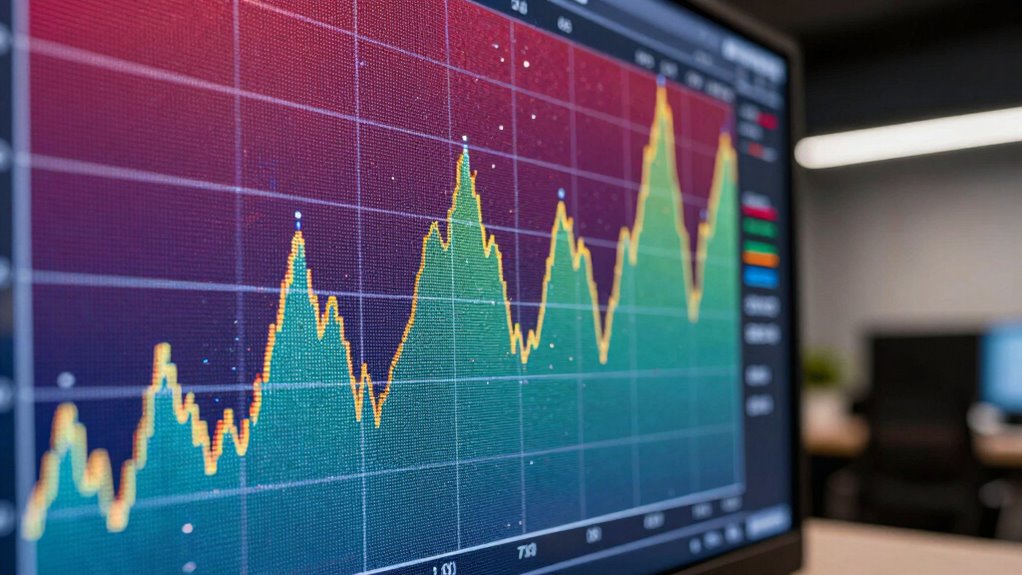

Statistical noise is the random fluctuation in data that doesn’t reflect true patterns, caused by measurement errors or natural variability. It can obscure real signals, leading you to misinterpret results or make wrong decisions. Understanding this noise helps you filter out irrelevant data and focus on meaningful insights. By recognizing these fluctuations, you improve your analysis accuracy. Keep exploring to learn how mastering statistical noise can considerably boost your data skills.
Key Takeaways
- Statistical noise represents random data fluctuations that do not reflect true patterns or trends.
- Recognizing noise prevents misinterpreting random variations as meaningful signals.
- Understanding noise improves data analysis accuracy and decision-making reliability.
- Noise arises from measurement errors, environmental factors, and instrument limitations.
- Filtering out noise helps focus on genuine data insights and enhances overall data quality.
Have you ever noticed how data sometimes appears unpredictable or inconsistent, even when collected under controlled conditions? That’s often due to what’s called statistical noise, which can seem confusing if you’re not familiar with it. Fundamentally, statistical noise is the random fluctuation in data that doesn’t reflect true changes or patterns. It’s a natural part of any measurement process, caused by factors like data variability and measurement errors. Understanding this noise is vital because it influences how you interpret data and make decisions based on it. Recognizing the sources of statistical noise helps you better understand the limitations of your data and avoid misinterpretations. Data variability plays a significant role here. No two measurements are exactly alike, even if you’re measuring the same thing multiple times. Small differences can occur due to environmental factors, instrument precision, or other uncontrollable elements. These variations are normal, but they can be mistaken for real trends if you aren’t aware of their existence. Recognizing data variability helps you differentiate between actual changes and what’s just statistical noise—random fluctuations that don’t carry meaningful information. Additionally, understanding how measurement tools function and their inherent limitations can help you better manage measurement errors in your data. Sometimes, measurement inaccuracies can be subtle yet impact data reliability significantly. Being aware of data variability and measurement limitations enables more accurate interpretation of your data, especially in complex or high-stakes scenarios. Moreover, being familiar with the concept of statistical fluctuations helps you develop strategies to filter out noise and focus on genuine signals within your data sets.
data smoothing techniques for statistical noise
As an affiliate, we earn on qualifying purchases.
As an affiliate, we earn on qualifying purchases.
Frequently Asked Questions
How Can I Reduce Statistical Noise in My Data?
To reduce statistical noise in your data, start by applying data smoothing techniques like moving averages or Gaussian smoothing to lessen fluctuations. You can also use noise filtering methods such as low-pass filters or median filters to eliminate unwanted random variations. Ensuring proper data collection and increasing sample size can further minimize noise, making your results clearer and more reliable. These approaches help you analyze cleaner, more accurate data.
Does Statistical Noise Affect All Types of Data Equally?
Statistical noise affects all types of data, but its impact varies depending on data variability and the presence of random fluctuations. You might notice more noise in small, unpredictable datasets, while larger, more stable datasets experience less. Recognizing this helps you decide whether to apply noise-reduction techniques. Even if noise varies, understanding its role allows you to interpret your data more accurately and make better-informed decisions.
Can Statistical Noise Lead to Incorrect Conclusions?
Yes, statistical noise can lead to incorrect conclusions because sampling variability and random fluctuations may distort your data. When you interpret data affected by noise, you risk seeing patterns that aren’t truly there or missing real ones. This is especially true with small sample sizes or inconsistent data collection. To avoid errors, you should use proper statistical methods and larger samples, minimizing the impact of random fluctuations.
What Tools Are Best for Detecting Statistical Noise?
Ironically, the best tools for detecting statistical noise are often simple, like data filtering and noise visualization. Data filtering helps you remove irrelevant data points, revealing the true signal beneath the chaos. Noise visualization, on the other hand, graphically highlights inconsistencies, making noise easier to spot. These tools empower you to distinguish genuine trends from random fluctuations, ensuring your conclusions are based on solid, trustworthy data.
Is Statistical Noise the Same as Measurement Error?
Statistical noise isn’t exactly the same as measurement error, but they’re related. Measurement error is a specific type of noise that stems from inaccuracies during data collection. Both impact data quality, making it harder to draw clear conclusions. To improve your results, focus on noise reduction techniques and guarantee accurate measurements. Recognizing the difference helps you better address issues and refine your data collection process for more reliable insights.
noise filtering tools for data analysis
As an affiliate, we earn on qualifying purchases.
As an affiliate, we earn on qualifying purchases.
Conclusion
Remember, “a little knowledge is a dangerous thing.” Understanding statistical noise helps you make smarter decisions and avoid being misled by random fluctuations. By recognizing when data is just noise, you prevent jumping to false conclusions. So, stay curious and skeptical—statistics can be tricky, but with a keen eye, you’ll see through the chaos. Embrace the learning process, and don’t let noise drown out the truth.
measurement error reduction devices
As an affiliate, we earn on qualifying purchases.
As an affiliate, we earn on qualifying purchases.
sample size increase for data accuracy
As an affiliate, we earn on qualifying purchases.
As an affiliate, we earn on qualifying purchases.