

Understanding probability means learning how likely events are to happen, with values from 0 (impossible) to 1 (certain). You’ll see that all possible outcomes add up to 1, and rules like addition and multiplication help you figure out combined chances. Recognizing whether events are independent or dependent impacts how you calculate their probabilities. If you keep exploring, you’ll discover how these basic concepts come together to analyze more complex situations effectively.
Key Takeaways
- Probabilities range from 0 (impossible) to 1 (certain) and sum to 1 across all outcomes in a scenario.
- Conditional probability updates the likelihood of an event based on the occurrence of another event.
- Independent events have probabilities that do not affect each other; dependent events require conditional calculations.
- Basic probability rules include the addition rule for at least one event and the multiplication rule for independent events.
- Understanding these concepts aids in modeling, predicting, and analyzing outcomes in complex situations.
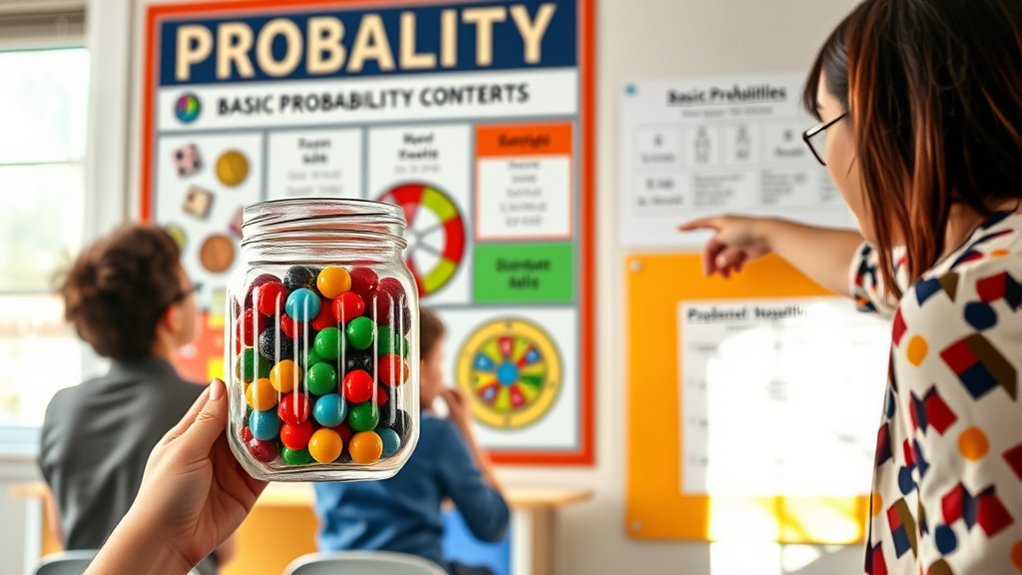
Have you ever wondered how likely it is to win a game or predict an outcome? Understanding probability can help you answer these questions by providing a way to measure uncertainty. At its core, probability deals with the chances of various events happening, and it’s built on some fundamental rules and concepts. To grasp these ideas, you need to explore how different events relate to each other, especially when they’re connected through conditions. These are called conditional events, which involve understanding how the probability of one event depends on another. For example, if you’re drawing cards from a deck, the chance of getting a queen changes based on what cards have already been drawn. This is where probability models come in—they’re mathematical frameworks that help you organize and analyze these relationships systematically. They enable you to assign probabilities to a broad range of outcomes, even in complex scenarios where multiple events influence each other.
One of the most basic rules in probability is that the probability of any event ranges from 0 to 1—0 means it’s impossible, and 1 means it’s certain. The sum of probabilities for all possible outcomes in a given situation must equal 1. For instance, if you flip a coin, the probability of landing heads is 0.5, and the probability of tails is also 0.5. These simple rules form the foundation for more advanced concepts, like conditional probability, which tells you how the likelihood of an event changes when you know that another event has already occurred. Imagine you’re trying to predict whether it’ll rain tomorrow, given that it’s cloudy today. The probability of rain depends on the condition of it being cloudy, and probability models help you quantify this relationship precisely.
Understanding how probabilities are calculated involves recognizing the importance of independent events and how they influence the overall likelihood of combined outcomes. When dealing with multiple events, you often use rules such as the addition rule and multiplication rule. The addition rule helps you find the probability that at least one of several events occurs, while the multiplication rule calculates the probability that multiple events happen together. If two events are independent—meaning one doesn’t affect the other—their joint probability is just the product of their individual probabilities. But if the events are dependent, you need to consider conditional probability. This involves updating your probability estimates based on new information, which is vital in real-world situations where outcomes are often interconnected. By mastering these rules and understanding how to model conditional events, you can better predict outcomes, make informed decisions, and understand the uncertainty inherent in many aspects of life.
Frequently Asked Questions
How Does Probability Relate to Real-World Decision Making?
Probability helps you make better decisions by evaluating risk and guiding actions based on likely outcomes. When facing uncertainty, you use statistical inference to interpret data and predict future events. This allows you to weigh options carefully, whether in finance, health, or daily life. By understanding probability, you can minimize risks and increase your chances of success, making smarter, more informed choices in real-world situations.
What Are Common Misconceptions About Probability?
You might think probability always predicts outcomes perfectly, but common misconceptions include confusing Bayesian updates with the frequentist interpretation. Bayesian updates involve updating beliefs based on new data, while frequentist interpretation focuses on long-term frequency. Many believe probability is only about chance, but it also helps in decision making and risk assessment. Recognizing these differences helps you avoid misunderstandings and use probability more effectively in real-world situations.
Can Probability Predict Individual Outcomes Accurately?
Probability can’t predict individual outcomes with certainty, even though it estimates chances for a single event. For example, if there’s a 70% chance of rain, it doesn’t mean it will rain every time the forecast predicts it. You understand that probability gives a likelihood, not a guarantee. So, while probability estimation helps in understanding trends and risks, it doesn’t determine specific, single event outcomes.
How Do Conditional Probabilities Differ From Simple Probabilities?
Conditional probabilities differ from simple probabilities because they incorporate new information, often through Bayesian updating, to refine your chances of an event. When two events are conditionally independent, knowing one doesn’t change the likelihood of the other. This distinction helps you update your beliefs accurately, making your predictions more precise based on existing evidence, unlike simple probabilities that ignore context or additional data.
What Are the Limitations of Probability Models?
You should be aware that probability models have limitations because they often simplify complex scenarios, which can affect their real-world applicability. These models rely on assumptions that may not hold true in practice, such as independence or constant probabilities. As a result, they might not account for all variables or rare events, making it essential to recognize their limitations when applying them to real-life situations for more accurate decision-making.
Conclusion
So, now you’re a probability pro—who knew? You’ve learned the basic rules, mastered the concepts, and even figured out that life’s chances aren’t always in your favor. Ironically, the more you understand, the more unpredictable everything seems. But don’t worry—your newfound knowledge just means you’re better equipped to handle those unexpected twists. After all, what’s life without a little chance? Embrace the uncertainty—you’re more prepared than you think.