

A confidence interval estimates where a population parameter, like a mean or proportion, likely falls, reflecting sampling variability. A prediction interval, however, predicts the range where a future individual observation is expected to land, including more variability. Confidence intervals are narrower and focus on the population, while prediction intervals are broader and target future data points. Understanding this difference helps you interpret data more accurately—continue exploring to get a clearer picture.
Key Takeaways
- Confidence intervals estimate the range for a population parameter, while prediction intervals forecast a future individual observation.
- Confidence intervals reflect sampling variability; prediction intervals include both sampling variability and total data point variability.
- Confidence intervals are narrower and used for parameter estimation; prediction intervals are broader for predicting future data points.
- Confidence intervals help generalize findings beyond the sample; prediction intervals focus on specific upcoming observations.
- Choosing between them depends on whether the goal is estimating a population parameter or predicting a future data point.
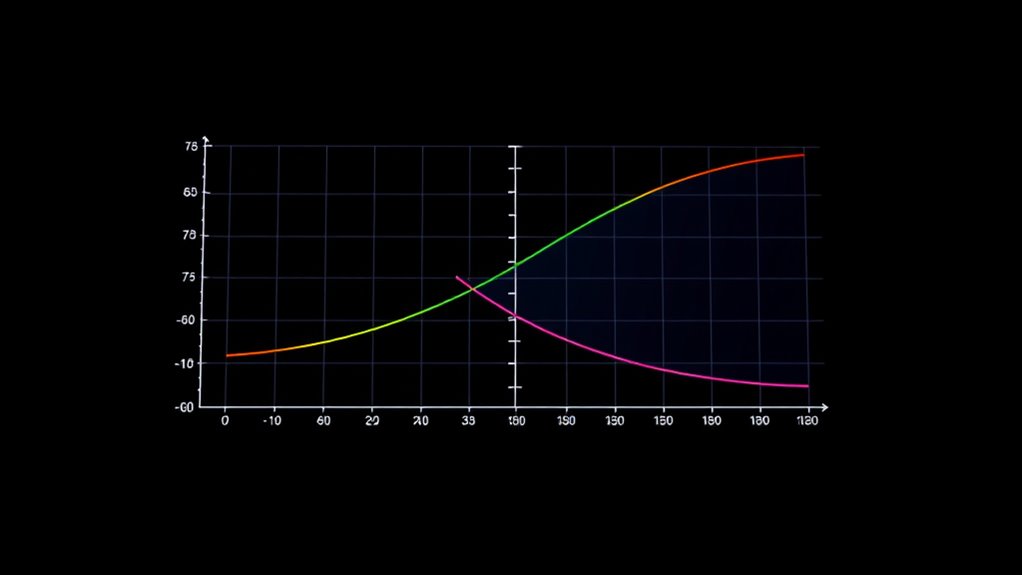
When working with statistical data, understanding the difference between a confidence interval and a prediction interval is fundamental. Both tools help you interpret data more accurately, but they serve different purposes and are based on distinct concepts. At the core, they address how uncertainty influences your estimates, yet they focus on different aspects of the data. A confidence interval gives you a range that likely contains a population parameter, such as a mean or proportion, based on the data you’ve collected. It reflects the uncertainty inherent in the sampling process, which is affected by sampling variability—the natural fluctuation you’d expect if you repeatedly drew samples from the same population. Because of this sampling variability, your point estimate (like a sample mean) won’t be exact; the confidence interval accounts for this inherent uncertainty. When you construct a confidence interval, you are essentially making a statement about what range the true population parameter probably falls into, based on your sample data. This is a cornerstone of statistical inference, allowing you to generalize your findings beyond the specific data at hand. Additionally, understanding the concept of sampling variability helps clarify why these intervals are necessary for accurate interpretation.
In contrast, a prediction interval is broader and is used when you’re interested in predicting a future individual observation, not just estimating a population parameter. Imagine you’ve collected data and want to predict what a new data point might look like. The prediction interval provides a range where you can expect this future observation to fall, with a specified level of confidence. Since it considers both the uncertainty in estimating the population parameter and the additional variability of individual data points, the prediction interval is typically wider than a confidence interval. It accounts for the total variability you’d encounter when making individual predictions, which includes the sampling variability as well as the inherent randomness in individual outcomes.
Understanding these differences helps you choose the right tool for your analysis. If your goal is to estimate the average of a population, you’ll rely on a confidence interval. But if you’re aiming to predict a specific future observation, then a prediction interval is more appropriate. Both rely on statistical inference, but they interpret the data’s uncertainty differently. Recognizing how sampling variability influences these intervals ensures you interpret your results correctly and communicate the degree of uncertainty in your findings. This clarity improves decision-making and enhances the credibility of your statistical conclusions.
statistical confidence interval calculator
As an affiliate, we earn on qualifying purchases.
As an affiliate, we earn on qualifying purchases.
Frequently Asked Questions
How Do Sample Size Differences Affect the Intervals?
You’ll notice that as your sample size increases, the interval width decreases, giving you a more precise estimate. Larger sample sizes reduce variability, making confidence and prediction intervals narrower. Conversely, smaller samples lead to wider intervals, reflecting greater uncertainty. So, your sample size directly impacts the accuracy of your intervals, with bigger samples providing tighter, more reliable bounds and smaller ones resulting in broader, less certain ranges.
Can Both Intervals Be Used Simultaneously?
Did you know that over 60% of statisticians sometimes use both intervals together? Yes, you can use a confidence interval and a prediction interval simultaneously, but be aware of potential interval overlap that might cause confusion in interpretation. When comparing intervals, understanding their distinct purposes helps avoid misjudging data variability. Using both provides a fuller picture—confidence intervals estimate the population parameter, while prediction intervals forecast individual future observations.
What Are Common Mistakes in Interpreting These Intervals?
You should be careful to avoid interval misinterpretation, which often leads to statistical fallacies. Many people mistakenly believe a confidence interval predicts a single future value, but it actually estimates a range for a population parameter. Similarly, misreading a prediction interval as a certainty for individual outcomes is common. To prevent these errors, understand that confidence intervals relate to population parameters, while prediction intervals address individual future observations.
How Do Outliers Impact Confidence and Prediction Intervals?
Outliers are like storms in calm seas—they disrupt the stability of your confidence and prediction intervals. Outlier influence can make these intervals less robust, leading to wider ranges or skewed estimates. You might think your intervals are reliable, but outliers can distort them, reducing their accuracy. To maintain interval robustness, you need to identify and address outliers, ensuring your conclusions are based on solid, representative data.
Are There Specific Industries Preferring One Interval Type Over the Other?
You’ll find that industry preferences vary based on application differences. For example, finance and healthcare often prefer confidence intervals for estimating parameters, as they focus on overall trends and population characteristics. In contrast, manufacturing and quality control lean toward prediction intervals to estimate future individual outcomes or measurements. Understanding these application differences helps you select the right interval type, ensuring your analysis aligns with industry-specific needs and decision-making processes.
prediction interval for data analysis
As an affiliate, we earn on qualifying purchases.
As an affiliate, we earn on qualifying purchases.
Conclusion
Understanding the difference between confidence and prediction intervals is like knowing the difference between a map and a compass; both guide you, but each serves a distinct purpose. Confidence intervals tell you where the true population parameter likely lies, while prediction intervals forecast where future individual values might fall. Grasping these concepts helps you interpret data more accurately, empowering you to make better decisions. With this knowledge, you’ll navigate statistical landscapes with the precision of a seasoned explorer.
statistics reference book with confidence and prediction intervals
As an affiliate, we earn on qualifying purchases.
As an affiliate, we earn on qualifying purchases.
software for calculating confidence and prediction intervals
As an affiliate, we earn on qualifying purchases.
As an affiliate, we earn on qualifying purchases.